
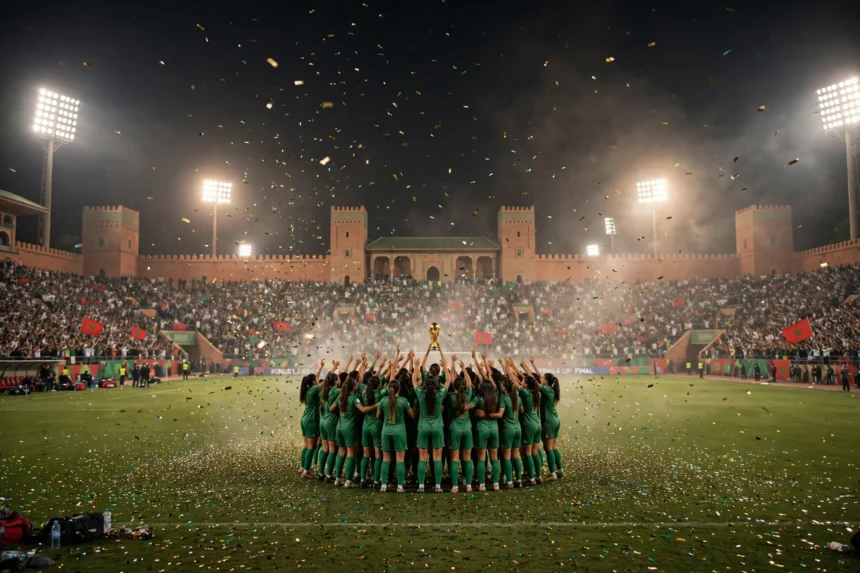
Nigeria’s Flamingos have done what no African team had ever done before. On Saturday night in Rabat, the young Super Falcons in green beat Japan 2-1 in the final of the FIFA U-17 Women’s World Cup, lifting the trophy for the first time in the tournament’s history and putting African women’s football on top of the world.
The win at the Mohammed VI Football Complex was built on two second-half goals inside eight minutes either side of the break, and then defended with everything the team had as Japan pushed hard in the closing stages. When the final whistle went, the Flamingos were world champions, and the first African side ever to win this competition.
Two goals, one historic night
Japan, the Little Nadeshiko, had reached the final as one of the tournament’s most organised sides, and the first half was tight. Then, in the 39th minute, Awawu Bashiru broke the deadlock with a strike from distance that gave Nigeria the lead going into half-time.
Two minutes after the restart, Oluebube Umejiaku doubled the advantage. Running onto a long pass, she controlled the ball and lifted it over the Japanese goalkeeper to make it 2-0. It was a goal that would prove decisive, and it later earned her the Player of the Match award.
Japan refused to fold. Fuki Ito pulled one back in the 80th minute, and the last ten minutes turned into a test of nerve for the Nigerian defence. But the Flamingos held their shape, saw out the pressure, and celebrated at full time as the first African winners of the U-17 Women’s World Cup.

A comeback story from day one
What makes this title even more remarkable is how the tournament began for Nigeria. The Flamingos lost their opening match 2-1 to Poland, and at that point few would have tipped them to go all the way. Instead, they became the first team in the history of the women’s U-17 competition to lose their opening game and still lift the trophy.
The run gathered pace from there. In the semi-final, Nigeria beat Brazil 3-1 to book their place in the final, while Japan’s route took them past the defending champions’ rivals to set up a first ever meeting between the two sides at this stage. In the third-place match, DPR Korea thrashed Brazil 6-0 to claim the bronze medal.
The tournament, held in Morocco from October 17 to November 8, has been running since 2008. In all those years, no African nation had ever won it, until Saturday night in Rabat.
Why this win matters beyond the trophy
The victory carries weight far beyond one final. Nigeria are now the first African country to have won FIFA U-17 World Cup titles in both the men’s and women’s categories, a mark of the depth of the country’s youth football programme.
For African women’s football, the timing matters too. The Flamingos are the first African women’s national team to win a FIFA World Cup trophy at any level, and the result was watched by FIFA president Gianni Infantino and CAF president Patrice Motsepe, both of whom were in the stands in Rabat.
Back home, the celebrations began quickly. President Bola Tinubu congratulated the squad and singled out the two goalscorers for special praise, while the National Sports Commission described the triumph as a defining moment for Nigerian and African women’s football.
Coach Akeem Busari, who guided the side through the group stage, the knockouts and the final, now has a team that has written itself into the record books. From a defeat in their first game to champions in their last, the Flamingos’ journey in Morocco is the kind of story that will be told in Nigerian football for years.
What next for the Flamingos
The players return home as world champions, with the focus now shifting to how many of this squad can make the step up to the U-20 side and eventually the senior Super Falcons. Youth World Cup winners do not always become senior stars, but this group has shown the temperament to win tight games under pressure, and that is exactly what the senior setup looks for.
For now, though, the moment belongs to the Flamingos, to Bashiru and Umejiaku, and to a team that turned an opening defeat into a world title.
FAQs
Who won the FIFA U-17 Women’s World Cup 2026?
Nigeria’s Flamingos beat Japan 2-1 in the final in Rabat, Morocco, on Saturday, November 7, 2026, to win the title for the first time.
Who scored for Nigeria in the final?
Awawu Bashiru scored in the 39th minute and Oluebube Umejiaku added the second in the 47th minute. Fuki Ito scored Japan’s goal in the 80th minute.
Why is Nigeria’s win historic?
Nigeria are the first African nation ever to win the FIFA U-17 Women’s World Cup, and the first African country to hold U-17 World Cup titles in both the men’s and women’s categories.
Who was the Player of the Match in the final?
Oluebube Umejiaku, whose second-half goal made it 2-0 and proved to be the winner.
Where was the final played?
At the Mohammed VI Football Complex in Rabat, Morocco, as part of the tournament held from October 17 to November 8, 2026.
Nigeria’s Flamingos are world champions. From an opening defeat to a historic title, their run in Morocco will be remembered as one of the great youth tournament stories.