A Rs 85,000 wearable that promises to track what is happening inside your brain has turned into one of the sharpest tech arguments of the year. On Monday, 9 November, clinical scientists stepped up their criticism of Temple, the head-worn device launched by Eternal founder Deepinder Goyal, saying there is no evidence it can measure what it claims. Goyal hit back the same day, insisting Temple is a fitness and artificial intelligence device, not a medical one.
The row is no longer just a social media argument. Doctors are now asking government regulators to examine the claims around the device before it reaches buyers.
What Temple claims to do
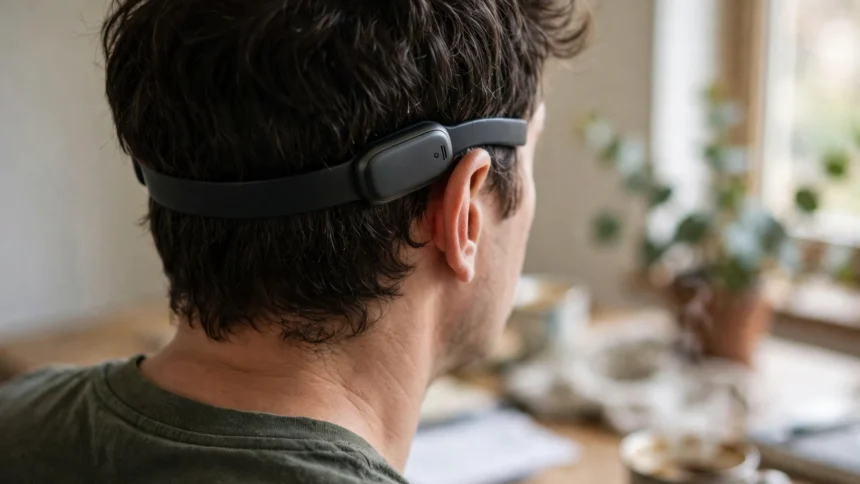
Temple is a slim head-worn wearable that sits on the side of the forehead, near the temple. It promotes two headline metrics. The first is BrainFlow, which is described as tracking relative changes in brain circulation. The second is Entropy, a score from 1 to 250 that is meant to show how hard the body is working.
Pre-orders for the device opened on 1 November, with deliveries expected in about three months. Goyal led a 54 million dollar funding round for the startup behind the product.
Why doctors are objecting
The sharpest criticism has come from hepatologist Dr Cyriac Abby Philips, who posts online as TheLiverDoc. In a post on X on Monday, he urged government regulators to assess the claims made for Temple, and said he and other clinical scientists had gone through the scientific material published on the company website.
Their conclusion was blunt: they found no evidence demonstrating that the device measures what it claims. According to the scientists, the sensors can capture heart rate and blood flow to the scalp through the temporal artery, but that is not the same as measuring circulation inside the brain.
Philips also pointed out that Temple’s website still promotes the device for cognitive health, brain tracking and Entropy, and argued that the marketing goes beyond what the published science supports.
What Goyal said in response
Goyal responded in a long post on X, thanking doctors and social media users for their feedback and saying it had given him clarity on what the company needs to explain better. But he pushed back firmly on the idea that the device makes medical claims.
“Temple is strictly a fitness and AI device, and we have made no medical claims. Temple is not proven to diagnose or prevent any disease. It does not do anything which replaces the need for you to see a doctor,” he wrote.
He also made it clear that India is not the main market for the product. “Temple is not made for India. It is made for the world. Please check pricing. We do not expect any more than 1 per cent of Temples being sold in India,” he said.
On the regulatory question, Goyal said social media is not the regulator for Temple, and that wherever regulatory clearances are needed, the company will have them before making any claim that needs them.
Where the argument goes from here
The core of the dispute is classification. If Temple is a fitness device, it faces a lighter set of rules. If its claims amount to measuring brain physiology, regulators in India, the United States and Europe may treat it as a medical device, which would mean far stricter evidence and approvals.
Goyal has argued that proof moves in stages, from whitepapers to pre-prints to peer-reviewed studies, and that buyers are free to wait for peer-reviewed proof before buying. The scientists’ answer is that a product already on pre-order at Rs 85,000 should not be marketed on claims that have not yet been independently validated.
For now, the device remains on pre-order, the scientists’ call for regulatory scrutiny is on the record, and Goyal has promised a detailed technical note on BrainFlow. What regulators do next will decide whether Temple is remembered as a bold fitness experiment or as a cautionary tale about selling science before it is proven.
FAQs
What is Temple?
Temple is a head-worn wearable launched by Eternal founder Deepinder Goyal. It sits near the temple and tracks BrainFlow and Entropy, described as measures of brain circulation and body exertion.
How much does Temple cost?
Temple is priced at Rs 85,000. Pre-orders opened on 1 November 2026, with deliveries expected in about three months.
Why are doctors criticising Temple?
Clinical scientists say the published science does not prove the device can measure brain blood flow. They argue it can only capture heart rate and blood flow to the scalp, and have called on regulators to examine its claims.
What has Deepinder Goyal said?
Goyal says Temple is strictly a fitness and AI device with no medical claims, that it is not proven to diagnose or prevent disease, and that regulatory clearances will be obtained wherever they are needed.
Is Temple a medical device?
That is the central question. Goyal says it is a fitness device, while critics argue its brain-tracking claims may need medical device regulation. Regulators have not yet given a public ruling.
With pre-orders live and regulators now being asked to look in, the next few weeks will show whether Temple’s science can stand up to the scrutiny it has invited.