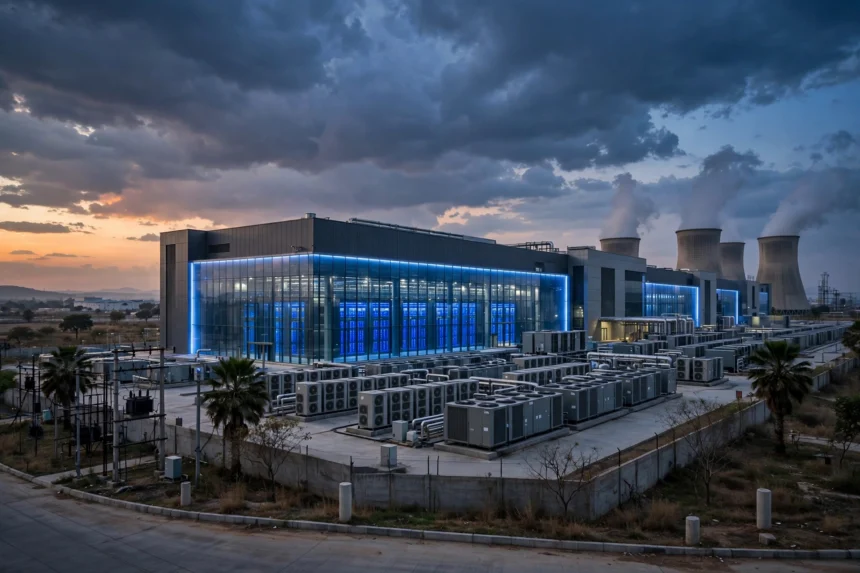
India is drawing up a dedicated policy for data centres, the government said on Wednesday, as the rush to build AI-ready server capacity runs into questions about how much power and water the facilities consume.
Junior IT minister Jitin Prasada announced the plan at an event organised by the Central Electricity Authority in New Delhi. He did not spell out what the policy would cover or when it would be unveiled, but his framing was clear: India wants the investment boom without letting household electricity bills pay for it.
“India is a very fertile ground for hyperscale data centres,” Prasada said, adding that in some countries data centres were taking power away from consumers, who then pay more for electricity, and “we don’t want to get into that.”
Why the policy matters now
India currently has no dedicated policy for data centres. Projects are cleared under existing environmental and building rules, with some states layering on their own incentives to attract the giants. That patchwork is starting to strain.
Residents outside Mumbai have protested against a data centre planned by Amazon, citing strain on local power and water supply, along with noise. In Visakhapatnam, environmentalists have raised concerns about Google’s $15 billion project, saying it threatens wildlife and improperly uses temple land. Both companies have denied any wrongdoing, saying the concerns are unfounded and that their facilities use advanced technology to keep resource use down.
The flashpoints matter because they show what is at stake. Data centres are central to Prime Minister Narendra Modi’s investment pitch, he has famously invited “the whole world’s data to reside in India,” and the government sees the sector as a $200 billion opportunity. A formal policy could decide which states win that race, and how fast.
Power, water and the AI buildout
The timing is no coincidence. The global AI boom has turned data centres into one of the fastest-growing electricity consumers anywhere, and India wants a big share of that buildout. But the same servers that train chatbots and run cloud services draw enormous amounts of power and need constant cooling.
- Power: Hyperscale facilities can consume as much electricity as a small city, putting pressure on local grids during peak hours.
- Water: Cooling systems are water-hungry, a sensitive point in regions that already face summer shortages.
- Land and noise: Local residents near proposed sites have flagged construction noise, traffic and land-use changes.
Prasada’s remarks suggest the coming policy will try to balance these concerns rather than simply fast-track approvals. That could mean stricter siting norms, water-use disclosures or rules ensuring data centres do not crowd out residential and commercial power demand.

What could the policy include
Since the minister did not elaborate, here is what a national data centre policy could plausibly address, based on the concerns raised so far:
- Uniform approval norms so projects do not face wildly different rules across states.
- Guidelines on power procurement, possibly nudging operators toward renewable energy.
- Water usage and cooling standards, especially in water-stressed districts.
- Community consultation requirements, after the protests near Mumbai and Visakhapatnam.
- Incentives for building in locations where grid capacity and renewable power are abundant.
For the industry, clarity is welcome even when it comes with conditions. Hyperscale projects involve billions of dollars and decade-long planning horizons, and investors prefer one predictable national framework over a patchwork of state-level incentives.
What this means for India
If India gets the balance right, the policy could accelerate an already fast-growing market while defusing the local opposition that has started to follow big projects. Get it wrong, and it could either slow investment or deepen the perception that data centres consume local resources while the benefits flow elsewhere.
Either way, the announcement confirms that data centres have moved from a niche infrastructure story to a mainstream policy question, one that touches electricity bills, water supply and land use. Expect the details of the policy to be closely watched by global tech majors, state governments and the communities living next door to the next hyperscale site.
FAQs
What is India’s data centre policy?
It is a dedicated national policy for data centres that junior IT minister Jitin Prasada announced on October 14, 2026. Details and a launch date are yet to be shared.
Why does India need a data centre policy?
India currently clears data centres under general environmental and building rules. A dedicated policy could standardise approvals and address concerns over power, water and land use.
How big is the opportunity?
The government sees the data centre sector as a $200 billion opportunity, and PM Modi has invited global companies to store data in India.
What are the concerns around data centres?
Residents near Amazon’s site outside Mumbai have protested over power, water and noise, while environmentalists have questioned Google’s $15 billion project in Visakhapatnam. Both companies deny the allegations.
When will the policy be unveiled?
The minister did not give a timeline. The government has so far only announced that a policy is being rolled out.
Informeia will update this story as the government shares more details of the data centre policy.