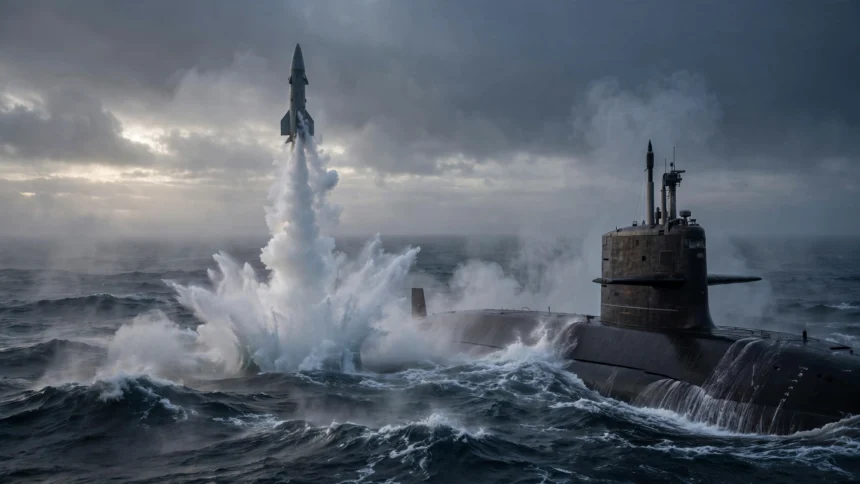
North Korea says it has test-fired two types of submarine-launched strategic cruise missiles into the East Sea, its latest show of underwater firepower as military tensions with South Korea keep climbing. State media reported on Thursday that the launches took place on Wednesday and were meant to check the navy’s readiness for strategic missions.
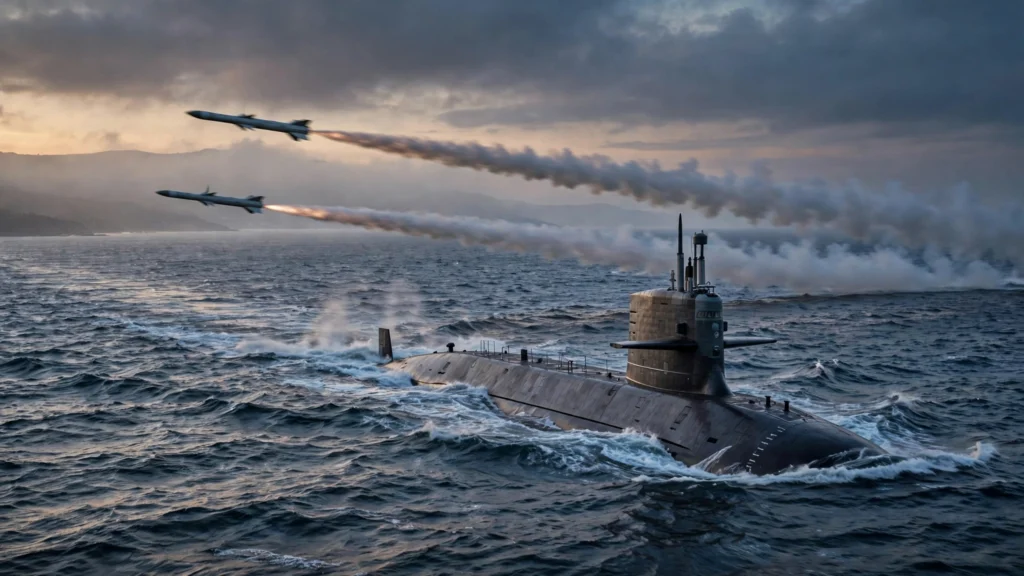
The announcement came from the Korean Central News Agency (KCNA), which described the tests as a naval training exercise designed to examine “the current mobilised posture of the underwater combat systems.” Photographs released by the agency show a missile bursting vertically out of the sea trailing thick smoke, another breaking the surface at an angle, and a submarine sailing on open water.
What the test involved
According to KCNA, the Missile Administration conducted the launches from a submarine in waters off North Korea’s east coast. The report gave no flight distance or target data, but said the missiles were fired without “any adverse impact on the security of neighbouring countries.” Senior military officials including Kim Jong Sik of the Workers’ Party Central Committee and Jang Chang Ha, head of the Missile Administration, observed the exercise alongside navy engineers specialising in underwater weapons.
South Korea’s military said it was aware of the launches but did not announce them publicly, which is standard practice. Seoul only publicly confirms ballistic missile launches, not cruise missile tests.
Why this matters now
The timing is significant. The test follows weeks of friction between the two Koreas triggered by a landmine explosion in the Demilitarised Zone on September 21, which injured three South Korean soldiers. Both sides have since tested upgraded weapons: South Korea launched its first domestically developed hypersonic glide vehicle last week, days after Pyongyang claimed an AI-assisted intermediate-range hypersonic weapon test.
Cruise missiles fly at lower altitudes than ballistic missiles and are propelled by jet engines, which makes them harder for radar to detect and intercept. A reliable submarine-launched cruise missile gives North Korea a stealthier strike option and an important step toward a genuine second-strike capability: the ability to launch from hidden positions at sea even if its land-based arsenal were hit first.
- The launches were reported only on KCNA, not in the Rodong Sinmun, the ruling party’s domestic newspaper, suggesting Pyongyang pitched the message abroad.
- US reconnaissance aircraft were tracked flying over the Korean Peninsula on the same day as the test.
- Pyongyang is not yet believed to have a fully operational modern missile submarine, though building one remains a top military priority.
The wider Korean standoff
The two Koreas remain technically at war, with the 1950 to 1953 conflict ending in an armistice rather than a peace treaty. This year has seen a steady drumbeat of weapons tests from Pyongyang, including the April cruise and anti-ship missile tests observed by Kim Jong Un from the Choe Hyon destroyer.
Analysts say submarine-launched weapons are the missing piece of North Korea’s nuclear strategy. Its ageing Romeo-class submarines have been modified for missile launches, but a modern nuclear-powered or diesel-electric ballistic missile submarine would take its deterrent to a new level, allowing deployments far beyond the Korean Peninsula.
For now, the East Sea test is another data point in a familiar pattern: a show of force, carefully calibrated to signal capability without crossing the line that would force a direct response from Seoul or Washington.
FAQs
When did North Korea conduct the submarine missile test?
The launches took place on Wednesday, October 14, 2026, and were announced by KCNA on Thursday, October 15.
What kind of missiles were tested?
Two types of submarine-launched strategic cruise missiles. KCNA released no technical details such as range or flight path.
Why are submarine-launched cruise missiles significant?
They fly low and are harder to detect than ballistic missiles, and launching from a hidden submarine gives a stealthier strike and potential second-strike option.
How did South Korea respond?
Seoul said it was aware of the activity but did not publicly announce it, in line with its policy of only confirming ballistic missile launches.
What triggered the current tension?
A September 21 landmine explosion in the Demilitarised Zone injured three South Korean soldiers, after which both Koreas stepped up weapons testing.
The Korean Peninsula remains one of the world’s most closely watched flashpoints, and every test adds another layer to the standoff. We will keep tracking developments as they unfold.