The Prime Minister’s Office has summoned Telecom Secretary Amit Agrawal to explain how the Department of Telecommunications ordered more than 100 websites to be taken down on the strength of court orders that turned out to be fake. The summons, issued on Saturday, has put the spotlight on a serious gap in the way India blocks websites.
According to Reuters, which first reported the story, Agrawal was asked to appear before the Prime Minister’s Office and explain the lapse. The summons cut short his trip to another state. Agrawal is the most senior bureaucrat in the telecom ministry, which oversees everything from large telecom operators to internet service providers.
What Reuters uncovered
On Wednesday, Reuters reported that telecom officials had directed internet providers to block 129 illegal betting websites after receiving what appeared to be orders from two High Courts. The orders, purportedly from the Rajasthan and Allahabad High Courts, had been emailed to officials by people posing as lawyers.
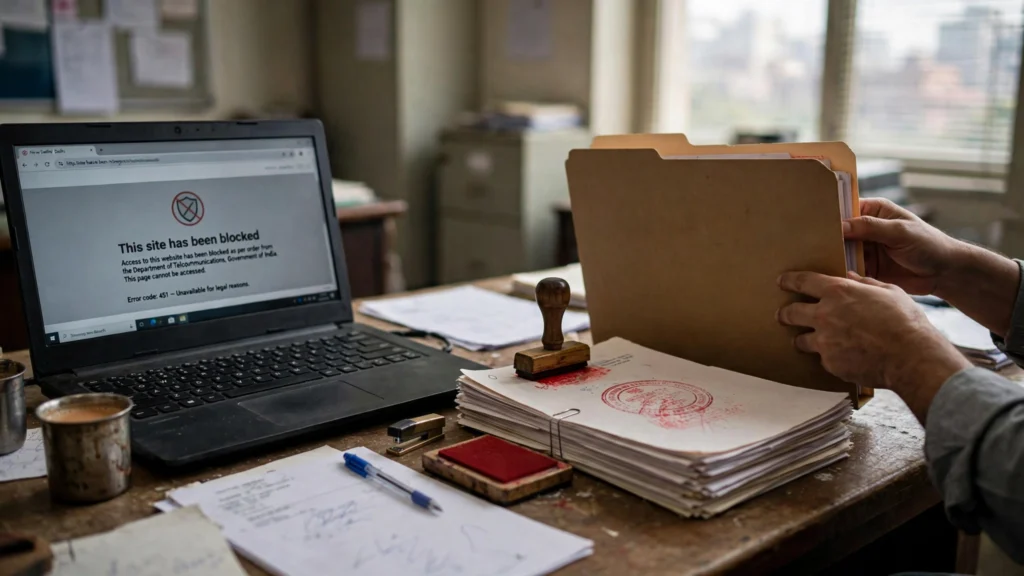
Checks with police and court registries showed the orders were fake, carrying fabricated court logos and seals and a fake QR code. Yet for months, the documents sat in public view on the Department of Telecommunications website, alongside correspondence ordering internet providers to remove the websites.
As of Saturday, one of the two fake orders was still accessible on the government’s website; the other had been removed.
How the system was fooled
The episode raises an uncomfortable question. If a forged order, sent by email from someone pretending to be a lawyer, can get 129 websites blocked, what stops the same trick from being used against a legitimate website?
Online betting is illegal in India, so the sites at the centre of this case were not lawful businesses. But the method matters more than the target: the takedown process appears to have relied on documents arriving by email, with no independent check against court records before internet providers were told to act.
One government source told Reuters that the action against the betting accounts was carried out through the relevant field officers. Neither the ministry nor the Prime Minister’s Office responded to Reuters’ queries about the case.
Investigations under way
State police have opened a criminal investigation against unknown persons for forgery and cheating. On Friday, Reuters reported that the telecom ministry had started an internal investigation, and police have sought ministry records as part of the criminal case.
The summons signals the matter is now being watched at the highest level, with the government seeking answers not only about who sent the fake orders, but about why the system accepted them.
Why this matters beyond betting sites
The case lands as courts worldwide grapple with fake legal material. In July, India’s Supreme Court set aside a tribunal’s orders that had relied on non-existent judgments, and a US judge recently disqualified lawyers over fabricated legal citations. Judges have also raised concerns about court precedents generated using artificial intelligence.
For India, the stakes are practical. Website blocking is routinely used against illegal betting, piracy and other unlawful content, and if the verification behind a blocking order is weak, the tool can be turned against news sites, businesses or anyone else with an enemy willing to forge a document.
The episode also underlines a wider problem: an order that exists only as an emailed PDF, with a QR code nobody scans and a seal nobody verifies, is an open invitation to fraud.
What happens next
- The telecom ministry’s internal investigation will look at how the fake orders were received and acted upon, and who signed off on the blocking instructions.
- State police will continue their criminal case against the people who forged the orders and posed as lawyers.
- Officials are likely to face questions about whether blocking orders will now be verified directly with court registries before they are sent to internet providers.
- The remaining fake order on the government’s website is expected to be taken down, along with the related correspondence.
Until those answers come, the case stands as a warning: a system built to act fast on court orders needs a way to tell a real order from a fake one, and right now, that check appears to have failed.
FAQs
What happened in the fake court order case?
Telecom officials ordered internet providers to block 129 betting websites after receiving fake High Court orders emailed by people posing as lawyers. Reuters exposed the fraud on Wednesday, and the Prime Minister’s Office summoned Telecom Secretary Amit Agrawal on Saturday.
How were the court orders found to be fake?
Police and court registries confirmed the two orders, purportedly from the Rajasthan and Allahabad High Courts, were forged. They contained fabricated court logos and seals and a fake QR code.
Is online betting legal in India?
No, online betting is illegal in India. The websites blocked in this case were illegal betting sites, but the concern is that the same forged-order method could be used to block legitimate websites.
What investigations are under way?
State police have opened a criminal investigation for forgery and cheating, and the telecom ministry has started an internal investigation. Police have also sought ministry records.
What changes could follow?
The case is likely to push the government to verify blocking orders directly with court registries before acting, closing the gap that let forged documents through the system.
Stay with Informeia for updates on this developing story.