Jharkhand is about to knock on every door in the state to find children who are not in school. The Jharkhand Education Project Council (JEPC) will begin a statewide door-to-door child register survey on Tuesday, November 10, covering children aged 3 to 18, to update the state’s child register so that no child slips through the cracks.
Diwali falls today, November 8, and the survey teams will fan out two days after the festival, when families are back home. Teachers from government schools across the state will visit households and record every child’s schooling status digitally, instead of on paper forms.
What the survey will cover
The survey is looking for three groups of children in particular. First, children who should be in school but have never enrolled. Second, children who enrolled at some point and then dropped out. Third, children who appear on school records but are not actually attending classes.
Children aged 3 to 5 will be counted to give the state a clearer picture of early childhood education, while those aged 6 to 18 will be checked against school attendance. You cannot fix a gap you have not measured, and Jharkhand wants the full picture before it plans its next year of school spending.
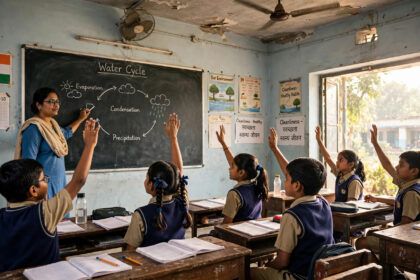
Teachers from government elementary, secondary and higher secondary schools will carry out the household visits. Government-aided schools are part of the exercise too, and non-government schools will also be mapped, so the register reflects the whole state rather than only the government system.
Key dates at a glance
- November 10, 2026: door-to-door household survey begins across Jharkhand
- November 10, 2026 to January 1, 2027: field data collection through the DAHAR 2.0 portal
- January 10, 2027: target date for completing the whole exercise
- Age group covered: children aged 3 to 18 years

How the DAHAR 2.0 portal works
Every answer collected at the doorstep will go straight into JEPC’s DAHAR 2.0 portal, short for Digital Application for Holistic Action Plan and Review for Out of School. Teachers will enter the data digitally instead of filling paper forms, so officials can watch progress in real time and check the information as it comes in.
JEPC project director Shashi Ranjan has issued detailed guidelines to District Superintendents of Education and District Education Officers for the exercise. The digital route also cuts down on the errors that creep in when paper registers are copied and recopied, and it leaves the state with a single, updated child register at the end.
Why Jharkhand is doing this now
Keeping children in school has been a persistent challenge in the state. According to the report, Jharkhand’s secondary dropout rate in 2024-25 was 3.5 percent, against 11.5 percent nationally, and the upper primary dropout rate stood at 1.7 percent. Those numbers show improvement, but they also show that thousands of children are still outside the classroom, and the state does not yet know exactly who or where they are.
Children leave school for many reasons: poverty, families moving for work, household responsibilities, distance from the nearest school, or simply lack of access. A household survey catches those reasons one family at a time, instead of relying on enrolment figures that may be out of date.
The last such exercise gives a sense of the scale. A Times of India report from September said the December 2025 to January 2026 round identified 19,862 children aged 6 to 18 as out of school, and 9,560 of them were later enrolled. Another 10,133 children aged 3 to 5 were identified in the same round.
What happens after the survey
The data will feed into Jharkhand’s annual work plan and budget for 2027-28 under the Samagra Shiksha scheme, the central programme that funds school education. The numbers collected at doorsteps this winter will decide where new enrolment drives and support for vulnerable children are aimed next year.
For parents, there is nothing to apply for and no form to fill in advance. A teacher will visit the home, ask about the children in the family and their schooling, and record the answers. For a family with a child out of school, the visit could be the first step toward getting that child back into a classroom.
FAQs
When does the Jharkhand school survey start?
The door-to-door survey begins on November 10, 2026, two days after Diwali, and field data collection runs until January 1, 2027.
Which children are covered by the survey?
All children aged 3 to 18 years in Jharkhand, including those who never enrolled, those who dropped out, and those on school records but not attending.
What is DAHAR 2.0?
It is JEPC’s digital portal, the Digital Application for Holistic Action Plan and Review for Out of School, used to record and monitor the survey data in real time.
Do parents need to do anything before the survey?
No application or form is needed. A teacher will visit the home and ask about the children’s schooling; families only need to answer the questions.
When will the survey be completed?
JEPC has set January 10, 2027 as the target date for completing the exercise.
The survey is a quiet, door-to-door exercise, but its results will shape Jharkhand’s school plans for the next financial year. For thousands of children currently out of school, a knock on the door on November 10 could be the first step back to a classroom.