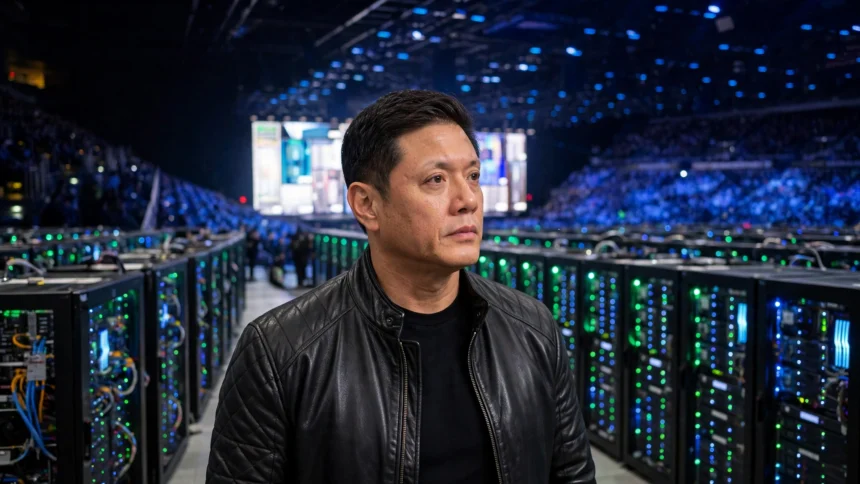
A spy row engulfing Nvidia, the world’s most valuable chipmaker, has put a sharp question to India: how much of the country’s artificial intelligence future rests on one American company? The controversy, centred on Nvidia chief executive Jensen Huang, has moved from a New York Times investigation last month to an FBI probe and a board inquiry this week, as India builds its AI mission on graphics processors, most of them Nvidia’s.
It began with a New York Times investigation which said US authorities had concluded that Alice Huang, a Chinese businesswoman linked to Singapore chip firm Megaspeed, was a Chinese intelligence asset who passed information to Beijing. Then, on November 10, The Information reported she had helped move at least $7.5 billion worth of Nvidia chips to Chinese companies, about 2,40,000 H100, H200 and A100 chips, after US export curbs stalled direct orders. Reuters, which cited the report, said it could not independently verify it.
On Monday, November 9, President Donald Trump said the FBI was looking into Huang’s affair with the businesswoman; Huang told him he had no idea she was a spy. Nvidia’s board has launched an independent investigation, saying it has no reason to believe national security or company secrets were compromised. Huang has told employees he was unfaithful to his wife. Beijing has called the accusations a groundless smear. Nvidia shares fell about 4 percent on Monday.
Republican Senator Kevin Cramer of the Senate Banking Committee has called on Huang to step down, citing the extortion risk around such sensitive chips. Senate Democratic leader Chuck Schumer said on Tuesday that Congress must have a full accounting and wants new curbs on chip exports to China.
Why India is watching closely
For India, this is not a distant corporate scandal: the government launched the IndiaAI Mission in March 2024 with an outlay of Rs 10,371.92 crore over five years, centred on shared computing power. Government figures show shared AI computing capacity had grown past 45,000 GPUs by June 2026, and by August 2026, 237 projects had won subsidised computing support, with 93.18 lakh GPU hours sanctioned.
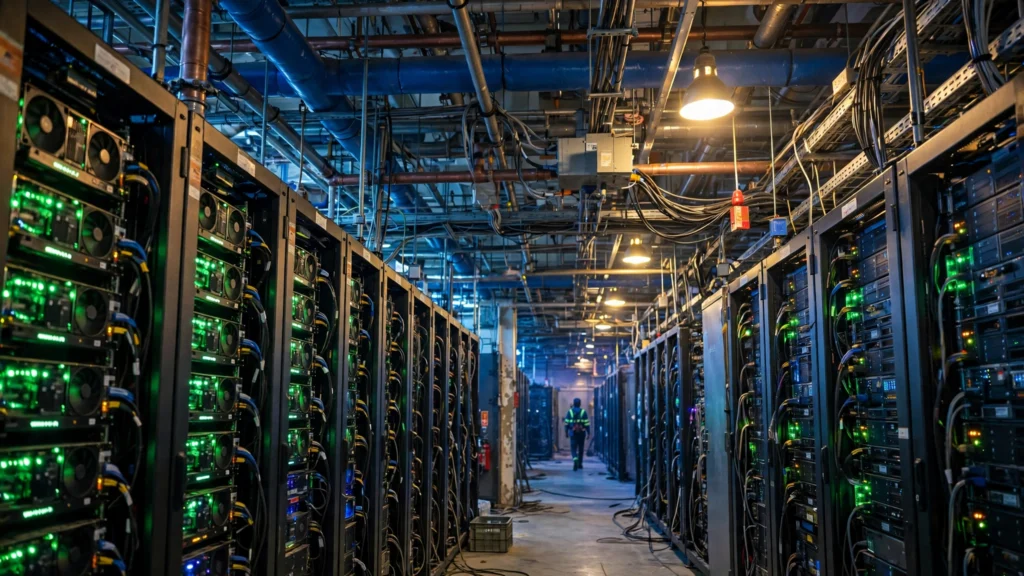
Much of that capacity runs on Nvidia hardware. Its H100, H200 and Blackwell GPUs are the workhorses of AI training worldwide. In February 2026, Nvidia highlighted partnerships with Yotta, Larsen and Toubro and E2E Networks, and Yotta’s Shakti Cloud alone is being built around more than 20,000 Blackwell Ultra GPUs. The dependence goes beyond chips: Nvidia’s CUDA software lets developers build AI applications on its GPUs, and switching is hard. AMD, Intel and Google offer alternatives, but none yet matches that mix of hardware, software and developer support.
What could change for India
There is no evidence so far that the row has disrupted India’s chip supply or its AI projects. But it exposes a familiar risk: a handful of companies control the technology powering the AI race. If US investigations bring tighter export controls or tougher supply-chain scrutiny, Nvidia-reliant countries could face higher costs or delays. Washington has restricted advanced AI chip exports to China since 2022, and Congress is now debating stricter curbs.
India’s longer answer is to build its own. The India Semiconductor Mission, with an outlay of Rs 76,000 crore, is supporting chip manufacturing and packaging, while indigenous processor efforts such as SHAKTI and VEGA aim to strengthen the domestic chip ecosystem. But making advanced AI processors is far harder than conventional chips: it needs specialised fabs, advanced technology, skilled engineers and huge investment, plus software for developers to actually use domestic processors. That work will take years, not months.
The road ahead
For now, India’s AI mission runs largely on imported computing power, with Nvidia at its centre. The row does not change that overnight, but it sharpens a long-standing question: how does an aspiring AI powerhouse keep its infrastructure accessible, secure and reliable? Building AI models is only half the job. Securing the chips, software and supply chains that run them is the other half, and India can no longer leave it to chance.
FAQs
What is the Nvidia spy row about?
The New York Times said US authorities concluded Alice Huang, a businesswoman linked to Singapore chip firm Megaspeed, was a Chinese intelligence asset. The Information later reported she helped move at least $7.5 billion worth of Nvidia chips to China. The FBI is now examining CEO Jensen Huang’s ties to her.
Has Nvidia confirmed any wrongdoing?
No. Nvidia’s board has launched an independent investigation and says it has no reason to believe national security or company secrets were compromised.
How dependent is India’s AI Mission on Nvidia?
Very. India’s shared capacity stands at more than 45,000 GPUs, largely Nvidia’s H100, H200 and Blackwell chips, including Yotta’s Shakti Cloud with over 20,000 Blackwell Ultra GPUs.
Will the controversy affect India’s AI projects?
No evidence of disruption so far. The risk is indirect: tighter US export controls or supply-chain scrutiny could raise costs or delay access to advanced chips.
What is India doing to reduce this dependence?
The India Semiconductor Mission, backed by Rs 76,000 crore, supports chip manufacturing and packaging, while homegrown processors like SHAKTI and VEGA aim to build domestic AI hardware over the long term.
India’s AI ambitions do not depend on Nvidia alone, but the row is a reminder that the chips powering the mission are, for now, largely someone else’s. Diversifying supply has just become more urgent.