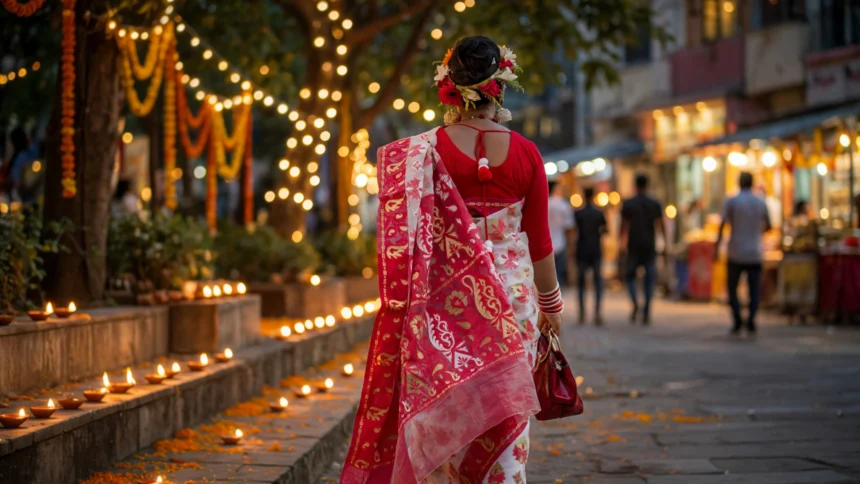
For generations, wearing a saree has meant one thing above all: patience. Six metres of fabric, a dozen pleats to fold just right, a pallu to pin, and usually a second pair of hands to get it all to sit properly. This festive season, though, a growing number of young women are skipping the struggle entirely. The pre-pleated saree, stitched and set in advance, is turning the most elegant outfit in the Indian wardrobe into something you can slip on in about five minutes.
It is a small change with a big following. Designers and tailors say demand for ready-to-wear and pre-pleated sarees has climbed steadily over the past five years, and this Diwali season the trend has moved from niche to mainstream. For a generation that loves the look but never quite mastered the drape, the shortcut is the whole point.
Why the six-yard classic needed a shortcut
Ask any first-time saree wearer what puts them off, and the answer is rarely the fabric or the price. It is the draping. Fashion designer and tailor S.C. Kavitha, who has watched the shift up close, says teenagers in particular find the traditional drape difficult. Getting the pleats right can take up to an hour, and many young women simply choose an anarkali, a kurti or a modern dress instead.
Pre-pleated sarees remove that barrier. The pleats are measured, arranged and steam-pressed in advance, then secured in place. Once prepared, the saree can be wrapped around the body in about five minutes, without anyone else having to straighten or rebuild the pleats. The look stays the same. The effort does not.
What exactly is a pre-pleated saree?
A pre-pleated or pre-draped saree comes with the hard work already done. The pleats are built in, the pallu is secured, and many designs include an integrated blouse or a drawstring waist that fastens much like a skirt. You step in, wrap, pin once, and you are ready.
The fabric itself is untouched. Surat-based saree house House of Vardha, which offers a pre-drape service at Rs 999 per saree, notes that nothing is stitched or cut. The saree is draped once, the fold lines are set, and after the occasion it can be washed and re-draped along the same lines. Lighter fabrics such as organza, tissue silk and lighter Kanjivaram work best, while heavier Katan silks need more pinning to hold their shape through a long event.

Who is actually buying them?
Three groups are driving the demand in India, according to sellers on the ground:
- Working professionals in metros: women in Mumbai, Delhi, Bengaluru and Surat who have a Diwali party on a weekday evening and cannot spend 40 minutes draping after work. They want to change and leave in under five minutes.
- NRI customers: women in the UK, the UAE, the US and Canada who want to wear sarees at community events but have no family nearby to help them drape. Pre-draping removes that dependency entirely.
- Trousseau brides: women building a post-wedding wardrobe who want each saree organised and immediately wearable for a year of functions ahead.
Designers are responding in kind. In its Deepavali 2026 fashion round-up, The Hindu noted pre-draped saris and pleated, cropped saris among the season’s defining looks, with New Delhi designer Shweta Kapur’s label 431-88 championing the pre-draped sari and Chennai-based Ashwin Thiyagarajan showing pleated and cropped saris in easy cotton. The appeal now stretches beyond Indian wearers too, with orders coming in for weddings, workplace cultural events and school functions.
The five-minute test
The real test of any fashion shortcut is whether it survives the evening. Sellers say the pre-pleated versions do, provided the fabric is right and the pleats are set well. The pallu stays put, the pleats do not unravel mid-party, and the wearer is not constantly adjusting the drape.
There are limits. A heavily embroidered or very stiff saree will not fold as neatly, and purists will always prefer the hand-draped original. But for a young woman heading to her first office Diwali party, or a teenager wearing a saree to a friend’s wedding, the trade-off is an easy one.
How to pick your first pre-pleated saree
- Start light: organza, georgette and tissue silk drape best and hold a pre-set pleat well.
- Check the waist fit: ready-to-wear versions fasten with hooks, buckles or a drawstring, so get the measurement right.
- Keep the blouse simple: a plain or lightly worked blouse lets the saree do the talking.
- Ask about re-draping: a good pre-drape service sets fold lines you can follow again after washing.
- Try it once at home: wear it for an hour before the event to make sure nothing slips or pinches.
FAQs
What is a pre-pleated saree?
A saree whose pleats are measured, folded and secured in advance, so it can be worn in about five minutes without help. It is also called a ready-to-wear or pre-stitched saree.
Does pre-pleating damage the saree?
No. The fabric is not cut or stitched. The pleats are set with steam and pressing, and the saree can be washed and re-draped along the same fold lines.
How much does pre-draping cost in India?
Services vary by city and fabric. Surat-based House of Vardha charges Rs 999 per saree for its pre-drape service, while tailors elsewhere price it by fabric type.
Are pre-pleated sarees only for young women?
They are most popular with younger buyers and first-time wearers, but working professionals of all ages use them for the convenience, especially for weekday festive events.
Which fabrics work best?
Lighter fabrics such as organza, georgette, tissue silk and lighter Kanjivaram hold a pre-set pleat best. Heavier silks can be pre-draped but need more pinning.
The saree is not going anywhere. It is simply learning to keep up. And for a generation that wants tradition without the hour-long tutorial, five minutes is exactly the right amount of time.