Telecom companies in India will pay capped charges when they connect their networks to each other. The Telecom Regulatory Authority of India (TRAI) on Monday released new rules that set annual ceilings on charges for Internet Protocol (IP) based interconnection ports, bringing a framework built for older technology in line with how networks actually work today.
The new rules, called the Telecommunication Interconnection (Port Charges) (Third Amendment) Regulations, 2026, will come into effect from January 1, 2027. They set a maximum annual charge of Rs 5.6 lakh for a 1 Gbps IP port and Rs 42.3 lakh for a 10 Gbps IP port.
The ceilings apply uniformly across fixed-line, mobile, national long-distance and international long-distance services. Operators are free to agree on charges below these ceilings if they wish.
What exactly has TRAI capped
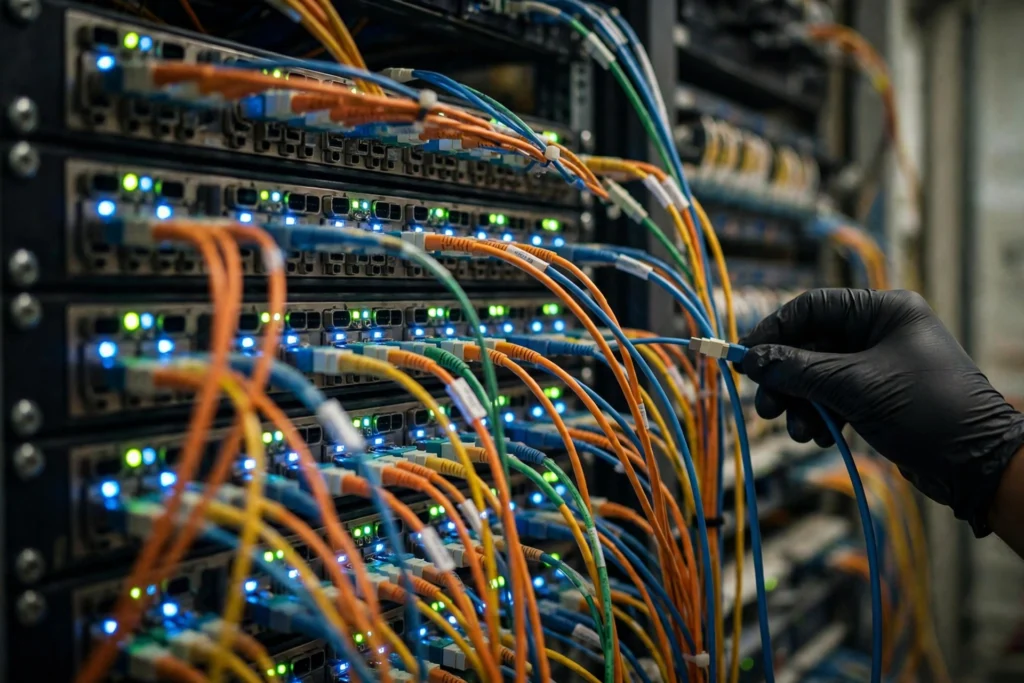
When a call or data session travels from one operator’s network to another, the two networks meet at points of interconnection. The operator seeking the connection pays the provider a port charge for terminating the link at that point. Until now, the rules governing these charges were written around E1 ports, an older technology that carries 2.048 Mbps per port.
The amended framework changes the definition of a port to include both legacy E1 ports and IP ports, with bandwidth expressed in Mbps or Gbps. The new ceilings are:
- 1 Gbps IP port: Rs 5.6 lakh per year
- 10 Gbps IP port: Rs 42.3 lakh per year
The charges prescribed earlier will continue to apply only to E1 ports. In other words, the old framework stays in place for legacy connections, while IP-based connections now get their own clear price ceiling for the first time.
Why the change was needed
The original Telecommunication Interconnection (Port Charges) Regulation dates back to 2001, and the charges under it were last revised in 2012. Since then, Indian telecom networks have moved steadily from circuit-switched E1 links to IP-based interconnection, but the port-charge rules had not kept pace.
TRAI began reviewing the framework with a pre-consultation paper on April 3, 2025, followed by a consultation paper on November 10, 2025. An open house discussion was held on January 28, 2026, after which the regulator finalised the amendment. The long consultation means operators, including Reliance Jio, Bharti Airtel and Vodafone Idea, had a chance to put their views on record before the ceilings were fixed.
The regulator said the new framework is meant to modernise the interconnection regime and support seamless communication across networks as traffic volumes keep growing.
What it means for Jio, Airtel and Vi
For operators, the biggest gain is predictability. Interconnection is a cost every operator bears, and a published ceiling removes the uncertainty of negotiated port charges for IP links. Smaller operators and new entrants, who typically seek interconnection from larger networks, get a clear upper limit they can plan around.
The uniform application across service types also simplifies things. A single framework now covers fixed-line, mobile and long-distance services, instead of leaving IP interconnection charges to case-by-case negotiation. Since the ceilings are maximums rather than fixed rates, operators can still agree on lower charges where it suits them.
The timing matters too. With data traffic rising and networks being upgraded for higher capacity, IP ports of 1 Gbps and 10 Gbps are now the standard building blocks of interconnection. A clear charge for these ports reduces one more friction point in how networks connect.
Will mobile tariffs or recharge prices change
Not directly. The new rules govern what operators pay each other for network connections, not what subscribers pay for calls or data. TRAI has not changed mobile tariffs, recharge prices or data rates through this amendment.
That said, interconnection costs are part of an operator’s overall cost base. Clearer and capped charges can help keep those costs in check over time, but any effect on retail prices would be indirect and is not something the new rules promise.
Penalties for breaking the rules
To make sure the framework is followed, TRAI has introduced a graded financial disincentive for violations of specified provisions of the amended regulations. The penalty is capped at Rs 15 lakh per service area for each instance of contravention.
The January 1, 2027 start date gives operators around seven weeks to align their interconnection agreements with the new framework.
FAQs
When do the new TRAI port charge rules take effect?
The Telecommunication Interconnection (Port Charges) (Third Amendment) Regulations, 2026 come into effect from January 1, 2027.
What are the new caps on IP port charges?
Rs 5.6 lakh per year for a 1 Gbps IP port and Rs 42.3 lakh per year for a 10 Gbps IP port. Operators can agree on lower charges.
Do the new charges apply to all telecom services?
Yes. They apply uniformly across fixed-line, mobile, national long-distance and international long-distance services.
Will my mobile bill or recharge price change?
No direct change. The rules cover charges operators pay each other for network interconnection, not retail tariffs or data rates.
What happens to the old E1 port charges?
The charges prescribed earlier continue to apply only to E1 ports. The new ceilings cover IP-based ports.
TRAI’s move closes a gap that had existed since networks began shifting to IP interconnection. With the ceilings fixed and a penalty framework in place, operators now have a clear, modern set of rules to work with from the start of 2027.