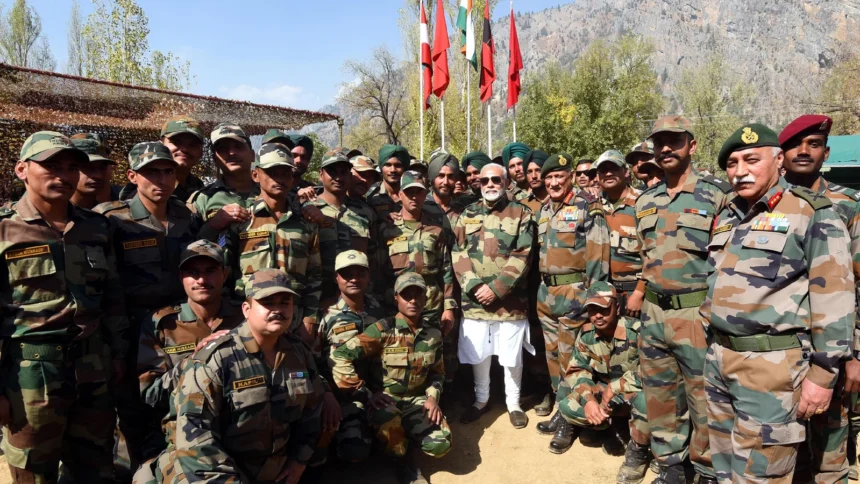
Prime Minister Narendra Modi’s Diwali visit to Chhattisgarh’s Bastar region has set off a sharp political row, with the Congress accusing him of turning a solemn occasion with security personnel into a platform to attack his rivals. The flashpoint is a phrase the Prime Minister used while addressing troops at a Central Reserve Police Force camp on Sunday: “Dimagi Naxals”.
Modi spent Diwali with jawans at the CoBRA operations base in Karanpur, Bastar, continuing a tradition he has kept for 13 straight years of celebrating the festival with soldiers rather than in Delhi. But it was not the visit itself that drew fire. It was what he said there, and the Congress response came within hours.
What PM Modi said in Bastar
Addressing security personnel at the CRPF camp, Modi said armed Naxalites had been wiped out from the forests, but warned that the threat was far from over. In his words, “Dimagi Naxals”, or ideological Naxals, had taken control of several organisations and even infiltrated political parties.
“We must remember one thing. Naxalites have been eliminated, but the threat is not yet over. While armed Naxalites have been wiped out from the forests, ‘Dimagi Naxals’ have taken control of several organisations. Even today, they are inciting people against the country’s Constitution and democracy,” the Prime Minister said.
He added that such elements had also entered several political parties and organisations, and said, “We must identify and defeat such elements and secure the country.”
The Prime Minister also distributed sweets to the personnel during the programme, and photographs from the visit showed him in the uniform of the security forces as he interacted with the jawans.
Congress hits back within hours
Congress general secretary in charge of communications Jairam Ramesh led the counterattack in a post on X, objecting both to the remark and to the setting in which it was made.
“The Prime Minister has not spared the nation even on Diwali day his trademark abuse. He has once again spoken of what he calls dimagi naxals. He has used a very solemn non-political occasion, donned the uniform of the security forces, and hurled invectives at his political rivals,” Ramesh wrote.
“This is a brazen assault on all institutional norms but when has that ever stopped this man?” he added.
In the same post, Ramesh described the Prime Minister in blunt terms: “The PM is clearly distraught, disturbed and desperate. Jhola-picking-up time is fast approaching.”
Ramesh lists past U-turns
Ramesh did not stop at the Bastar remark. He pointed to two earlier occasions, he said, when the Prime Minister had used similar language against his critics, only for the government to later accept the very demands it had opposed.
He recalled that on April 28, 2024, Modi had described those demanding a caste census as “urban naxals”. Then, on April 30, 2025, the government announced that a caste census would be carried out as part of Census 2027.
He also cited September 2020, when the Prime Minister had called those agitating against the three farm laws supporters of a Naxal ideology. The farm laws were later withdrawn, on November 19, 2021.
The Congress argument, in short, is that the label has been used before against critics who were later proved right, and that the Bastar remark follows the same pattern.
Why the remark matters
The exchange lands at a sensitive moment. The Congress has been running a sustained campaign over electoral rolls and the Election Commission, and on Sunday its general secretary K. C. Venugopal said the party would continue its agitation until Chief Election Commissioner Gyanesh Kumar is removed. The party has also announced a nationwide “Vote Bachao, Desh Bachao” campaign at the panchayat level over the next six weeks.
Against that backdrop, the Prime Minister’s remarks in Bastar and the Congress response have sharpened a political argument that is likely to carry into the winter session of Parliament, where the Congress has said it will raise electoral issues.
For now, the row is a war of words, but it underlines how even a festival visit to the troops can become a political battleground in the current climate.
FAQs
What did PM Modi say in Bastar?
During his Diwali visit to a CRPF camp in Karanpur, Bastar, on November 8, 2026, the Prime Minister said armed Naxalites had been eliminated from the forests, but “Dimagi Naxals” had taken control of several organisations and political parties and were inciting people against the Constitution and democracy.
Why is the Congress objecting?
Congress leader Jairam Ramesh said the Prime Minister used a solemn, non-political occasion, while wearing the uniform of the security forces, to attack his political rivals. He called it a “brazen assault on all institutional norms”.
What does “jhola-picking-up time” mean?
It is Ramesh’s jibe that the Prime Minister’s time in office is running out. In his post on X, he wrote: “The PM is clearly distraught, disturbed and desperate. Jhola-picking-up time is fast approaching.”
Has Modi used similar terms before?
According to Ramesh, yes. He cited April 28, 2024, when Modi called caste census supporters “urban naxals”, and September 2020, when farm law protesters were described as supporters of a Naxal ideology. In both cases, the government later accepted the demands.
The row is set to echo in Parliament, where the Congress has said it will raise electoral issues in the coming session.