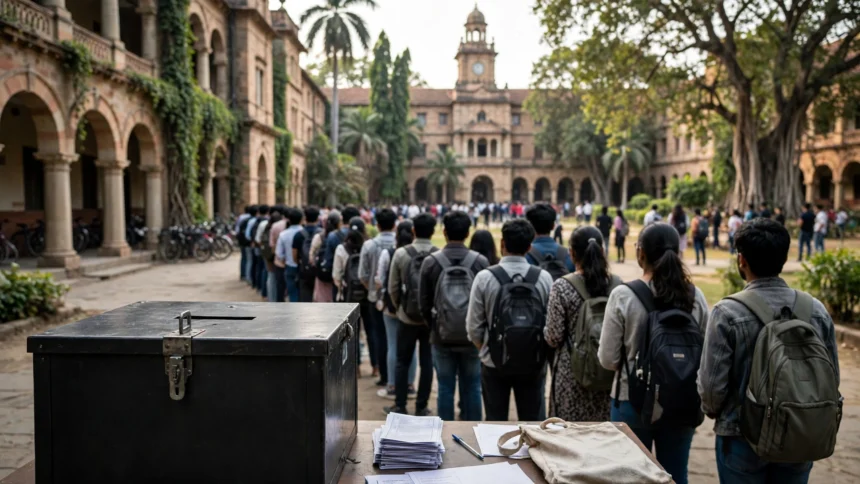
After eight years without a vote on campuses, students in Odisha have delivered a clear verdict. The Akhil Bharatiya Vidyarthi Parishad (ABVP) has claimed victory in eight of the state’s 13 public universities and in more than 200 colleges, making this round of student union elections one of the most consequential campus polls the state has seen in a decade.
Voting took place on Thursday, October 15, and results were declared on Saturday. The elections were a direct result of the BJP government’s promise to restore student union polls in the state, a manifesto commitment that the party’s student activists wasted no time in celebrating. ABVP workers distributed sweets across campuses after the results, thanking Chief Minister Mohan Charan Majhi for keeping his word.
“The entire electoral process, from filing nominations and identifying candidates to holding meet-the-candidate sessions and the final voting, was conducted in a well-organised manner,” said ABVP’s Odisha state secretary Diptimayee Pratihari. “The Vidyarthi Parishad’s demand for clean and impartial elections was met, and today the organisation has secured overwhelming support from the student community across the entire state.”
What the numbers say
According to the ABVP’s tally, its candidates won the president’s post in eight universities, along with eight vice-president posts, ten secretary posts and eleven assistant general secretary posts across the 13 institutions. The organisation’s showcase wins came at Utkal University, where it swept the entire panel, and at Ravenshaw University, where it won every post except that of president.
At the college level, the ABVP said its candidates won the president’s post in 208 of over 340 colleges where results were declared, with vice-president wins in 214, general secretary wins in 221 and assistant general secretary wins in 199. The rival Biju Chhatra Janata Dal (BCJD), the student wing of the opposition Biju Janata Dal, put up its own tally: its president Ipsita Sahoo claimed her organisation won 55 to 60 per cent of student union seats across the state.
The BCJD pointed to its wins at Rama Devi Women’s University and at Ravenshaw as proof that it remains a force on campuses, particularly at women’s colleges. Pratihari conceded the loss at Rama Devi Women’s University but alleged that rival organisations had used money and muscle power during the elections.
The Congress-affiliated National Students’ Union of India (NSUI), meanwhile, claimed president posts in 30 colleges and said it finished second in another 80 institutions.
Amit Shah calls it a message
The results drew a reaction from the top of the BJP leadership. Union Home Minister Amit Shah described the ABVP’s performance as “a stern response to anti-national forces” and said it reaffirmed that the country’s youth stood with the ‘nation first’ ideology.
“Heartfelt congratulations to all office bearers of ABVP for achieving a resounding victory in the Odisha student union elections,” Shah wrote in a post on X. “First Panjab University, then Delhi University, and now Odisha, this victory of the Akhil Bharatiya Vidyarthi Parishad clearly conveys the message that the youth power of the country is firmly aligned with the ‘Nation First’ ideology.”
The remark appeared to reference the ongoing agitation against the Special Intensive Revision (SIR) of electoral rolls, suggesting the BJP views the campus results as a broader political signal.
Why these polls matter
Student union elections in Odisha are not formally fought along party lines, though political parties openly back candidates and student organisations. That is why the results are being read as more than a campus affair.
For the ruling BJP, which unseated the BJD in the 2024 assembly elections, the ABVP’s showing is a chance to extend its dominance into campuses that were long considered BJD strongholds. For the BJD, its tally of college-level wins is a reminder that its organisational machinery among students is far from dead.
Campus politics experts say the eight-year gap is what makes this cycle special. An entire generation of students graduated without ever voting in a union election. For many first-time voters on these campuses, Thursday was their first experience of organised student democracy, complete with nomination filings, candidate debates and voting queues.
- Voting held on October 15, 2026 across 13 state universities and 340-plus colleges
- ABVP claims 8 of 13 universities and president posts in 208 colleges
- BCJD claims 55-60 per cent of all student union seats statewide
- NSUI claims 30 college president posts and second place in 80 colleges
- Elections restored after an eight-year gap on a BJP manifesto promise
FAQs
When were the Odisha student union elections held?
Voting took place on Thursday, October 15, 2026, and results were declared on Saturday, October 17.
Why is this election being discussed so much?
Student union elections had not been held in Odisha for eight years, so this was the first campus vote for an entire generation of students.
How many universities did ABVP win?
The ABVP claims victory in eight of Odisha’s 13 state universities, including a clean sweep at Utkal University.
What did the rival student groups claim?
The BJD-backed BCJD claimed 55 to 60 per cent of student union seats across the state, while the Congress-backed NSUI claimed 30 college president posts.
What did Amit Shah say about the results?
The Union Home Minister called the ABVP’s victory a “stern response to anti-national forces” and a sign that youth power is aligned with the ‘nation first’ ideology.
Eight years is a long time to wait for a vote. This week, Odisha’s students finally got theirs, and the results will shape campus politics in the state for years to come.