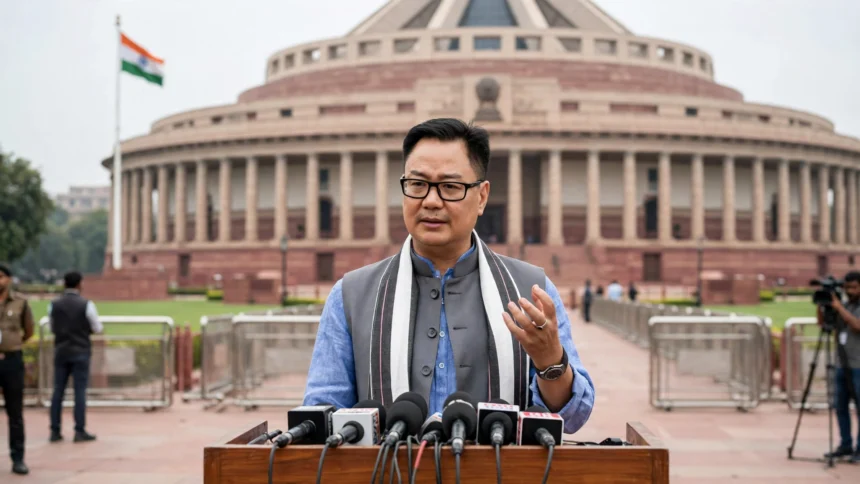
New Delhi: The political row over Prime Minister Narendra Modi’s “Dimagi Naxals” remark sharpened further on Tuesday, with Parliamentary Affairs Minister Kiren Rijiju hitting back at Congress leader Rahul Gandhi and declaring that the government’s next target is to finish “Dimagi Naxals” after eliminating armed Maoists.
Rijiju’s response, posted on X, came a day after Gandhi attacked the Prime Minister over the phrase and challenged him to a public debate. The exchange has turned a remark made by Modi during his Diwali visit to Chhattisgarh into one of the sharpest political fights of the week, with both sides now trading charges over who stands against the Constitution and who is misusing the language of national security.
What Rijiju said
Rijiju directly addressed Gandhi in his post and credited the Prime Minister with ending armed Maoist violence. “Rahul ji, thank Modi ji for eliminating the Armed Maoists. Former PM Dr Manmohan Singh ji had famously described Left-Wing Extremism and Naxalism as ‘The single biggest internal security threat’ to India. Next target is to finish Dimagi Naxals,” he wrote.
The minister was responding to Gandhi’s post from Monday, in which the Leader of Opposition in the Lok Sabha had accused the Prime Minister of misleading the CRPF personnel he addressed in Chhattisgarh. By invoking former Prime Minister Manmohan Singh’s description of Left-Wing Extremism, Rijiju sought to frame the government’s position as a continuation of a long-standing national security concern rather than a new political slogan.
Rijiju’s post also carried a clear political message: the government sees the fight against what it calls “Dimagi Naxals”, or people with a Naxal mindset, as the next phase of the campaign against Left-Wing Extremism.
How the row began
The controversy began on Sunday, when Modi celebrated Diwali with security personnel at a CRPF camp in Chhattisgarh’s Bastar region, continuing his tradition of spending the festival with men and women in uniform. Addressing the personnel, the Prime Minister said armed Maoists have been eliminated but “Dimagi Naxals” have infiltrated several political parties and organisations and are instigating people against the Constitution and democracy.
“We must identify and defeat such elements and secure the country,” Modi said.
The remark drew an immediate reaction from the Opposition, which accused the Prime Minister of using the term to brand and delegitimise democratic dissent. The Congress alleged that Modi is “distraught, disturbed and desperate” and that his “jhola-picking-up time” is fast approaching, a jibe the party has used before to suggest the Prime Minister’s tenure is nearing its end.
Rahul Gandhi’s challenge
On Monday, Gandhi hit out at Modi over the remarks, saying the CRPF personnel did not buy the Prime Minister’s “lies”. In a post on X addressed to the force, he wrote, “Dear @crpfindia, Your faces said it all: you didn’t buy the PM’s lies.”
Gandhi added, “He called us Naxals. My challenge stands. Let him debate me on who is anti-national and who is controlled by foreign forces. Any time, any place. My guarantee: after the debate, the PM won’t have the guts to stand in front of a single jawan again.”
The debate challenge is one Gandhi has issued before, and it has become a recurring feature of his attacks on the Prime Minister. This time, however, it is tied directly to the armed forces, with Gandhi claiming that the personnel Modi addressed in Bastar did not accept the Prime Minister’s characterisation of his critics.
Why the phrase has sparked a debate
This is not the first time Modi has used the term. In his Independence Day address in August, he had also referred to “Dimagi Naxals”, saying the country succeeded in removing armed Naxalism but its ideological supporters were seeking opportunities to promote violence. The phrase has since become shorthand in the BJP’s campaign against what it describes as an ecosystem that supports extremist ideas while staying away from armed action.
The Opposition reads it very differently. Congress and other parties argue that the label is being stretched to cover legitimate criticism of the government, and that calling critics “Naxals” of any kind is an attempt to silence dissent by associating it with a banned violent movement.
The timing adds to the sensitivity. Modi’s Bastar visit was presented by the government as a celebration of the first Naxal-free Diwali in the region in decades, a claim tied to the security forces’ operations against Maoist groups. The Prime Minister’s warning about “Dimagi Naxals” was meant to extend that victory to the ideological front. For the Opposition, it was an attempt to turn a security achievement into a political weapon.
What happens next
With Rijiju now joining the exchange, the row looks set to continue through the week. The government is unlikely to step back from the phrase, which fits its broader narrative on national security, and the Congress is unlikely to drop a line of attack that lets it accuse the Prime Minister of insulting both the Opposition and the armed forces in the same breath.
Whether Gandhi’s debate challenge gets any response beyond Rijiju’s post remains to be seen. The Prime Minister has not accepted such challenges in the past, and the BJP has generally treated them as political theatre rather than serious proposals. But the exchange has already ensured that the “Dimagi Naxals” remark, made on a Sunday in Bastar, will dominate political conversation well beyond Diwali week.
FAQs
What did Kiren Rijiju say about “Dimagi Naxals”?
On Tuesday, Rijiju posted on X that after eliminating armed Maoists, the government’s next target is to finish “Dimagi Naxals”. He also cited former PM Manmohan Singh’s description of Left-Wing Extremism as the single biggest internal security threat to India.
What did PM Modi say in Bastar?
While celebrating Diwali with CRPF personnel in Chhattisgarh’s Bastar on Sunday, Modi said armed Maoists have been eliminated but “Dimagi Naxals” have infiltrated several political parties and organisations and are instigating people against the Constitution and democracy.
What was Rahul Gandhi’s response?
On Monday, Gandhi said the CRPF personnel did not buy the Prime Minister’s “lies” and challenged Modi to debate him on who is anti-national and who is controlled by foreign forces, at any time and any place.
Has Modi used the term before?
Yes. In his Independence Day address in August, Modi referred to “Dimagi Naxals” and said the country had removed armed Naxalism but its ideological supporters were seeking opportunities to promote violence.
Why is the Opposition objecting to the phrase?
Opposition parties accuse the Prime Minister of using the term to brand and delegitimise democratic dissent, arguing that legitimate criticism of the government is being linked to a banned violent movement.
The “Dimagi Naxals” row is now a full-blown political fight, and neither side looks ready to back down.