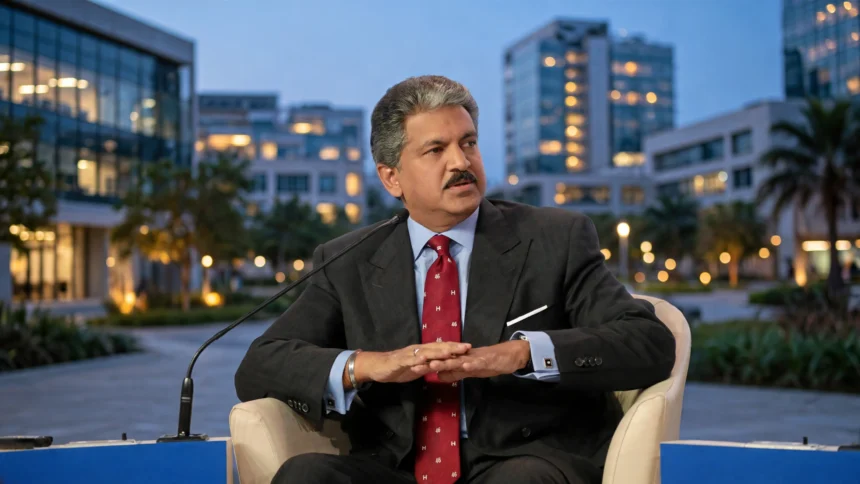
India has secured the third spot in the global artificial intelligence race, according to Stanford University’s Global AI Vibrancy Index, and Mahindra Group chairman Anand Mahindra believes the ranking tells only part of the story. In a post on X on Tuesday, November 10, Mahindra argued that India’s real strength in AI is not chips or foundational models, but the ecosystem around them: software talent, systems integration and a huge domestic market.
“Stanford now ranks India #3 in global AI vibrancy,” Mahindra wrote, placing India ahead of countries such as the UK, Japan and South Korea. Only the United States and China sit above India.
The post struck a chord because it pushed back against a familiar doubt about India’s AI ambitions. India does not manufacture the most advanced semiconductors, and it does not lead the development of frontier large language models. Mahindra did not dispute either point. His argument was that the next phase of the AI boom may be decided not by who builds the biggest models, but by who puts them to work.
What Mahindra actually said
Mahindra began with a note of irony. “I recently posted about the irony of India coming back into favour with global investors, partly because we were seen as being outside the supposedly overheated AI trade. But perhaps there’s another way to look at it,” he wrote.
He then reached for a phrase made famous by American political strategist James Carville, recasting it for the AI era: “It’s the ecosystem, stupid!” The point, he explained, is that the biggest opportunities may emerge when businesses start using AI to solve specific problems, improve operations and build applications for different sectors.
To make the case, Mahindra recalled an analogy from Tech Mahindra’s annual report, comparing AI with the rise of smartphones. Smartphones created the platform, but applications eventually unlocked their real potential. AI, he suggested, could follow a similar path.
“The real explosion of applications, domain expertise and enterprise-wide deployment may still lie ahead,” he wrote.
The ranking in context
Stanford’s Global AI Vibrancy Tool combines indicators such as research output, computing infrastructure, talent, education, policy and commercial adoption into a single score. A JPMorgan report published in June 2026, drawing on the same index, also placed India third globally in AI readiness, after the US and China.
India’s case rests on three strengths Mahindra identified. The first is the country’s large pool of software professionals and technology talent, built over decades of work by Indian IT companies in developing software and managing complex technology projects for businesses worldwide.
The second is systems integration expertise. As companies move beyond experimenting with AI tools and begin deploying them across their operations, stitching different technologies into existing business systems becomes increasingly important, and that is work Indian firms have done for years.
The third is the domestic market itself. With a population of more than 1.4 billion and a fast-digitising economy, India offers an enormous testing ground for AI applications across industries, from banking and telecom to agriculture, healthcare and manufacturing.

Why the investor angle matters
Mahindra also connected India’s AI position with the changing mood of global investors towards Indian markets, noting that India was attracting renewed interest partly because it was seen as being outside the overheated AI trade.
“Perhaps India isn’t just a refuge from the AI hype. It may have a compelling AI opportunity of its own,” he wrote. He added that if this opportunity materialises, the renewed interest in Indian equities could have more staying power than investors currently expect.
What comes next
None of this guarantees success. Ranking third on a vibrancy index is not the same as leading the AI economy, and India still faces real gaps in computing infrastructure, research funding and advanced chip supply. The government’s IndiaAI Mission and the upcoming India AI Impact Summit, which will bring together more than 100 countries, are attempts to close some of those gaps. But if the next contest is about using AI well at scale, Mahindra believes India has a genuine shot.
FAQs
Where does India rank in the Stanford AI vibrancy index?
India ranks third in the world in Stanford University’s Global AI Vibrancy Index, behind the United States and China, and ahead of countries such as the UK, Japan and South Korea.
What did Anand Mahindra say about India’s AI opportunity?
In a post on X on November 10, 2026, Mahindra said India’s strength lies in its AI ecosystem, software talent, systems integration and domestic market, adding: “It’s the ecosystem, stupid!”
Does India lead in AI chips or large language models?
No. Mahindra acknowledged India does not make the most advanced chips or lead in frontier models. His argument is that the next phase of AI growth will be driven by applications and enterprise adoption, where India is strong.
What is the Stanford Global AI Vibrancy Index?
It is a tool from Stanford University that scores countries on the competitiveness of their AI ecosystems, using indicators such as research, computing infrastructure, talent, policy and commercial adoption.
Why did Mahindra link AI to investor interest in India?
He argued that if India’s talent and domestic demand translate into real AI opportunities, renewed investor interest in Indian equities could last longer than markets expect.
India’s AI story is still being written, and the next chapter depends on how quickly businesses turn the technology into working products.