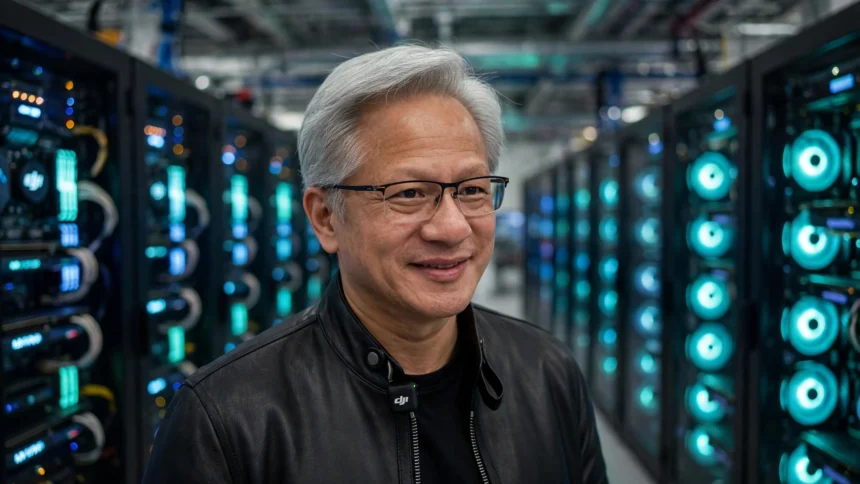
Jensen Huang has resigned as chief executive of Nvidia with immediate effect, bringing a sudden end to a 33-year run at the helm of the company that became the face of the global artificial intelligence boom. The chipmaker announced the decision on Thursday, 12 November 2026, and said chief financial officer Colette Kress will take over as interim CEO while the board searches for a permanent successor.
Huang, 63, co-founded Nvidia in 1993 and led it from a small graphics chip startup to the world’s largest AI chipmaker. His resignation closes one of the most remarkable leadership eras in modern technology, and it comes at a moment when Nvidia sits at the centre of the AI economy, supplying the chips that power data centres, cloud platforms and AI research around the world.
In its statement, Nvidia’s board said Huang had resigned as president, chief executive officer and a member of the board, effective immediately. The board thanked him for what it called his immeasurable contributions to the company and the industry.
Who takes charge now
Colette Kress, Nvidia’s executive vice president and chief financial officer, has agreed to serve as interim chief executive. She will keep her finance role while she leads the company, and the board said she has the backing of an experienced leadership team. Kress joined Nvidia in September 2013 and has run its finance operations for more than a decade.
The board has also appointed longtime director Harvey C. Jones as its first-ever chairman. In the announcement, Jones said the board expects operations and the company’s product roadmap to continue without interruption.
Nvidia said it has begun a formal search for a permanent chief executive and will consider both internal and external candidates. No timeline has been given for the appointment. The company also confirmed that its third-quarter results for fiscal 2027 will be announced on 17 November as previously scheduled, with an earnings call later that day.
The controversy behind the exit
Huang’s resignation follows days of intense scrutiny over reports about his personal life. According to reports in US media, the board had been weighing his future after revelations about two extramarital affairs, one involving a Singapore-based tech executive whom US intelligence officials suspect of spying for China, and another involving a senior Nvidia executive.
The controversy first surfaced publicly when The New York Times reported in October 2025 about Huang’s business connection with Alice Huang, an executive at a cloud computing company. On 8 November, Nvidia announced that independent directors, assisted by outside legal counsel, would oversee an investigation into whether Huang had been the target of a foreign intelligence operation.
Reuters reported that Nvidia’s board met on 11 November to decide whether to oust Huang. The board accepted his resignation the following day, according to a regulatory filing. The company has not disclosed the specific circumstances of the resignation or the terms of any agreement with the board.
US lawmakers had also called for Huang’s resignation as the reports gathered pace, adding political pressure to a situation that was already rattling investors.
Markets react sharply
Wall Street’s reaction was swift and severe. Nvidia shares fell as much as 14 percent in premarket trading on Thursday, wiping more than 400 billion dollars off the company’s value in early trade. By the opening bell, the stock was down around 9.7 percent, dragging the Nasdaq composite down 0.9 percent and the S and P 500 down 0.6 percent in early trading.
The fall extended a slide that began when the board announced its investigation. Nvidia’s shares had already dropped about 27 percent from that announcement through Wednesday, as investors worried about whether Huang would stay and how the company would cope without him.
At least seven analysts have downgraded the stock since the controversy broke, including Oppenheimer, William Blair, Evercore ISI, Melius, Baird, Bernstein and KeyBanc. Bernstein cut its price target on Nvidia by half, from 400 dollars to 200 dollars, while warning that the company’s value looked very different without Huang at the top.
Rival chipmakers moved in the opposite direction. Shares of AMD, Nvidia’s closest rival in AI chips, rose more than 7 percent, and Broadcom gained nearly 4 percent, as investors considered whether customers might start diversifying their AI hardware suppliers.

What happens next
The immediate test comes on 17 November, when Nvidia reports its quarterly results. Investors will be watching not just the numbers, but whether the company’s strategy of aggressively supporting the AI ecosystem stays intact under new leadership. Nvidia alone accounts for roughly 6 percent of the S and P 500, so its fortunes move the wider market.
Analysts are divided on what the future holds. Morningstar, which has kept its wide economic moat rating on Nvidia, has warned that Huang’s departure could mean less AI dealmaking and financing, greater regulation and more political backlash around artificial intelligence. Others point out that Nvidia’s technology lead, its software platform and its order book do not disappear with one person, however central he was.
The bigger question is succession. Huang had about 60 direct reports and had said publicly that he did not believe in succession planning. Whoever takes over will inherit a company under unusual pressure: a leadership crisis, an ongoing board investigation, political scrutiny in Washington, and a market that has tied the entire AI boom to one man’s judgment.
For now, the era of Jensen Huang at Nvidia is over. The company he built from a three-person startup into an AI giant must now prove it can thrive without him.
FAQs
Why did Jensen Huang resign from Nvidia?
Nvidia announced on 12 November 2026 that Huang had resigned as president, CEO and board member with immediate effect. The resignation followed reports about two extramarital affairs, including one with a Singapore-based executive US intelligence officials suspect of spying for China, and an ongoing board investigation into whether he was targeted by a foreign espionage operation.
Who is Nvidia’s interim CEO?
Chief financial officer Colette Kress has been named interim CEO. She joined Nvidia in September 2013 and will continue as executive vice president and CFO while the board searches for a permanent successor.
How long was Jensen Huang CEO of Nvidia?
Huang co-founded Nvidia in 1993 and served as its chief executive for 33 years, making him one of the longest-serving CEOs in the technology industry.
How did Nvidia shares react to the resignation?
Nvidia shares fell as much as 14 percent in premarket trading on Thursday and were down around 9.7 percent in early trade, after already sliding about 27 percent since the board announced its investigation. Rival chipmakers AMD and Broadcom rose as investors bet they could benefit.
When will Nvidia report its next results?
Nvidia is scheduled to announce its third-quarter results for fiscal 2027 on 17 November 2026, as previously planned, despite the leadership change.
Nvidia’s board investigation into the circumstances surrounding Huang’s departure is ongoing, and this story will be updated as new details emerge.