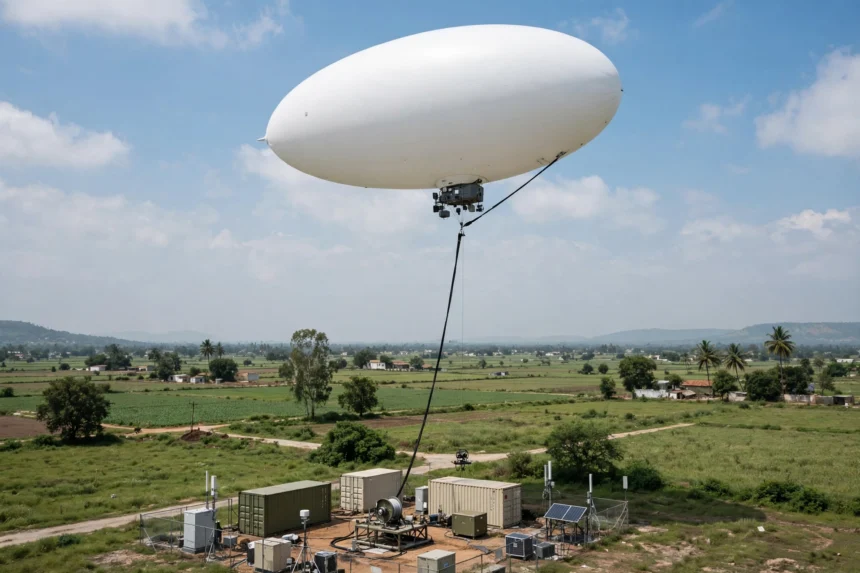
Bengaluru witnessed a quiet first on Thursday. A balloon rose into the sky near Nelamangala town, held its position, came back down and refilled its own lifting gas. Nobody was at the controls at any point. It was the public debut of India’s first autonomous tethered balloon, built by a deep-tech startup incubated at the Indian Institute of Science.
The system comes from Thinking Balloon, a Bengaluru startup incubated at the Foundation for Science Innovation and Development (FSID) at IISc. The team had spent three days, from October 28 to 30, putting the aerostat through its paces at the test site before opening the gates for the public demonstration on November 5.
What makes the flight notable is not the balloon itself. Tethered balloons, or aerostats, have been around for decades. What is new here is the autonomy. The platform launches, holds station, recovers and docks itself, and refills its lifting gas without a human in the loop. During field testing in Bengaluru, it has completed more than 100 autonomous launch-and-recovery cycles.
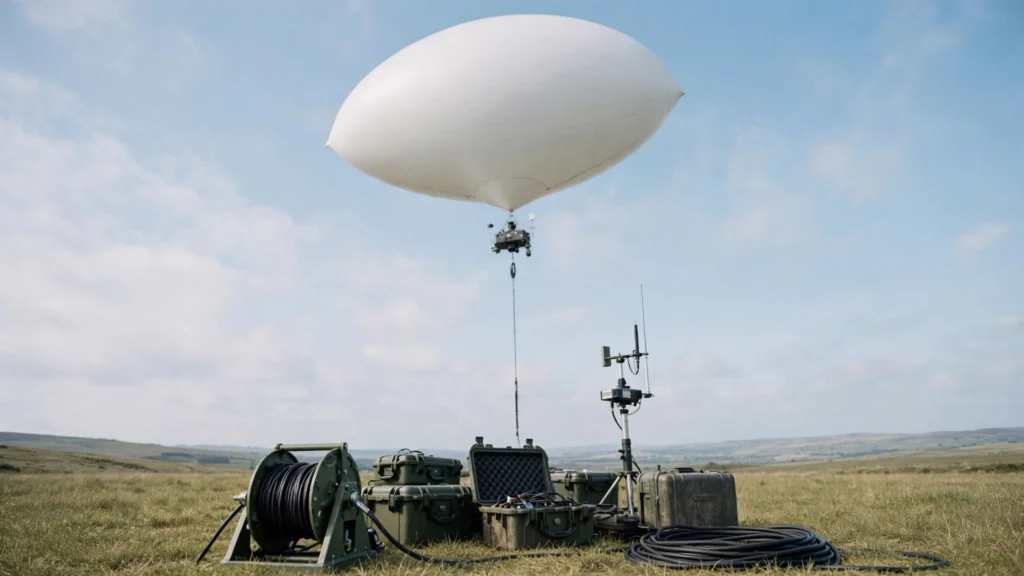
A watchtower that never blinks
The aerostat is built to stay up for months at a stretch, carrying heavy, power-hungry equipment that drones simply cannot lift for long. Radars, cameras and radios ride on the platform, which can hold a payload between one and five kilometres up, with no engines of its own.
That combination of height and endurance is what gives it a job. Low-flying drones are hard for ground radars to spot, because hills, buildings and the curve of the earth get in the way. A sensor parked kilometres above the ground sees over all of that. The same platform can keep radio links alive across hilly or border terrain where ground towers struggle.
India has more than 15,000 kilometres of land borders and over 11,000 kilometres of coastline to watch, and persistent aerial coverage has traditionally been expensive to deploy. A tethered balloon costs a fraction of a crewed aircraft or a satellite pass, and unlike a drone it does not need to land every hour to recharge.
From ports to border posts
The first uses the company talks about are practical rather than futuristic. Port and industrial monitoring comes first, along with work as an aerospace test range. Counter-drone early warning, communications relay and signals intelligence follow.
Rushabh Chalke, co-founder and chief executive of Thinking Balloon, has described the approach as testing in stages and trusting no limit until a test has proved it. The demonstrator now flying is a small aerostat with its launch, recovery and docking station. Flights at several kilometres come later, once each stage has been proven in the field.
The startup, formally Thinking Near Space Private Limited, is based in Bengaluru and builds its systems in the city. Its platform is designed for Indian weather, a detail that matters when a system is expected to sit in the sky through monsoon winds and summer heat for months at a time.
Why it matters now
India’s deep-tech ecosystem has been gathering pace, from space debris removal startups to indigenous AI models launched this week. The autonomous aerostat adds another piece to that picture: hardware that solves a very Indian problem, watching long borders and a long coastline, with technology built at home.
The public flight is only a demonstrator, and the road from a test site near Nelamangala to operational deployment is still long. But 100 autonomous cycles without a human at the controls is a serious start. For a country that has long imported its surveillance aerostats, a home-grown system that launches, watches and lands itself is worth keeping an eye on.
FAQs
What is an autonomous tethered balloon?
It is a balloon held in place by a tether that can launch, hold position, recover and dock itself without a human operator, while carrying sensors such as radars and cameras high above the ground.
Who built India’s first autonomous tethered balloon?
Thinking Balloon, a deep-tech startup incubated at the Foundation for Science Innovation and Development (FSID) at IISc Bengaluru. Its co-founder and CEO is Rushabh Chalke.
How high can the aerostat fly?
The platform is designed to hold a payload between one and five kilometres up. The current demonstrator is a smaller system, with flights at several kilometres planned for later stages.
How long can it stay in the air?
The system is designed to stay up for months, carrying radars, cameras and radios. It has completed more than 100 autonomous launch-and-recovery cycles during field testing in Bengaluru.
What will it be used for?
Port and industrial monitoring first, then defence roles such as spotting low-flying drones early, keeping radio links alive over difficult terrain, and acting as a communications relay.
India’s first self-flying balloon is a small step for a startup and a useful one for the country. The sky above Nelamangala just got a new kind of watchman, and it does not need a pilot.