

For the delivery rider weaving through Hyderabad traffic at midnight, or the cab driver waiting hours for the next ride, work has always come without a safety net. That changed on Saturday, 14 November, when Congress leader Rahul Gandhi launched the Telangana Gig Workers Social Security and Welfare Scheme in Hyderabad, bringing insurance, pension and legal protection to around 4.5 lakh platform workers across the state.
Gandhi, who is the Leader of Opposition in the Lok Sabha, released the rules framed under the Telangana Platform Based Gig Workers (Registration, Social Security and Welfare) Act, 2026, at a gathering of gig workers at Jayabheri grounds in Madhapur. Telangana Chief Minister A Revanth Reddy joined him at the event, after the two rode in a bike rally of gig workers through the city.
The scheme is the first of its kind in India to move from a law on paper to a working system. Telangana passed the gig workers welfare law in March this year and formally launched the Act on 2 June, Telangana State Formation Day, but it could not be implemented until the rules were framed. The 35-page rules released on Saturday complete that process, and the programme now takes full effect.
What gig workers will get
The headline benefits are straightforward. Every registered gig worker in Telangana will get accident insurance of Rs 5 lakh and health insurance of Rs 10 lakh. The scheme also provides for maternity benefits, disablement cover, old age protection and pension, decided by a welfare board set up under the Act.
Perhaps the most important change is money. Platforms will contribute 1 per cent of the value of every delivery and transport transaction to a welfare fund. The contribution will be borne entirely by the aggregator, not the worker, and Gandhi said the money will go directly into workers bank accounts for their future and protection. The rules allow the levy to go up to 2 per cent, but it has been fixed at 1 per cent for now, and the rate can be reviewed through separate notifications.
- Rs 5 lakh accident insurance for every registered gig worker
- Rs 10 lakh health insurance cover
- 1 per cent of every transaction value paid into the welfare fund by platforms
- Pension and maternity benefits through the welfare board
- Wi-Fi enabled rest zones in Hyderabad and other cities across the state
Data rights and protection from sudden sacking
Beyond money, the law gives gig workers something they have long asked for: control over their own work information. Workers will be able to see details of their assignments, completed rides and earnings on their mobile phones, instead of relying on what the app chooses to show them.
The rules also put a check on arbitrary deactivation. Aggregators can terminate a worker only on valid grounds, and the reasons must be given in writing with at least seven days notice. For workers who can lose their livelihood overnight when an account is blocked, that protection matters as much as the insurance.
The state will also set up Wi-Fi enabled rest zones where riders can park their vehicles, rest, sit and sleep, starting in Hyderabad and extending to other cities. A welfare board constituted under the Act will register workers and run the scheme.
A promise from the Bharat Jodo Yatra
Releasing the rules, Gandhi said the legislation was a response to demands gig workers had put to him during his Bharat Jodo Yatra in Telangana in 2023. At the rally, he rode pillion with a gig worker, a gesture that underlined the point he was making: the people who deliver food, parcels and passengers through the day have been working without the protections other workers take for granted.
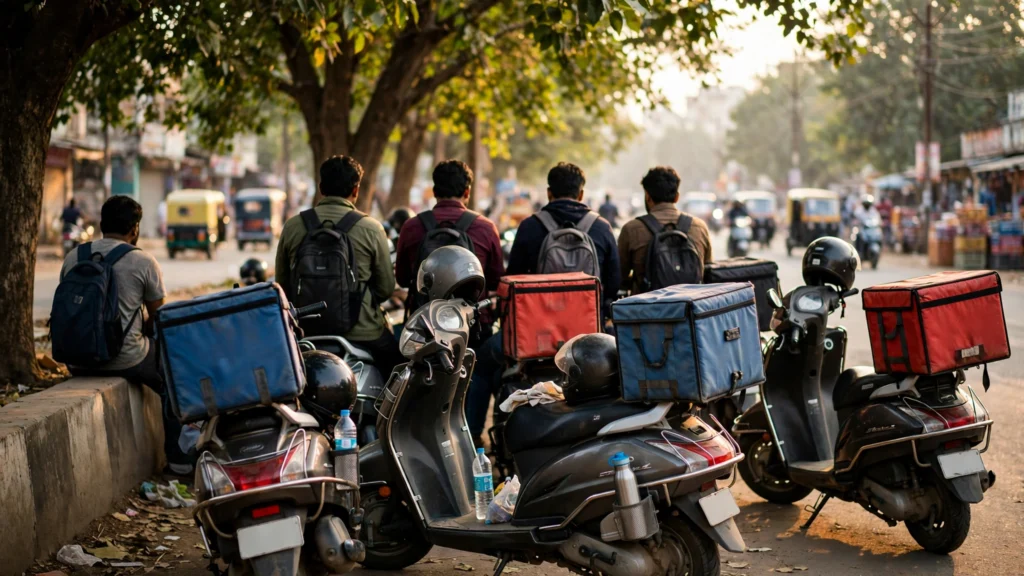
Telangana is home to a large gig workforce, concentrated in Hyderabad, where delivery and ride-hailing apps run at a huge scale. The 4.5 lakh workers covered by the scheme include food delivery executives, cab drivers and workers on service platforms.
What happens next
The immediate task is registration. The welfare board will register gig workers under the Act, after which the insurance and pension benefits can flow. Workers should watch for the registration process announced by the state government and apply through the official channels, not through agents or middlemen asking for money.
Other states will be watching closely. Rajasthan passed a gig workers welfare law in 2023, and Karnataka has moved in the same direction, but Telangana is now the first to put a fully framed set of rules, a funded welfare board and a per-transaction levy into operation together. If the system works in practice, it could become the template for gig worker protection across India.
For now, the message to Telangana gig workers is simple: the law that was passed in March finally has teeth, and the safety net it promises is now real.
FAQs
Who is covered by the Telangana gig workers scheme?
Around 4.5 lakh platform-based gig workers in Telangana, including delivery executives, cab drivers and service workers on aggregator apps, once they register with the welfare board.
What insurance do gig workers get?
Rs 5 lakh accident insurance and Rs 10 lakh health insurance, along with maternity benefits, disablement cover and old age protection.
Who pays for the welfare fund?
Aggregators pay 1 per cent of every transaction value into the fund. The cost is borne by the platform, not the worker, and the money goes directly into workers bank accounts.
Can a platform sack a gig worker without notice?
No. Under the rules, termination is allowed only on valid grounds, with the reasons given in writing and at least seven days notice.
When did the scheme launch?
The rules were released on 14 November 2026 by Rahul Gandhi in Hyderabad, completing the law passed by Telangana in March 2026.
Gig workers in Telangana should register through the official welfare board process once it opens, and check their entitlements on the state government portal.