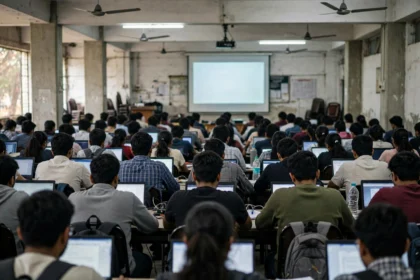
New Delhi is hosting some of the sharpest minds in Indian cybersecurity this week. The third National Conference on Cyber Security, Digital Forensics and Intelligence, NCCDFI 2026, opens on Monday, November 16, at the Dr Ambedkar International Centre, bringing together police officers, defence officials, researchers and technology companies for two days of hard conversations about the threats facing India’s digital future.
Organised by the National Institute of Electronics and Information Technology (NIELIT) under the Ministry of Electronics and Information Technology, the conference carries the theme “Cyber Secure Bharat: Fortifying India’s Digital Future”. It comes at a moment when financial fraud, AI-enabled cyberattacks and increasingly sophisticated digital criminal networks are placing new demands on the country’s investigators.
Who is in the room
The guest list reads like a map of India’s cyber defence establishment. Knowledge partners include the Indian Cyber Crime Coordination Centre (I4C), the Indian Computer Emergency Response Team (CERT-In), Delhi Police, Maharashtra Cyber and the Telangana Cyber Security Bureau. The Military College of Telecommunication Engineering in Mhow, CyberPeace and the Ministry of Skill Development and Entrepreneurship are also associated with the event.
Cybercrime rarely respects state borders. In a financial fraud case, the offender, the victim, the bank accounts and the servers can sit in different states or even different countries, so investigators need help from banks, telecom companies, technology platforms and forensic specialists to trace stolen money and identify suspects. The conference is built to strengthen exactly that coordination.
Ten tracks, from AI security to crypto crime
The programme covers ten thematic areas, including digital evidence, AI security, protection of critical infrastructure, threat intelligence, cryptocurrency investigations, cloud security and the examination of drones and connected devices.
Sessions will also look at quantum computing, autonomous systems, incident response, advanced device and multimedia forensics, cyber law and international cooperation. An industry exhibition running alongside the conference will showcase investigative tools and security technologies, with forensic technology providers Magnet Forensics, MSAB, Oxygen Forensics and Stellar among the participating companies.
Cyber Kushti: 3,093 participants, 10 finalists
The headline event within the conference is Cyber Kushti 2026, a national cybersecurity and artificial intelligence competition that tests something unusual: not just finding vulnerabilities, but judging them. Participants examine assessment material containing machine-generated findings, including deliberately inaccurate or incomplete information, and must identify genuine vulnerabilities, reject incorrect findings and explain their decisions.
The numbers tell the story of its scale:
- 1,031 teams registered, comprising 3,093 participants
- 923 teams shortlisted for Level 1, the Review stage
- 50 teams qualified for Level 2, the Attack stage
- 10 teams reached the final Level 3, the Defend stage, to be held during the Delhi conference

The competition was launched on August 15 by Professor M.M. Tripathi, Director General of NIELIT, in collaboration with the Information Sharing and Analysis Center (ISAC Foundation), under the National Security Database initiative. Tripathi has argued that as automated tools become better at generating security assessments, professionals must develop the judgment to tell which findings are accurate and which problems deserve priority. The final stage runs in controlled environments rather than targeting live public systems.
A platform that began in the Northeast
This is the third edition of the conference, and it has grown quickly. The inaugural edition was organised in Kohima, Nagaland, in 2024 in collaboration with Nagaland Police and the state government’s information technology department. The second edition was held at Gauhati University in Guwahati in November 2025. The Delhi edition expands the platform further, with proposed memoranda of understanding between NIELIT and industry partners to support collaborative research, professional development and institutional cooperation.
The proposed partnerships could help educational institutions align cybersecurity training more closely with practical investigative work.
Why it matters now
For students and cybersecurity professionals, the message from the conference is practical: develop real skills in digital forensics, incident response and AI security, and learn to verify automated findings rather than trusting them blindly. For organisations handling sensitive information, the takeaway is to strengthen incident-response procedures and make sure electronic evidence can be preserved when a cyberattack happens.
India’s digital economy now runs on systems that criminals probe every day. Whether the work done in Delhi this week turns into capabilities that investigators can actually use will be the real test of the conference, but with more than 3,000 participants in its flagship competition alone, the country’s cyber talent pipeline is clearly getting deeper.
FAQs
What is NCCDFI 2026?
The third National Conference on Cyber Security, Digital Forensics and Intelligence, organised by NIELIT under the Ministry of Electronics and Information Technology, held in New Delhi on November 16 and 17, 2026.
Where is the conference being held?
At the Dr Ambedkar International Centre, Janpath, New Delhi.
What is Cyber Kushti 2026?
A national cybersecurity and AI hackathon built around the themes Review, Attack and Defend. It drew 1,031 teams and 3,093 participants, with 10 teams reaching the final round in Delhi.
Which agencies are involved?
Knowledge partners include I4C, CERT-In, Delhi Police, Maharashtra Cyber and the Telangana Cyber Security Bureau, along with defence institutions, researchers and technology companies.
What is the theme of NCCDFI 2026?
“Cyber Secure Bharat: Fortifying India’s Digital Future”, with ten tracks covering AI security, digital forensics, critical infrastructure, threat intelligence and cyber law.
The conference runs through Tuesday, November 17, with technical sessions, panel discussions and the Cyber Kushti final all taking place in the capital.