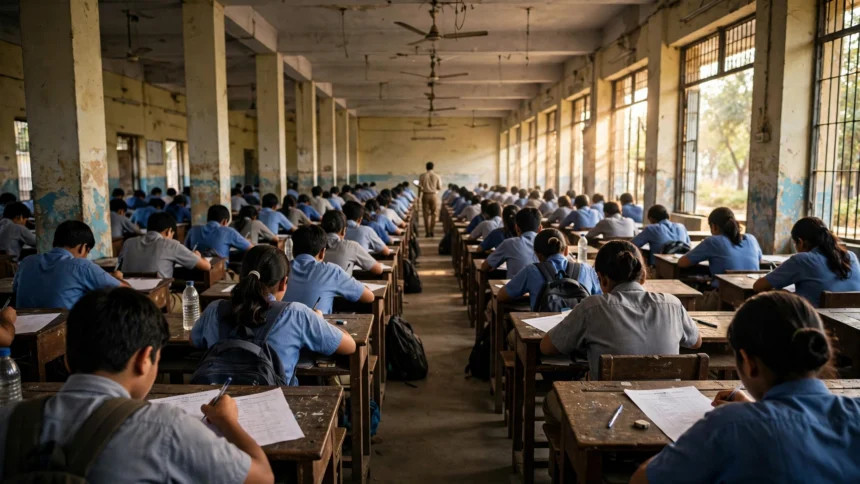
Board exams in India may soon reward understanding far more than memory. The Central Board of Secondary Education (CBSE) is preparing changes to the way Class 10 and 12 students are assessed, with a sharper focus on conceptual understanding, logical thinking and the practical application of knowledge. The move, outlined in a recent circular from the board, could change how lakhs of students prepare for the biggest exams of their school life.
The board has been clear about one thing: no immediate change to the question paper pattern has been announced. What is on the table right now is a direction of travel, and a national discussion before anything is finalised. For students appearing in the 2027 board exams, which begin in February, the message is to keep preparing as before, but to think harder about the why behind every answer.
What CBSE has proposed
Under the proposed approach, students would need to show that they actually understand a subject, rather than reproduce memorised answers. In science, for example, a student may be asked to explain how a principle works in an everyday situation instead of simply writing down its definition. In mathematics, knowing a formula would not be enough on its own; applying it to solve an unfamiliar problem would carry the weight.
The circular says the assessment framework is being aligned with the National Education Policy (NEP) 2020, which has long pushed for a shift away from rote learning towards analytical and logical ability. Education experts have made the same point: practising application-based questions and learning to explain concepts in your own words is becoming as important as covering the syllabus.
This is not a sudden break from the past. Since the 2024-25 academic session, half of every Class 10 and 12 theory paper has already been made up of competency-focused questions, including case-based questions, source-based questions and application-driven multiple choice questions. The latest proposal builds on that foundation rather than starting from scratch.
The December conference in Jammu
The proposed assessment policy will be discussed with school principals and educationists from across the country at CBSE’s 32nd National Conference, scheduled in Jammu on December 17 and 18. The theme of the conference is “Assessment: Globally Oriented, Future-Ready Learners”.
Discussions there will focus on moving beyond conventional marks-based evaluation, and on finding ways to assess learning ability, innovative thinking and practical understanding. The conference will also look at evaluation practices, including guidance for teachers on assessing answer sheets. Any concrete change to the examination pattern is likely to emerge only after these deliberations.
Why it matters
For years, board exam preparation in India has rewarded the student who could reproduce the textbook most faithfully. That system produced high scores, but it also produced a familiar complaint from colleges and employers: students who scored 95 per cent yet struggled to apply what they had learnt. CBSE’s direction of travel is an attempt to close that gap at the source, in the exam hall itself.
The practical effect, if the reforms go through, would be felt first by students and then by schools. Coaching that drills model answers would lose value, while classroom teaching that builds concepts would gain it. Students who understand a topic deeply would find the new questions easier than students who only memorised them, which is exactly the reversal the board appears to want.
There is a caution here too. A shift towards application-based questions only works if teachers are trained to frame and mark them fairly, and if students get enough practice material before the change lands. The December conference’s focus on evaluation practices suggests the board knows this, and the fact that no implementation date has been announced yet gives schools time to prepare rather than scramble.

What students should do now
- Practise application-based questions: Use case-based and source-based questions from NCERT exemplars and previous papers, not just short and long answers.
- Explain concepts aloud: If you cannot explain a topic in your own words to a friend or family member, you have probably only memorised it.
- Connect chapters to real life: For science and maths especially, ask where each principle shows up outside the textbook.
- Do not change your plan for 2027: The board has announced no change to the current question pattern, so keep preparing on the existing pattern while building understanding alongside.
- Watch for the December conference: Any firm decision on the new assessment approach is expected to follow the Jammu conference on December 17 and 18.
FAQs
Has CBSE changed the Class 10 and 12 exam pattern?
No. The board has outlined a proposed direction in a circular and will discuss it at its national conference in December. No immediate change to the question paper pattern has been announced.
When will the new assessment system apply?
CBSE has not announced an implementation date. The 2027 board exams, which begin in February, will follow the existing pattern.
What is competency-based assessment?
It tests whether a student understands and can apply what they have learnt, through case-based questions, source-based questions and application-driven MCQs, rather than testing memory alone.
How much of the current paper is already competency-based?
Since the 2024-25 session, 50 per cent of Class 10 and 12 theory papers consists of competency-focused questions, with 20 per cent MCQs and 30 per cent short and long answers.
Where can students check official updates?
All official announcements come through the CBSE website, cbse.gov.in, and circulars issued to affiliated schools. Students should rely on those rather than viral posts on social media.
CBSE’s message to students is becoming hard to miss: understanding the subject matters more than memorising it. The December conference will show how far, and how fast, the board intends to go.