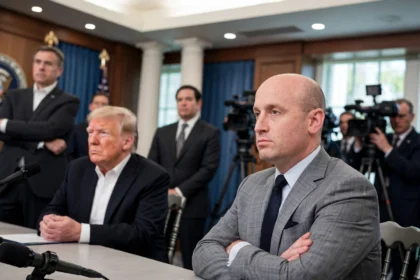
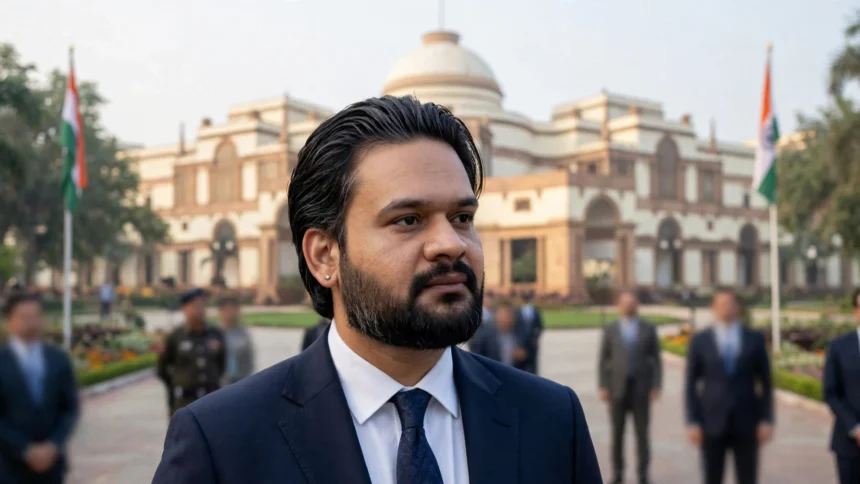
Nepal Prime Minister Balendra Shah meets Prime Minister Narendra Modi in New Delhi today, in the first in-person meeting between the two leaders since Shah took office in March this year. The talks at Hyderabad House will cover energy, trade and connectivity, along with a $2-billion economic assistance package that Kathmandu has sought from New Delhi.
Shah, 35, arrived in New Delhi on Sunday afternoon and was received by Minister of State for Commerce and Industry Jitin Prasada. External Affairs Minister S. Jaishankar called on him on Sunday evening. The visit, from November 22 to 23, is Shah’s first bilateral foreign visit since assuming office on March 27, 2026.
Monday’s schedule is packed: a ceremonial welcome at Rashtrapati Bhavan, respects to Mahatma Gandhi at Rajghat, and a call on President Droupadi Murmu, before a 30-minute one-on-one with Modi. Delegation-level talks, an exchange of memoranda, a joint press conference and an official luncheon follow. Shah, who leads a 34-member delegation, departs on Monday evening.
A first meeting eight months in the making
The meeting has been awaited since Shah took office. He is among the youngest prime ministers in Nepal’s recent history, and his government came to power at a moment of deep political churn in Kathmandu. That his first foreign engagement as prime minister is with India sends its own signal about where the new government wants the relationship to go.
The visit also follows a rocky patch. In a late-night social media post in November 2025, Shah had used profanity about both India and China. New Delhi chose engagement over escalation, and Modi extended the invitation for the state visit. That the two leaders are meeting within eight months of Shah taking office says something about how both capitals want to move past the episode.
For India, the stakes are straightforward. Nepal shares an open border with five Indian states, deep cultural ties, and hydropower potential that matters to India’s energy future. For Nepal, India is its largest trade partner and the transit route for almost everything it imports and exports.
What is on the table today
Energy is expected to dominate the talks. Both countries want to expand cross-border electricity trade and hydropower development. Nepal has surplus hydropower in the monsoon months, and India has the demand to absorb it. The question is how far and how fast that trade can grow.
Trade and infrastructure are also high on the agenda, including the proposed Raxaul-Kathmandu railway link, which the two sides have been exploring for years. The railway would connect Nepal’s capital region directly to India’s rail network.
Then there is the money. Kathmandu has proposed a $2-billion economic assistance package from New Delhi, according to reports ahead of the visit. If agreed, it would be among the largest Indian assistance commitments to Nepal, covering development partnership, post-disaster reconstruction and infrastructure.
Aviation is the other big item. Nepal has long asked India to allow three additional air entry routes through Indian airspace, using Janakpur, Bhairahawa and Nepalgunj as entry points, and to make the L626 air corridor bidirectional. New Delhi has sought reciprocal access for flights to and from Bagdogra in West Bengal.
Trains, bridges and a military exercise
The visit will produce visible outcomes as well. The two prime ministers will virtually flag off the Saryu-Kamala Express, a new weekly train service connecting Ayodhya Cantt in Uttar Pradesh with Janakpur Dham in Nepal. The train links two cities with deep religious significance, Ayodhya, revered as the birthplace of Ram, and Janakpur, revered as the birthplace of Sita.
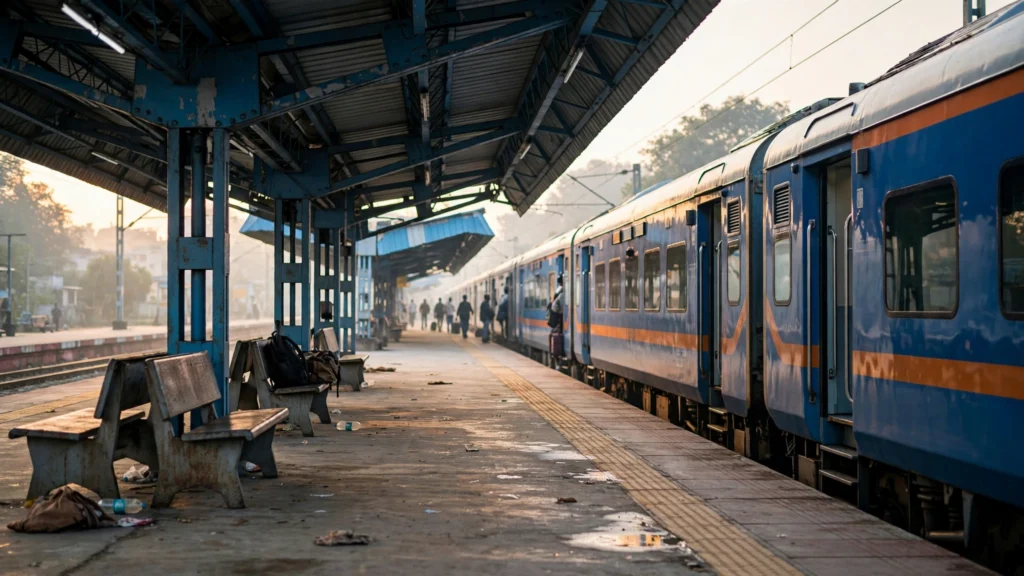
They will also jointly inaugurate the Charchum International Motor Bridge over the Kali river in Uttarakhand’s Pithoragarh district. The defence relationship is moving in parallel, with the armies of the two countries set to hold the 20th edition of their joint military exercise, Suryakiran.
Why it matters
This visit matters because it is the first real test of the new government in Kathmandu, and of Delhi’s willingness to work with it. Shah arrives with a mandate for change at home and a short window to show results. Modi has invested heavily in the neighbourhood-first approach, and a stable, friendly Nepal is central to it.
The energy story is the most concrete part of the reset. Nepal’s rivers can generate far more power than the country consumes, and India is the only realistic buyer at scale. Every megawatt that flows across the border earns Nepal revenue and gives both governments a shared interest that survives political change.
The air routes matter for a different reason. Without entry corridors through Indian airspace, flights into Nepal’s airports face long detours that make routes unviable and fares high. For a country that depends on tourism and on workers flying in and out, that is not a minor inconvenience. It is a daily tax on ordinary Nepalis, and a deal would be felt by travellers long before it shows up in any joint statement.
What happens next
The joint press conference on Monday afternoon will be the first indication of what was agreed. Watch for specifics on the assistance package, any announcement on air routes, and the memoranda exchanged. Vague language would suggest the hard decisions were deferred.
After Shah returns to Kathmandu, the files move to officials on both sides. The train will begin its weekly schedule, the bridge will open to traffic, and the exercise will go ahead. The bigger questions will be judged by what gets built and signed in the coming months.
FAQs
Who is Balendra Shah?
Balendra Shah, known as Balen Shah, is the 35-year-old prime minister of Nepal. He took office on March 27, 2026, and this is his first bilateral foreign visit as prime minister.
Why is this visit significant?
It is the first in-person meeting between Shah and Prime Minister Narendra Modi, after a rocky patch in ties. The agenda covers energy, trade, connectivity and a proposed $2-billion assistance package.
What is the Saryu-Kamala Express?
A new weekly train service connecting Ayodhya Cantt in Uttar Pradesh with Janakpur Dham in Nepal. The two prime ministers will flag it off virtually during the visit.
What is the $2-billion package about?
Kathmandu has proposed a $2-billion economic assistance package from New Delhi, covering development partnership, reconstruction and infrastructure. It is on the agenda for Monday’s talks.
What are Nepal’s air route demands?
Nepal wants three new air entry routes through Indian airspace, via Janakpur, Bhairahawa and Nepalgunj, and wants the L626 corridor made bidirectional.
The meeting is the headline, but the real story will be written in the months that follow, in power lines, railway tracks and flight paths.