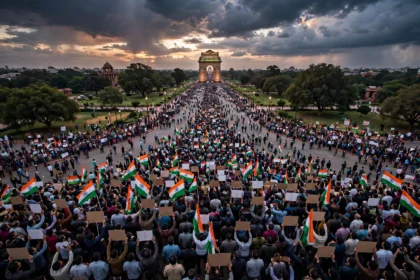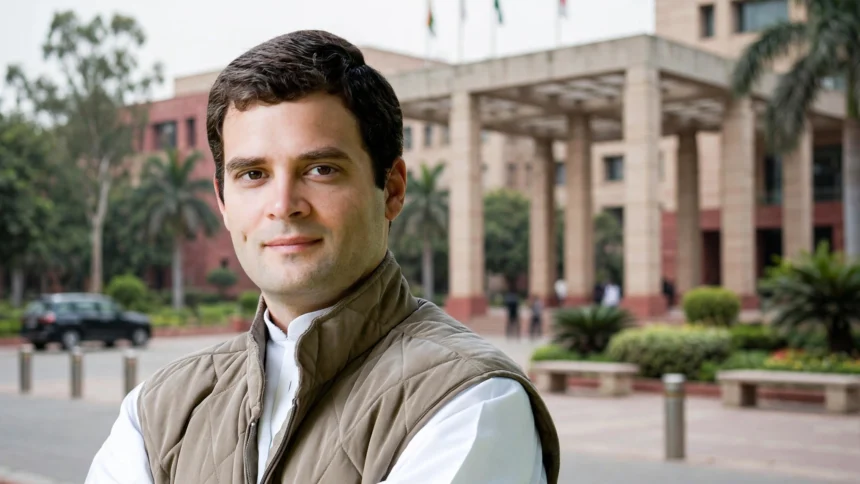
The Indian Youth Congress has taken Meta to the Delhi High Court, accusing the tech giant of using an automated system that blocks political posts carrying the name or photograph of Leader of Opposition Rahul Gandhi. The petition, filed on November 25, turns a week of street protests into a courtroom battle over online political speech ahead of state elections due early next year.
Filed by Youth Congress national secretary Manu Jain, it names Meta and the Union government as respondents and asks the court to strike down the automated-takedown rule, restore the posts, and force Meta to disclose its blocking criteria.
What the petition says
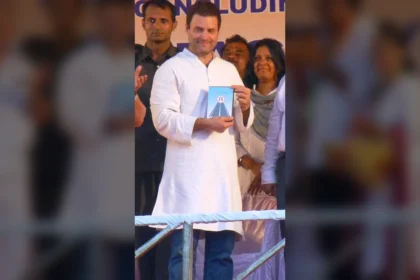
Congress workers received notices between September 29 and November 23 that their posts had been made unavailable in India. The restricted posts were not abusive or unlawful, the petition says. They included a wedding invitation extended to Rahul Gandhi, birthday greetings between party workers, tributes to former Prime Minister Rajiv Gandhi, photographs of activists standing beside Gandhi, and updates on his University of Chicago lecture.
One post about the Chicago lecture was restricted on November 19 and restored later the same day, a reversal the petition cites as proof the filters lack clear logic. “The one feature common to all of them is the photograph or the name of Rahul Gandhi,” the plea states, arguing that the automated tool appears to treat his name and image as keywords.
The petition also challenges Rule 4(4) of the Information Technology Rules, 2021, as amended in February 2026, along with advisories issued by the electronics and IT ministry on October 8 and 10. The February amendment requires large platforms to use automated tools to block any post “exactly identical” to content already removed under a court order or government notice. Before that change, platforms were only asked to “endeavour” to use such tools.
The numbers behind the row
The scale of the restrictions is what has turned a party complaint into a national debate. Meta restricted more than 5.4 million posts across Facebook and Instagram in India in the first half of 2026, up from about 70,000 in all of 2025, according to Meta’s transparency disclosures cited by Reuters. That is roughly a 77-fold jump within a year.
Meta says it restricts only “100% identical copies of content, at scale and in country” to comply with the amended rules, and that it is still testing and refining the system. Facebook has about 400 million users in India and Instagram about 515 million, according to research firm DataReportal, making India Meta’s biggest market. Congress argues the system “distorts the level playing field” needed for a free and fair election.

What Meta and the government say
Meta declined to comment on the lawsuit. At a closed-door meeting with Congress leaders earlier this week, its executives said the company is neutral towards all political parties and bound by local laws. Meta said some removals were linked to its AI-generated content policies, while Congress pointed to AI-generated BJP posts that stayed up. The meeting ended in a stalemate.
The government maintains such laws are essential to curb illegal and harmful content online in a market of more than 1.1 billion internet users. The IT and home ministries, named as co-respondents, did not immediately respond to requests for comment. Congress has also noted that India is one of seven markets where Meta does not tell users which government authority sought a restriction.
Why it matters
This case is about far more than one party’s posts. If an automated filter can quietly remove a birthday greeting or a wedding invitation simply because it carries a public figure’s photograph, then the same system can shape what millions of voters see before an election, without any order being shown to the person affected. That is the heart of the Congress argument: the rule was written for exact copies of already-blocked content, but in practice it is catching ordinary political speech.
There is also a precedent question. Elon Musk’s X is already fighting the government in court over its own content-removal system. If the Delhi High Court agrees that Rule 4(4) goes beyond what the IT Act allows, the obligations of every large platform in India would change overnight. If it upholds the rule, automated filtering at this scale becomes settled law. For ordinary users, the outcome decides a practical question: when a post disappears, will the platform have to say who ordered it removed and why, or can a machine make that call silently?
What happens next
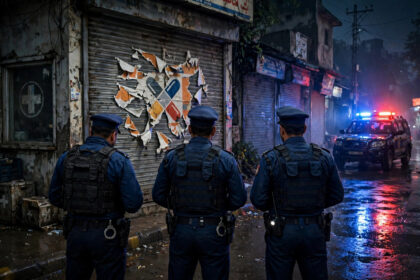
Hearings are expected to begin in the coming days, when the court will decide whether to issue notice to Meta and the government. Meanwhile, Youth Congress protests outside Meta offices in several cities show the party will keep up the pressure in the streets as well as in court.
FAQs
Who has sued Meta?
The Indian Youth Congress, through national secretary Manu Jain, on November 25, 2026.
What does the petition challenge?
Meta’s automated blocking of posts carrying Rahul Gandhi’s name or photo, and Rule 4(4) of the IT Rules, 2021.
How many posts has Meta restricted in India?
More than 5.4 million across Facebook and Instagram in the first half of 2026, up from about 70,000 in all of 2025.
What happens next?
Hearings are expected to begin in the coming days, when the court will decide on issuing notice to Meta and the government.