India now has a homegrown artificial intelligence model that speaks the country’s languages. The Ministry of Electronics and Information Technology (MeitY) has launched Chariot-1, a suite of foundation models built entirely from scratch in India under the IndiaAI Mission, with support for English and 10 Indian languages.
MeitY Secretary S. Krishnan unveiled the models at Bharat Mandapam in New Delhi, calling the launch a significant step for the country’s technology ecosystem. Chariot Artificial Intelligence Pvt. Ltd., the startup behind the models, is among the first four teams selected under the IndiaAI Mission to build sovereign foundation models.
What Chariot-1 actually is
Chariot-1 is not a single model but a suite. At its core is Chariot-1 LLM, an 11-billion-parameter mixture-of-experts language model with four billion active parameters per token. It comes in three sizes, 10.7 billion, 1.7 billion and 745 million parameters, so it can run in different computing environments, from large data centres to lighter deployments.
Alongside it sits Chariot-1 TTS, a text-to-speech model that can generate speech in English and 10 Indian languages: Hindi, Bengali, Marathi, Tamil, Telugu, Kannada, Malayalam, Gujarati, Punjabi and Odia. The speech model recorded over 97 percent verbalisation accuracy on the Async TTS Pronunciation Benchmark, a test built from 1,029 real-world sentences and 2,251 instances of non-standard text across 42 categories.
The model also combines text generation, text-to-speech and automatic speech recognition in a single architecture, according to Chariot co-founder Parth Sarthi, reducing the need for separate specialised models for each task.
Three ideas that make it different
The Chariot team built three research innovations into the models, each aimed at the practical problem of making AI work well in Indian languages.
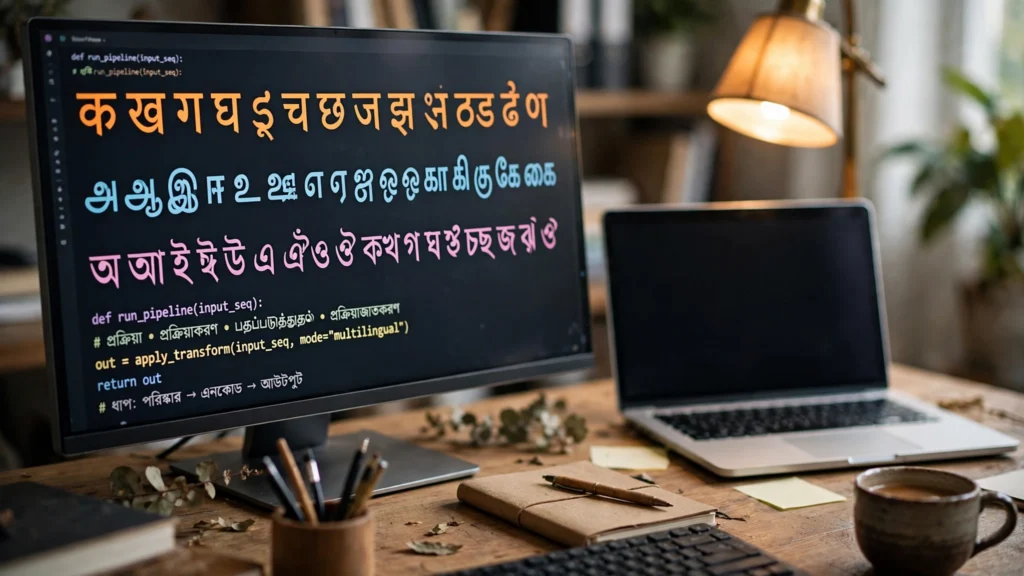
- IndicShift: an open-source technique that creates a shared alphabet for Indian scripts, letting the model use similarities across languages instead of treating each script separately. It cuts the tokens needed to process Indian text by about 2.5 times.
- Nested Training: a method that trains all three model sizes in a single run with one set of weights, cutting training time by 62 percent.
- Mixture of Vocabularies: a way of splitting the model’s vocabulary into 11 groups and scoring only the relevant group when choosing a word, making training 38 percent faster.
These are efficiency gains, not just research curiosities. Training large models is expensive, and for Indian languages the cost has often been the reason global models treat them as an afterthought. Chariot-1 is built around the opposite assumption: that Indian languages are the starting point.
Why it matters
Most Indians do not use the internet in English. Yet the most capable AI models in the world are trained overwhelmingly on English text, and Indian languages have long been an add-on, handled through translation layers that lose nuance. A foundation model pre-trained from scratch with Indian languages at its centre changes that equation in three concrete ways.
First, it gives Indian developers and government services a base model they can build on without depending on a foreign provider’s roadmap or pricing. That matters for services in health, education and governance, where data often cannot leave the country and where a model that understands a farmer’s question in Marathi or a student’s query in Odia is genuinely more useful than one that needs English as an intermediary.
Second, the efficiency numbers point to a cheaper path. If IndicShift really does cut token use for Indian text by 2.5 times, running AI services in Indian languages becomes materially cheaper, which is what decides whether a small startup or a state government can afford to deploy them at scale.
Third, the launch comes at a moment when the IndiaAI Mission itself is under scrutiny. The government this week said it found no misuse of IndiaAI support by Sarvam, another mission-backed startup, after questions were raised about it hosting Chinese-developed models on its commercial platform. Chariot-1 arriving as a from-scratch, India-trained model gives the mission a clean demonstration of what the Rs 10,370-crore programme was set up to produce.
The honest caveat is that a launch is not adoption. Chariot-1 will be judged on whether developers actually build with it, whether its accuracy holds up outside benchmark tests, and whether the government and industry put it into real services. MeitY has also said its AI regulation papers are in the final stages and will be released shortly, which will shape the rules these models operate under.
What happens next
The IndiaAI Mission was designed to find and support Indian talent capable of building advanced AI at home, and Chariot-1 is one of its first visible results. The models are now out in the open, and the next test is practical: pilots in government services, adoption by Indian developers, and independent evaluation of how well the models handle the languages they claim to serve.
For readers, the change will be invisible at first and then obvious: voice assistants, chatbots and government helplines that understand Indian languages properly, instead of translating them badly. That is the promise Chariot-1 has to deliver on.
FAQs
What is Chariot-1?
Chariot-1 is a suite of AI foundation models developed in India by Chariot Artificial Intelligence under the IndiaAI Mission. It includes a large language model and a text-to-speech model, both pre-trained from scratch in India.
How many languages does Chariot-1 support?
The models work in English and 10 Indian languages: Hindi, Bengali, Marathi, Tamil, Telugu, Kannada, Malayalam, Gujarati, Punjabi and Odia.
Who launched Chariot-1?
MeitY Secretary S. Krishnan launched the models at Bharat Mandapam in New Delhi. Chariot AI is among the first four teams selected under the IndiaAI Mission to build sovereign foundation models.
What makes Chariot-1 different from other AI models?
It was trained from scratch in India with Indian languages as the focus, and it uses three homegrown innovations, IndicShift, Nested Training and Mixture of Vocabularies, to make training and processing Indian text faster and cheaper.
Is Chariot-1 available for developers to use?
The models have been unveiled under the IndiaAI Mission. Details of public access and deployment will follow as the mission and the company roll them out.
India’s AI story has so far been mostly about using other countries’ models. Chariot-1 is an attempt to write a different chapter, in India’s own languages.