


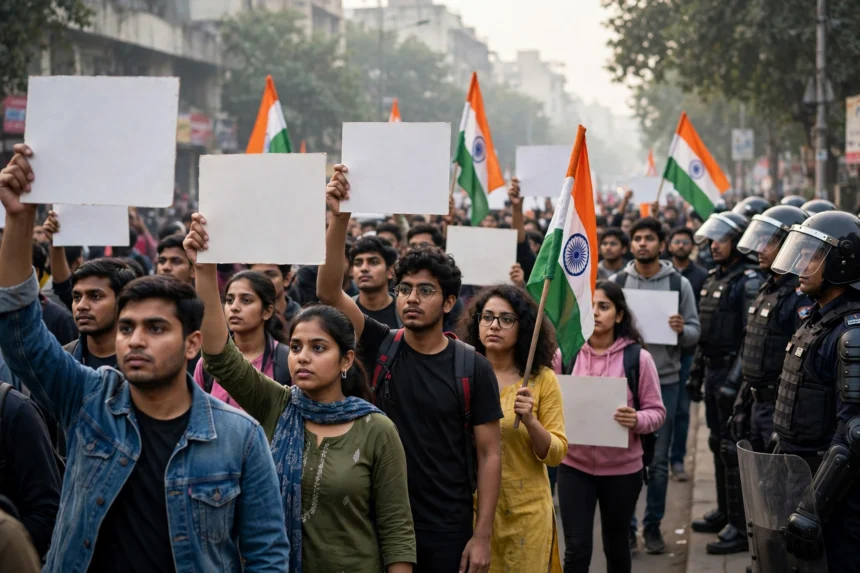
New Delhi woke up to a lockdown-like atmosphere on Saturday as thousands of protesters headed for Jantar Mantar, demanding the resignation of Chief Election Commissioner Gyanesh Kumar over alleged irregularities in the Special Intensive Revision (SIR) of voter rolls. The rally, called by the youth-led Cockroach Janata Party (CJP) and backed by a clutch of opposition parties, has turned the capital into the centre of a fresh storm over the credibility of India’s electoral process.
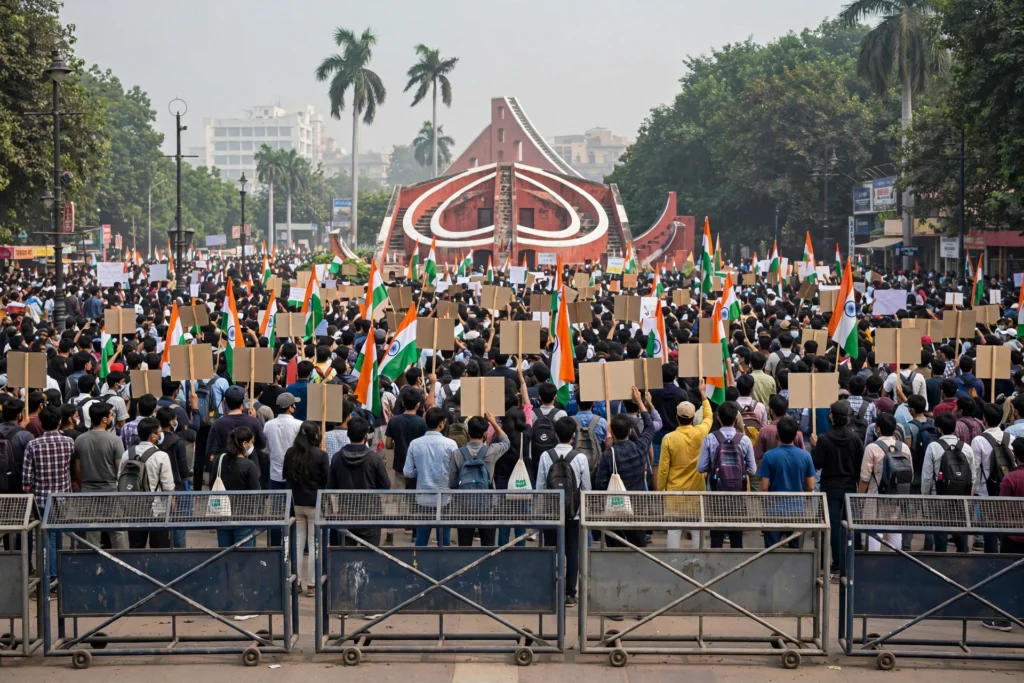
By early morning, multiple layers of yellow metal barricades had come up on roads leading to Jantar Mantar, the city’s designated protest site. Delhi Police deployed thousands of personnel and paramilitary troops across the capital, tightened security at the airport, installed spike strips near Mohan Estate and restricted metro movement. Officials said rallies at Jantar Mantar were not authorised this weekend, citing security and procedural requirements.
What the protesters are demanding
The demonstrators have laid out a five-point charter. They want the CEC to step down, the SIR process to be scrapped, state elections allegedly conducted through irregular rolls to be cancelled, the Chief Justice of India to be involved in selecting the next election chief, and a return to ballot papers across the country.
“The CJP protest is to save democracy,” AAP Rajya Sabha MP Sanjay Singh said on Friday, clarifying that the march is being organised by the youth group and not by his party, even as AAP members joined the mobilisation. Singh said his party had also participated in the group’s October 2 protest and would support the nationwide agitation planned for October 10.
The agitation is the culmination of weeks of opposition mobilisation after a newspaper investigation last month alleged misconduct during the nationwide voter-roll revision. The Election Commission of India has rejected those charges, saying the SIR was meant to remove duplicate and ineligible names. Critics counter that the exercise risks disenfranchising genuine voters to the advantage of the ruling BJP, a charge the government denies.
Rahul Gandhi ups the ante
Leader of Opposition Rahul Gandhi weighed in late Thursday with a sharp post on X, writing that “Gyanesh Kumar will go, this government will go, and then the repair of democracy will begin.” Addressing INDIA bloc leaders, Gandhi alleged that millions of people were affected by wrongful additions and deletions in electoral rolls across Haryana, Maharashtra, Karnataka, Madhya Pradesh and Gujarat, claiming he had been shown “black and white proof” of the manipulation.
Notably, the Congress is not formally joining the Jantar Mantar demonstration. Gandhi is scheduled to attend a “Chhatron ki Goonj” event in Chennai on Saturday, and it remains unclear whether the Congress or Akhilesh Yadav’s Samajwadi Party will back the agitation at all. The Left and AAP, along with West Bengal Chief Minister Mamata Banerjee, have come forward in support.
Why this protest is different
Unlike earlier rounds of opposition criticism that played out through petitions and commission hearings, Saturday’s mobilisation brings the SIR battle squarely onto the streets. Analysts note three distinctive features:
- A leaderless, youth-driven base. Students and young voters form the core of the CJP movement, which already forced the education minister’s resignation in July after an examination scandal.
- An unlikely political mix. Regional parties, the Left and AAP are aligning with a street movement the establishment admits it is unsure how to engage with.
- A law-and-order response so far. The government’s answer has come largely through prohibitory orders, barricades and detentions, rather than political dialogue.
Samajwadi Party chief Akhilesh Yadav, criticising the curbs, posted that attempts to halt the march would backfire. “Jantar-Mantar is no longer just a place’s name; it has become a symbol of a new consciousness and awakening,” he wrote, adding that young people would gather in Delhi regardless of the hurdles.
Detentions and disruptions
Live updates from the scene reported that CJP founder Abhijeet Dipke and fellow organisers were detained at Delhi airport ahead of the protest. Police action also swept up dozens of others, with reports of more than 200 detentions through the morning. Dipke, posting on X, said the shutdown of the capital was “not a sign of strength, but of a leader terrified of his own people.”
Commuters felt the ripple effects early. Train cancellations, metro station restrictions, the closure of retail liquor shops and heavy police presence disrupted movement across large parts of the capital, raising concerns about access to hospitals, workplaces and the airport.
What happens next
The Election Commission has so far stood its ground, insisting the SIR followed due process. But with the SIR debate now a citizenship and trust issue in the public mind, observers say a purely security-driven response risks deepening the confrontation. The coming days will test whether the government opens a political channel, whether the opposition’s uneasy unity holds, and whether today’s show of street strength translates into sustained pressure on the poll body.
For now, all eyes are on Jantar Mantar, where a protest that began as a demand about voter lists has become the biggest test yet of how India handles dissent over its own democratic machinery.
FAQs
Why are protesters demanding the CEC’s resignation?
They allege large-scale irregularities in the Special Intensive Revision of voter rolls and hold Chief Election Commissioner Gyanesh Kumar responsible for what they call a non-transparent, non-consensual exercise.
What is the SIR of voter rolls?
The Special Intensive Revision is an Election Commission exercise to update electoral rolls by adding new eligible voters and removing duplicate or ineligible entries. The poll body says it is routine and lawful; critics allege it risks disenfranchising genuine voters.
Which parties are backing the October 10 protest?
The Left, AAP and Mamata Banerjee have extended support to the CJP’s protest. The Congress and Samajwadi Party have criticised the government’s response but it is unclear whether they will formally join the demonstration.
Has Delhi Police allowed the Jantar Mantar rally?
No. Police have not authorised rallies at the site this weekend, have enforced prohibitory orders in the New Delhi area and have urged people to follow the restrictions.
What are the protesters’ key demands?
The CEC’s resignation, scrapping of the SIR, cancellation of state elections allegedly held on flawed rolls, involvement of the Chief Justice of India in the next CEC’s selection, and elections through ballot papers.
Stay tuned for live updates as the situation develops through the day.