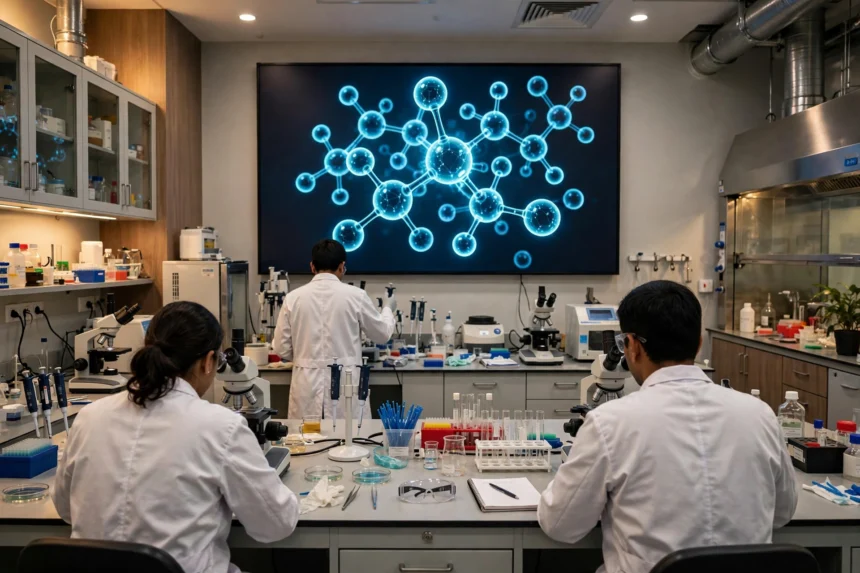
New Delhi: The government has placed a major bet on artificial intelligence as the future of drug discovery. In an announcement made on Monday, the Technology Development Board (TDB) confirmed Rs 86 crore in financial support for Peptris Technologies, a Bengaluru-based company whose AI platform has already identified four promising new drug candidates.
The funding, cleared under the Research, Development and Innovation (RDI) Fund, will power a three-year programme called VIGOR: Advancing AI-Discovered Molecules from Bench to Clinic. With a total project cost of Rs 172 crore, the initiative aims to push machine-designed molecules closer to clinical trials for conditions including cancer, hair loss, neuropathy and Duchenne muscular dystrophy.
What the VIGOR project plans to do
Finding a new drug the traditional way is famously slow and expensive. A molecule can take a decade to move from a lab notebook to a pharmacy shelf, and the vast majority never make it. Peptris is trying to change that arithmetic with algorithms that sift through massive chemical and biological datasets to spot candidates humans might never find on their own.
Under VIGOR, the company will take four AI-discovered molecules through the long grind of pre-clinical development: lab testing, safety studies and the careful regulatory groundwork that must happen before any drug can be tested in people. The Technology Development Board, which operates under the Department of Science and Technology, has signed a formal agreement with the company to back this work.
The four target conditions say a lot about where the opportunity lies. Cancer needs no introduction. Duchenne muscular dystrophy is a rare, devastating genetic disorder with few treatment options. Neuropathy, or nerve damage, affects millions of Indians, many of them living with diabetes. And hair loss, while less serious medically, is a multi-billion-rupee market where safe new options are thin on the ground.
Why this announcement matters
India has long been called the pharmacy of the world. Its manufacturers supply affordable generic medicines to more than 200 countries, and Indian vaccines reached arms across the globe during the pandemic. But manufacturing someone else’s molecule is a very different business from inventing your own.
That is the gap this funding tries to close. Despite its generics muscle, India accounts for a small share of truly novel drugs discovered anywhere in the world. The bet behind VIGOR is that AI can compress the riskiest, most expensive stage of the process, the part where researchers guess which molecules might work, and in doing so give Indian companies a genuine shot at owning the next generation of medicines.
- The money: Rs 86 crore from the Technology Development Board under the RDI Fund.
- The project: VIGOR, a three-year programme with a total budget of Rs 172 crore.
- The company: Peptris Technologies, an AI-driven drug discovery firm.
- The targets: Four drug candidates for cancer, hair loss, neuropathy and Duchenne muscular dystrophy.
- The goal: Move AI-discovered molecules from the lab toward clinical trials.
AI is reshaping how medicines get made
This is not happening in isolation. Around the world, pharmaceutical giants and startups alike have been pouring money into machine-learning platforms that predict how molecules behave, flag toxic compounds early, and even design drugs from scratch. The first AI-designed molecules are already entering human trials globally, and the results of those early studies are being watched closely by everyone in the industry.
For India, the timing is worth noting. The country has deep strengths in both software engineering and pharmaceutical manufacturing, a combination few other nations can match. If AI can bridge the discovery gap, Indian firms could move from making affordable copies of Western drugs to selling original medicines of their own, with patent-protected pricing to match.
That shift would also matter for patients. Treatments invented and developed in India tend to reach Indian patients faster and cheaper than imported ones, and for rare conditions like Duchenne muscular dystrophy, where global development pipelines are thin, homegrown research can be the only real hope.
What happens next
The funding clears the runway, but the hard part is just beginning. Pre-clinical development is a careful, unforgiving process, and most candidate molecules still fail before they ever reach a human trial. Three years is a realistic window to find out whether these four molecules have the makings of real medicines.
The government will be watching closely too. If VIGOR delivers even one molecule into clinical development, it would be a powerful proof of concept for the RDI Fund and a signal to other startups that AI drug discovery is worth pursuing in India. Watch this space: the next update will come when the first candidates move toward trial applications.
FAQs
What is the VIGOR project?
VIGOR stands for Advancing AI-Discovered Molecules from Bench to Clinic. It is a three-year, Rs 172 crore programme by Peptris Technologies to develop four AI-discovered drug candidates, with Rs 86 crore of support from the Technology Development Board.
Which diseases are the drug candidates aimed at?
The four candidates target cancer, hair loss, neuropathy and Duchenne muscular dystrophy, a rare genetic disorder.
What is the RDI Fund?
The Research, Development and Innovation Fund is a government mechanism to support high-risk, high-reward research and deep-tech innovation in India, administered with the Technology Development Board under the Department of Science and Technology.
When could these drugs reach patients?
Not soon. The molecules are still at the pre-clinical stage, and drug development typically takes many years, with most candidates failing along the way. The three-year programme aims to move them closer to clinical trials.
Why does AI drug discovery matter for India?
India leads the world in generic medicines but invents few original drugs. AI could cut the time and cost of the riskiest stage, discovery, helping Indian companies create novel medicines of their own.
Stay with Informeia for updates on Indian healthcare, science and the technologies shaping tomorrow.