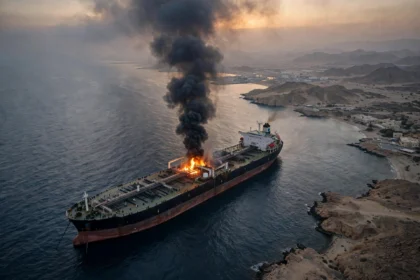
For the first time, the war between Yemen’s Houthis and Saudi Arabia has reached the world’s most valuable company. Late on Tuesday night, a ballistic missile struck Saudi Aramco’s corporate headquarters in Dhahran, setting its upper floors ablaze.
- A week of escalation
- Riyadh hits back
- Oil at $100 and what it means for India
- What happens next
- Frequently asked questions
- Did the Houthi attack damage Aramco’s oil production?
- How many people died in the recent Houthi attacks on Saudi Arabia?
- Why are the Houthis attacking Saudi Arabia now?
- Will this affect petrol and diesel prices in India?
Saudi Arabia’s energy ministry confirmed the attack on Wednesday morning, describing the fire as “limited” with no injuries. But sources told Reuters a graver story: the fire began on the ninth floor of the south wing and spread between the sixth and tenth floors, gutting the floors where CEO Amin Nasser keeps his office. Ceilings caved in, windows blew out, and the fire burned into the early hours of Wednesday.
Operations continued through the night, though some employees worked from home. The site hosts a major control centre overseeing Aramco’s web of oil rigs, pipelines, refineries and export terminals. This is the first time the corporate headquarters has been hit: not a remote pipeline, but the boardroom of global oil.
A week of escalation
The Dhahran strike did not come out of nowhere. For a week, Yemen’s Iran-allied Houthis have fired ballistic missiles and drones at Saudi sites, retaliating for the kingdom’s backing of government forces in Yemen’s reignited civil war.
The deadliest strike hit Riyadh’s King Khalid International Airport on Saturday, killing 13 people and wounding more than 300: the deadliest attack on Saudi soil in a decade. Among the dead was an Indian national, one of eleven Indians hurt in the blast, who died of his wounds on Sunday night. The airport was struck four times in a week.
The Saudi-led coalition says it has intercepted missiles and drones over Riyadh, the southern region and Dhahran, though shrapnel fell into a residential area. The Saudi cabinet has warned the Houthis will “bear the consequences” of what it called heinous attacks on civilian sites.
Riyadh hits back
The response came fast: coalition jets struck an oil site in Houthi-held Sanaa, hitting the Al Sabah facilities and a refuelling station whose tanks had been emptied beforehand, with further strikes reported in Saada and Al Jouf.
Diplomacy is circling the conflict too. Israel’s Benjamin Netanyahu offered to join Saudi Arabia’s war effort against the Houthis, but Crown Prince Mohammed bin Salman reportedly said no. Riyadh seems determined to fight this war on its own terms, without new players widening it.
Oil at $100 and what it means for India
Markets are watching nervously. Brent crude has traded at or above $100 a barrel for more than a month, and each strike adds fuel to the price. Iran has also been stepping up attacks on ships in the Strait of Hormuz, the waterway carrying a fifth of the world’s oil. A direct hit on Aramco’s nerve centre plus a tightening noose on Hormuz is the scenario that keeps energy economists awake at night.
For India, the arithmetic is personal. India imports roughly 85 percent of its crude, and Saudi Arabia is one of its largest suppliers. Higher crude means a wider import bill, pressure on the rupee, and the question every Indian motorist knows: will petrol and diesel prices move? Pump prices have been frozen for months, but every week Brent sits above $100 tightens the government’s fuel subsidy math.
New Delhi has not been quiet. India strongly condemned the repeated attacks on the Riyadh airport, calling the October 10 strike “dastardly” and saying attacks on civilians and civilian infrastructure are “completely unacceptable”. External Affairs Minister S Jaishankar expressed grief over the Indian national’s death and assured the family of all possible assistance, voicing solidarity with Saudi Arabia in defending its sovereignty.
What happens next
The next few days will tell whether this is a peak or a prelude. If the Houthis can reach the heart of Aramco once, they can do it again, and Riyadh’s retaliation suggests the kingdom is done absorbing blows. Markets will stay jumpy, flights to Saudi Arabia are disrupted, and India, with millions of citizens working in the Gulf, will watch every headline out of Dhahran.
Frequently asked questions
Did the Houthi attack damage Aramco’s oil production?
The missile hit an administrative building, not production facilities. Operations at the complex continued normally, though some staff worked from home. No production disruption has been reported.
How many people died in the recent Houthi attacks on Saudi Arabia?
The October 10 strike on Riyadh’s airport killed 13 people, including one Indian national, and injured over 300. At least 18 people have died in Saudi Arabia over the past week of fighting.
Why are the Houthis attacking Saudi Arabia now?
The Houthis say they are retaliating for Saudi backing of government forces in Yemen’s reignited civil war. Striking airports and now Aramco’s headquarters marks a sharp escalation.
Will this affect petrol and diesel prices in India?
Not immediately, with pump prices frozen. But Brent above $100 raises India’s import bill and pressures the fuel subsidy math. Sustained high prices eventually feed into inflation.
The Houthi war has crossed a line nobody wanted crossed: the headquarters of the world’s biggest oil company, burning in the night. Whether it stops there depends on choices made in Sanaa and Riyadh this week. We will keep tracking this story as it develops.