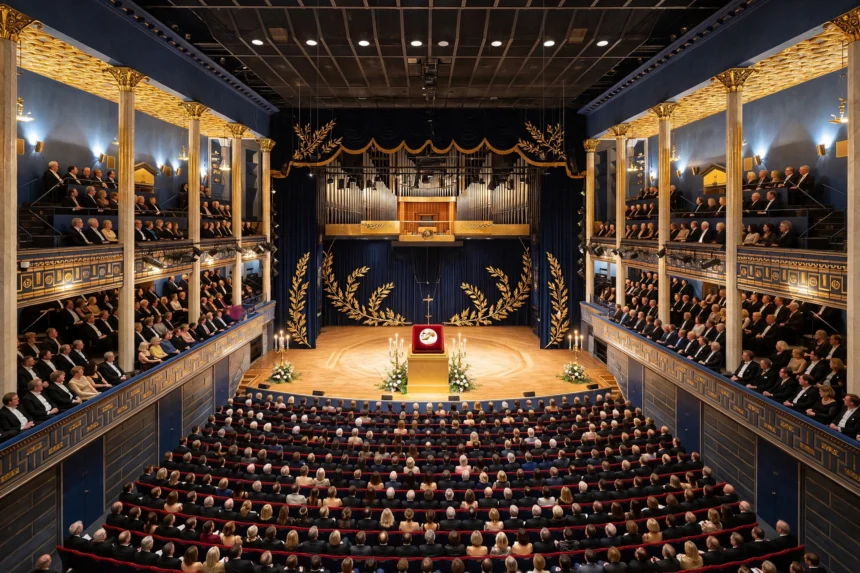
Stockholm has spoken, and this time the economics prize comes with a message that central banks everywhere, including the Reserve Bank of India, will hear loud and clear. On October 12, the Royal Swedish Academy of Sciences awarded the 2026 Nobel Prize in Economic Sciences to two American economists, Robert E. Hall and Michael Woodford, for their work on the microeconomic foundations of macroeconomic stabilisation.
It is the final Nobel prize announced this year, and it lands at a moment when the world economy is anything but stable. Growth forecasts keep getting revised, inflation refuses to die quietly in several economies, and energy prices swing on every headline. In that sense, the Academy could not have picked a more relevant topic, or a more practical one.
Who are the winners?
Robert E. Hall, 83, is a professor emeritus at Stanford University and a senior fellow at the Hoover Institution. If you have ever read an RBI monetary policy statement, you have felt Hall’s influence without knowing it. His famous 1978 research paper argued that households try to keep their spending stable even when their income fluctuates, making consumption surprisingly hard to predict. He also showed how rigid wages, wages that do not fall easily, can deepen recessions and push unemployment higher.
Michael Woodford, 71, is a professor at Columbia University and the leading name in modern monetary policy theory. He built the so-called New Keynesian model, which explains how interest rates and, just as importantly, what people expect about future policy, shape prices and business cycles. His big insight: a central bank can steady the economy not only by moving rates today, but by clearly signalling where rates are headed tomorrow. In central-banking jargon, that is called forward guidance. Every inflation-targeting central bank in the world uses some version of it now.
What did they actually figure out?
Here is the simple version. Old economic models drew statistical lines between big numbers like inflation, output and consumption, and then policymakers crossed their fingers. Hall and Woodford flipped the approach: start with how real people and businesses behave.
People and firms, they showed, are forward-looking. A family deciding whether to buy a car today thinks about its future income. A shop owner setting prices thinks about what costs and demand will look like next year. Because expectations shape today’s decisions, governments and central banks can steer the economy partly by shaping those expectations, communicating their plans credibly so households and firms act in a stabilising way.
The Academy’s prize committee put it plainly: with these models, central banks and governments are better equipped to deal with shocks like energy crises or sudden drops in household spending. In other words, the toolkit that kept the 2008 crash and the pandemic from turning into a full-blown depression rests, in part, on the ideas these two men built.
Why this matters for India

For Indian readers, this is not an abstract foreign prize. The RBI’s entire inflation-targeting framework, the 4 per cent CPI target it has defended since 2016, runs on models that descend directly from Woodford’s work. When the RBI governor holds a press conference and carefully phrases every sentence about the future path of rates, that is forward guidance in action, exactly what Woodford theorised.
The timing is pointed, too. The IMF has just raised India’s GDP growth forecast to 7 per cent for 2026-27, calling India the world’s fastest-growing major economy. Managing that growth without letting inflation run away is precisely the kind of stabilisation problem Hall and Woodford spent their careers solving.
- The prize: 12 million Swedish kronor, roughly $1.2 million, shared equally between the two laureates.
- The citation: “for microeconomic foundations of macroeconomic stabilisation”.
- The context: this is the last Nobel announced for 2026. Last year’s economics prize went to Joel Mokyr, Philippe Aghion and Peter Howitt for work on innovation and creative destruction.
- The reaction: Woodford, speaking to the committee by phone from New York, called it “a tremendous honour” and said it came as a surprise.
FAQs
Who won the 2026 Nobel Prize in Economics?
American economists Robert E. Hall of Stanford University and Michael Woodford of Columbia University won the prize on October 12, 2026.
What was the prize awarded for?
For the “microeconomic foundations of macroeconomic stabilisation”, meaning new models that show how individual and business behaviour shapes the economy, and how central banks can use that knowledge to smooth out booms and busts.
How much is the Nobel economics prize worth?
The award is worth 12 million Swedish kronor, about $1.2 million, split equally between Hall and Woodford.
Why does this prize matter for India?
The RBI’s inflation-targeting framework and its use of forward guidance in monetary policy are built on the same models Woodford developed, so the prize honours the science behind India’s own economic management.
Is the economics prize a real Nobel?
Strictly speaking, no. It was established by Sweden’s central bank in 1969, not by Alfred Nobel’s 1895 will, and its formal name is the Sveriges Riksbank Prize in Economic Sciences in Memory of Alfred Nobel.
Stockholm’s message this year is simple: the economy cannot be commanded from above, but it can be steadied from below, by understanding people. That is a lesson worth keeping, in New Delhi no less than in Washington.