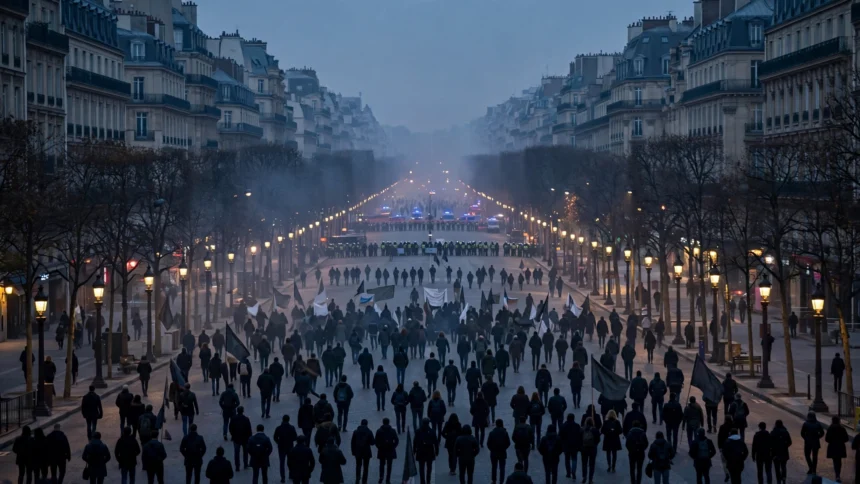
Paris turned tense on Saturday evening as a third consecutive weekend of protests across France ended in clashes, tear gas and hundreds of arrests. The French Interior Ministry said around 320,000 people demonstrated nationwide on October 31, including about 70,000 in the capital, in a movement that began with students and has grown into a broad protest over the cost of living, fuel prices and conditions in schools.
The main Paris march began in the east of the city at Porte de Bagnolet and headed for Porte de Charenton. For much of the day it was peaceful, with students walking hand in hand at the front and some marchers in Halloween costumes. As the march reached its end point, police said a hard core of rioters at the rear began throwing paving stones, fireworks and at least one Molotov cocktail at officers. Police answered with tear gas, water cannon and charges, and the protest spilled towards Place de la Bastille.
By 8 pm on Saturday, authorities said 511 people had been arrested across France. Earlier counts through the day had been lower, rising as evening clashes spread to Lyon, Marseille, Toulouse and Bordeaux. France had deployed around 70,000 police officers and gendarmes for the day, and Paris police carried out more than 1,200 checks at railway stations and nearby areas in the morning.
What the protesters are demanding
The movement started in late September, when high school students took to the streets over budget cuts, teacher shortages and deteriorating school buildings. Since mid-October, trade unions, student organisations and Yellow Vest activists have joined, widening the focus to the rising cost of living, fuel prices and inequality.
Interior Minister Laurent Nunez had warned before Saturday of a very high risk of disorder, particularly after dark on Halloween. The government blamed far-left extremist groups for attacks on officers, and described a Molotov cocktail thrown at a riot police officer in Paris as an attempted murder. One gendarme was struck in the leg by a Molotov cocktail and suffered burns, the national Gendarmerie said.
Protest organisers dispute the official turnout. Youth organisations put the national figure at close to half a million, including 200,000 in Paris, against the ministry count of 320,000 and 70,000. Turnout was nevertheless lower than the two previous weekends, when officials counted 410,000 on October 24 and 550,000 on October 17. In Paris, the October 31 crowd of 70,000 was also below the roughly 110,000 counted there the weekend before.
A movement spreading beyond France
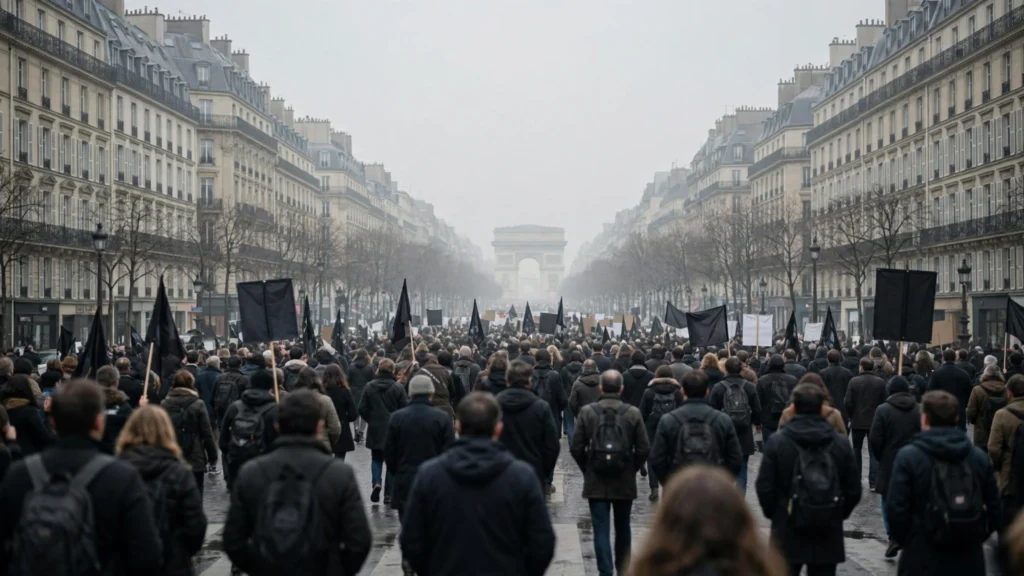
Saturday was not only a French story. Youth-led rallies over housing affordability, living costs and public services also took place in Germany, Portugal and the Netherlands, and clashes were reported in Germany as protests spread across Europe. In France, the Paris route had been moved outside the city centre after a last-minute court battle, in an attempt to keep the march away from government buildings and tourist sites.
The political backdrop is febrile. Presidential elections are less than six months away, and the protests come as households feel the squeeze from fuel and food prices. President Emmanuel Macron has accused far-left groups of fostering violence by attacking buildings and police, while protesters say the government has failed to answer their demands on schools, wages and living standards.
For now, neither side looks ready to back down. Students say they will keep marching until school staffing and funding improve. Unions and cost-of-living campaigners say the same about household budgets. The government, for its part, has signalled a firm response to violence while insisting that peaceful protest will be protected. After three weekends in a row, the question now is whether the movement holds its numbers into November, or whether fatigue and the autumn cold begin to thin the crowds.
Key numbers from October 31
- 320,000 demonstrators nationwide, according to the Interior Ministry
- 70,000 marchers in Paris, on the official count
- 511 arrests across France by 8 pm on Saturday
- 70,000 police officers and gendarmes deployed for the day
- 3 consecutive weekends of nationwide protests
FAQs
Why are people protesting in France?
The protests began with students demanding better school staffing, funding and buildings, and have grown to include the rising cost of living, fuel prices and inequality, with unions and Yellow Vest activists now involved.
How many people protested on October 31?
The Interior Ministry counted around 320,000 people across France, including 70,000 in Paris. Youth organisations claimed a higher national turnout of close to half a million.
Why did the Paris protest turn violent?
Police said a small group at the rear of the march threw paving stones, fireworks and a Molotov cocktail at officers near the end point at Porte de Charenton. Police responded with tear gas and water cannon.
How many people were arrested?
Authorities said 511 people had been arrested across France by 8 pm on Saturday, after more than 1,200 preventive checks in Paris in the morning.
Is this the first weekend of protests?
No. October 31 was the third consecutive weekend of nationwide demonstrations, following larger turnouts of 410,000 on October 24 and 550,000 on October 17, according to official figures.
France now waits to see whether the streets stay full next weekend, or whether this autumn of protest begins to lose steam.