
New Delhi: The chairman of the Education Ministry’s review committee for the National Education Policy 2020 has said the panel is pushing hard to make the country’s nearly three crore undergraduate students genuinely employable, not just degree-holders. In an interview this week, Mamidela Jagadesh Kumar said a pilot project involving 30 universities is already underway, linking colleges directly with companies and employers across the country.
The move targets the vast majority of India’s higher education population: BA, BCom and BSc students, who make up the bulk of the 4.5 crore students enrolled in higher education according to the All India Survey on Higher Education 2023-24. Of these, 76.8 per cent are undergraduates.
From degrees to skills
Speaking to The New Indian Express on Thursday, Kumar said the committee was “rigorously pushing” for students to be work-ready through tie-ups with companies and employers. The response, he said, has been encouraging both from workplaces and from colleges and universities.
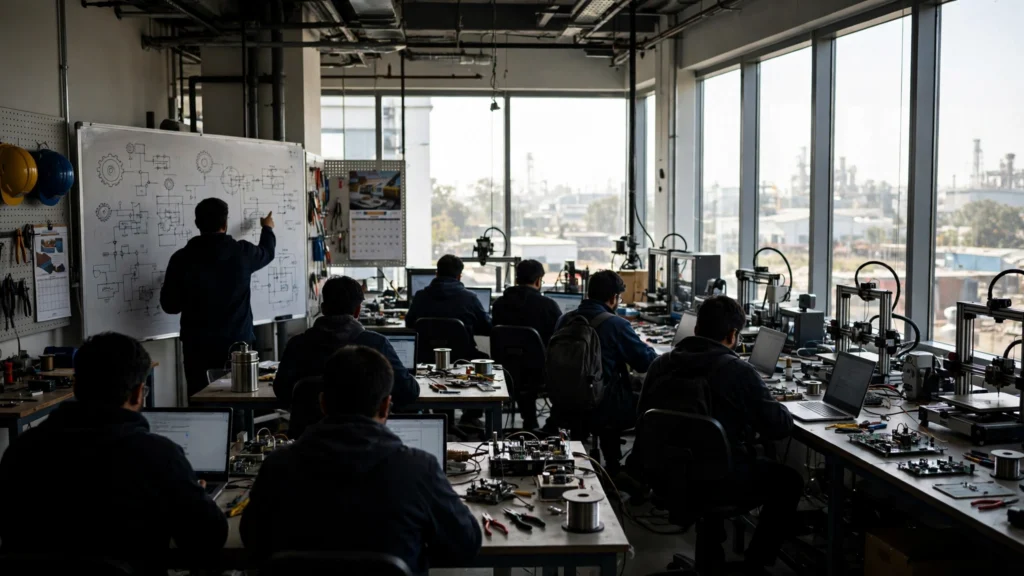
The centrepiece of the push is the Apprentice Embedded Degree Programme (AEDP), which allows an undergraduate to spend a year, or even 18 months, of the degree gaining live industry experience. The programme is optional. Students who want to pursue their degree in a purely academic way remain free to do so.
The underlying message from the panel is blunt: a college that only hands out degrees is no longer enough. In a separate address to newly qualified students of the Institute of Cost Accountants of India at a convention themed “Shaping Gen Z for Viksit Bharat”, Kumar said universities and colleges must move beyond being mere degree-granting institutions.
Why this matters now
India’s graduate employability has been a stubborn problem. Employers routinely complain that fresh graduates arrive with certificates but without the practical skills a workplace demands. The NEP 2020 review committee’s answer is to blur the line between the classroom and the workplace, so students apply their knowledge to real problems while still earning credits toward their degree.
- Who is covered: Primarily BA, BCom and BSc undergraduates, the largest student groups in Indian higher education.
- How it works: Through the Apprentice Embedded Degree Programme, students can spend 12 to 18 months in live industry roles as part of their degree.
- Where it is live: A pilot is currently running in 30 universities, with plans to extend it across all states and union territories.
- Is it mandatory: No. Students can choose a fully academic path; the apprenticeship route is an option, not a requirement.
What the panel wants from colleges
Kumar, who also chairs the Board of Governors at IIM Calcutta and is a former UGC chairperson, argued that the success or failure of any education policy ultimately depends on the capacity of institutions. The quality of institutional leadership and the ability of faculty to adapt to a changing system, he said, are crucial.
That argument connects to a broader reform menu the committee is working through: credit frameworks that recognise skill-based and experiential learning alongside academics, professors of practice drawn from industry, and courses co-designed with employers in areas like AI, data analytics and other emerging fields. Over 100 institutions are already offering some form of apprenticeship-embedded programme, according to earlier disclosures by the committee’s leadership.
The road ahead
For now, the 30-university pilot will be the test bed. If employer response stays positive and universities manage the logistics of placing large numbers of students in industry roles, the programme is set to scale nationwide. The challenge will be execution: ensuring enough quality apprenticeships exist, especially outside the big metros, and making sure faculty are prepared to mentor students through industry-integrated coursework.
For students and parents weighing degree options this year, the signal is clear. Degrees are becoming starting points, not finish lines, and the programmes that plug students into real workplaces are likely to be the ones recruiters notice first.
FAQs
What is the Apprentice Embedded Degree Programme?
It is a programme that lets undergraduate students spend a year or up to 18 months of their degree working in industry, with that experience counting toward their qualification.
Is the apprenticeship track mandatory for students?
No. The panel chairman has said it is fully optional. Students who prefer a purely academic degree can continue with that.
Which students does the NEP review panel’s job-readiness push focus on?
Primarily BA, BCom and BSc undergraduates, who form the largest share of India’s roughly 4.5 crore higher-education students.
When will the programme reach all universities?
A pilot is running in 30 universities at present. The committee says it will be extended across all states and union territories based on how the pilot performs.
Who heads the NEP 2020 review committee?
Mamidela Jagadesh Kumar, chairperson of the Board of Governors at IIM Calcutta and a former chairman of the University Grants Commission.
Stay with Informeia for the latest updates on education policy and higher education reforms.