
India’s cars are about to get a lot smarter. The Ministry of Road Transport and Highways (MoRTH) has proposed making Advanced Emergency Braking Systems (AEBS) mandatory for all new car models sold in the country, in a draft notification that could change the way every Indian vehicle is built from October 1, 2030.
The draft, numbered G.S.R. 904(E) and dated October 19, 2026, was published in the Gazette of India on October 22. It proposes amendments to the Central Motor Vehicles Rules, 1989, laying out a phased rollout that gives carmakers roughly four years to prepare. If approved, India would join the growing list of major markets where automatic emergency braking is no longer a premium feature but a legal requirement.
What the draft proposes: the timelines
The ministry’s plan works in stages. From October 1, 2028, any M1 or N1 category vehicle that is offered with AEBS must comply with the Automotive Industry Standard AIS-185, which is the technical benchmark for emergency braking systems. M1 covers passenger cars, while N1 covers goods vehicles up to 3.5 tonnes.
The real mandate kicks in later. From October 1, 2030, every new car model manufactured in India will have to come fitted with AEBS conforming to AIS-185. Models already in production before the deadline get extra time: they must comply from October 1, 2032.
People familiar with the development told The Times of India that the timelines deliberately account for the lead time industry and consumers would need. The draft also covers more advanced systems that can intervene in steering and lane-keeping, bringing them under the relevant Automotive Industry Standards as well.
How AEBS actually works
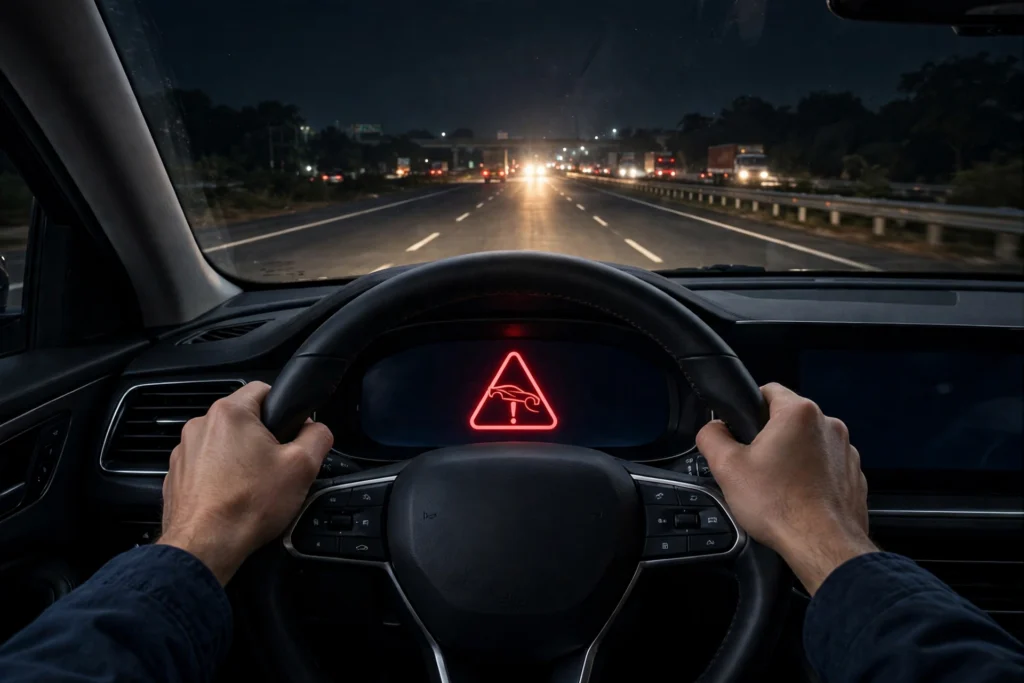
Advanced Emergency Braking is a core Advanced Driver Assistance System (ADAS) feature. Using radar, cameras or a combination of sensors, the system constantly watches the road ahead. If it detects an impending collision and the driver does not respond in time, it applies the brakes automatically, either avoiding the crash entirely or reducing its severity.
On Indian roads, where mixed traffic throws everything from bullock carts to trucks at drivers in seconds, that split-second intervention can be the difference between a near miss and a fatality. Global data shows automatic emergency braking significantly cuts rear-end crashes, and regulators in Europe, the US and Japan have all moved toward mandating it.
Trucks get tighter rules sooner
Alongside the car proposal, the government has moved faster on heavy vehicles. A revised braking standard for trucks comes into effect from October 1, 2027, and Electronic Stability Control (ESC) conforming to AIS-162 becomes mandatory for trucks from the same date.
ESC keeps a vehicle stable by detecting loss of control and selectively applying brakes to individual wheels, particularly during sudden manoeuvres and cornering. For top-heavy trucks on Indian highways, that technology directly targets the skidding and rollover incidents that make highway crashes so deadly.
Why now: the road safety numbers
The push comes against grim numbers. Government data showed road accidents in India rose 5.3 per cent to more than 5.13 lakh in 2025, with crashes claiming 21 lives every hour and an average of 59 accidents every hour.
Road Transport and Highways Minister Nitin Gadkari has repeatedly said the government is targeting a 50 per cent reduction in road accidents and fatalities by 2030, with an eventual goal of zero road deaths. The ministry has also identified 100 districts with high accident rates for urgent intervention, including fixing accident-prone black spots.
Automobile and mobility expert Rama Pandey told TOI the norms could be a boon for commercial drivers who spend hours behind the wheel. By shifting more safety-critical and fatigue-inducing driving decisions to automated systems, ADAS could make driving safer and less strenuous, she said.
What happens next
- The draft is open for public consultation for 30 days from its publication in the Gazette of India.
- After that, the ministry will consider all objections and suggestions received before finalising the rules.
- Carmakers are expected to file detailed responses on cost and supply-chain readiness.
- Component makers in radar, sensors and embedded software see a major domestic opportunity.
For car buyers, the message is simple: the safety technology that today sits in top-end variants is heading for every showroom. The braking mandate may still be a draft, but the direction of Indian car safety is now unmistakable.
FAQs
Q: Is automatic emergency braking mandatory in India now?
A: Not yet. It is a draft proposal published in the Gazette of India on October 22, 2026. It becomes mandatory only after public consultation and a final notification.
Q: From when will new cars need AEBS?
A: All new car models manufactured from October 1, 2030 must have AEBS. Cars already in production get until October 1, 2032.
Q: What is AIS-185?
A: It is the Automotive Industry Standard that defines the technical requirements for Advanced Emergency Braking Systems in India.
Q: Will this make cars more expensive?
A: Safety mandates usually add cost in the short term, but mass adoption and local sensor manufacturing typically bring prices down. Carmakers have four years to prepare.
Q: Are trucks covered too?
A: Yes. Revised braking standards and mandatory ESC for trucks take effect from October 1, 2027, under the same draft framework.
India’s push for smarter, safer cars is gaining speed. Whether you drive a hatchback or a truck, the days of relying on reflexes alone are numbered.