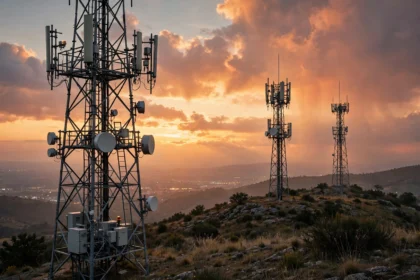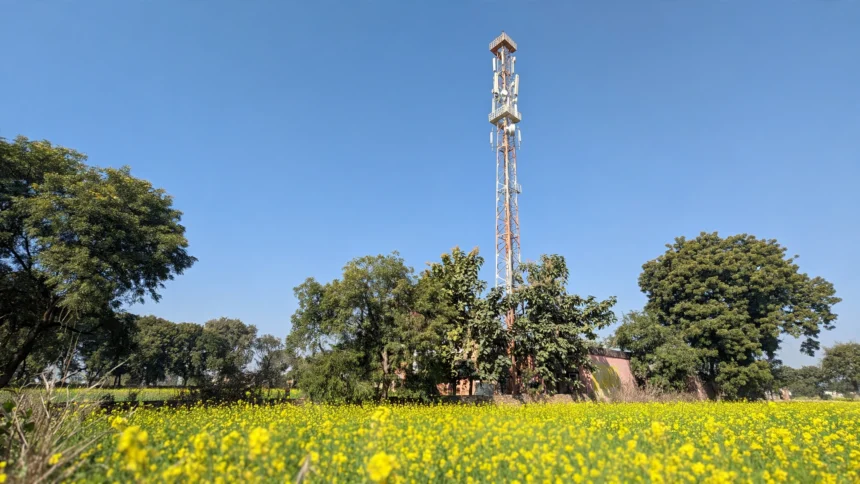
India’s three big telecom operators have made a joint push for faster rural broadband, and it does not involve a new phone, a spectrum auction, or a price change. On Tuesday, their industry body asked the Department of Telecommunications (DoT) to move quickly on a rule change that would let wireless broadband links run at higher power outdoors in the lower 6 GHz band.
The Cellular Operators Association of India (COAI), which represents Reliance Jio, Bharti Airtel and Vodafone Idea, said the recommendation should be implemented without further delay. The request, reported on October 27 and 28, puts the spotlight on 500 MHz of spectrum that is already delicensed in India, but is still largely restricted to low-power indoor use. If the rules change, operators say fixed wireless links could reach places where laying fibre is slow, costly, or not practical.
What the operators have asked for
COAI has urged DoT to notify rule amendments that allow standard-power outdoor operations in the lower 6 GHz band, covering 5925 to 6425 MHz, for point-to-multipoint and point-to-point links. In plain terms, a wireless transmitter on a tower or rooftop could send broadband over a longer distance, at higher power, to receivers at homes, offices, and schools.
The power level in the request is 36 dBm. That figure comes from an expert committee set up by DoT and led by Professor Radha Krishna Ganti of IIT Madras, which recommended higher-power outdoor use at that level in the same band. COAI director general S. P. Kochhar said several months have passed since the committee submitted its report.
“COAI earnestly requests the DoT to expedite the notification of the necessary rule amendments enabling standard power (36 dBm) outdoor operations in the lower 6 GHz band (5925-6425 MHz) for P2MP/P2P,” Kochhar said.
Why 500 MHz matters
The lower 6 GHz band gives wireless networks a wide, continuous stretch of airwaves. A wider channel can carry more data at once, which helps with video calls, streaming, online classes, and several devices using one connection at the same time.
Operators argue that keeping this spectrum to low-power indoor use wastes much of its value. Kochhar said enabling outdoor standard-power operations would ensure the 500 MHz of delicensed spectrum is fully harnessed and can be used by all service providers. COAI added that it should become a genuine engine of rural broadband penetration and digital inclusion, not only indoor enterprise and consumer Wi-Fi.
In January 2026, India delicensed this range for low-power indoor use, opening the door to Wi-Fi 6E and Wi-Fi 7 devices. The new request is about outdoor links strong enough to serve as the last-mile connection to a building.
Why fibre alone is not enough
COAI’s case rests on a practical problem. In many rural, semi-urban, and hard-to-reach areas, getting a fibre cable to every home runs into right-of-way hurdles, limited fibre availability, and high deployment costs. The cost per home rises sharply when homes are spread out.
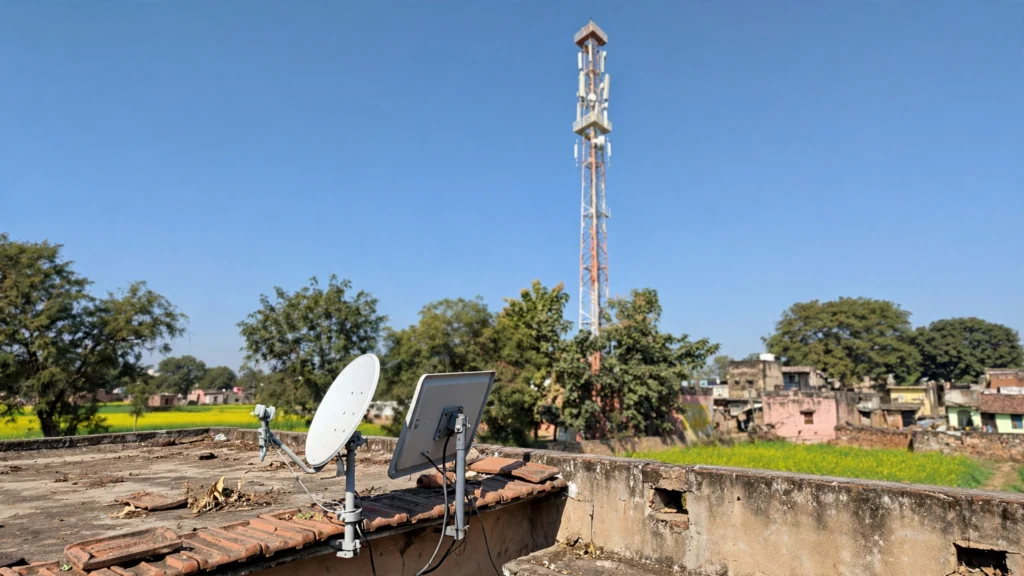
Fixed wireless access, or FWA, works differently. A wireless link connects a nearby tower or access point to a receiver at the premises, without a cable for the final stretch. Point-to-multipoint systems can serve several locations from one transmitter, which is why operators say they suit last-mile delivery where fibre is absent, unviable, or impractical. Fibre would still carry data between towns and cities; the argument is only about the final link.
- Fixed wireless access: broadband over a wireless link to a fixed receiver at a home or office, instead of a cable into the building.
- Point-to-multipoint: one transmitter serves several receivers, useful for villages and small clusters of homes.
- Standard power: a higher permitted transmit power for outdoor use, compared with low-power limits that apply mainly indoors today.
What happens next
If DoT notifies the amendments, the first change would be behind the scenes, in how operators plan rural networks. Over time, more homes could be offered broadband without waiting for fibre, with steadier connections for online classes and small businesses.
This is not a spectrum auction, and it does not hand the band to one company. COAI has framed the 500 MHz as delicensed spectrum usable by all service providers. No decision or timeline from DoT was reported alongside the request, so readers should treat this as an industry ask, not a done deal. The coming weeks will show whether the government accepts the expert committee’s recommendation in full, with conditions, or after more time.
FAQs
What is the lower 6 GHz band?
It is the 5925 to 6425 MHz range, a 500 MHz stretch delicensed in India for wireless use under technical conditions. It supports modern Wi-Fi and, potentially, outdoor fixed broadband links.
Who asked for the change?
COAI, representing Reliance Jio, Bharti Airtel, and Vodafone Idea. Its director general is S. P. Kochhar.
What power level is sought?
Standard-power outdoor use at 36 dBm, as recommended by a DoT expert committee led by Professor Radha Krishna Ganti of IIT Madras.
Will this replace fibre?
No. Fibre remains central to telecom networks. The proposal covers the last-mile link where fibre is absent, unviable, or impractical.
Has DoT approved it?
Not as reported. COAI has urged DoT to notify the amendments quickly. No approval or date was announced.
India’s broadband story has often been told in terms of big auctions and new networks. This one is quieter, and it is about using spectrum that is already there, more fully, in the places that need it most.