Technical colleges across India have something concrete to look forward to this academic year. The All India Council for Technical Education (AICTE) has launched four new schemes for 2026-27, aimed at giving engineering and technical institutions better labs, sharper teaching and stronger links with the world of research. The announcement came on November 1, and it covers everything from hands-on innovation labs for students to funding for academic conferences.
AICTE Chairman Professor Yogesh Singh launched the four initiatives under the council’s Institutional Development Cell, in the presence of Member Secretary Professor Shyama Rath. The schemes are IDEA Lab, MODROBS, Margdarshan and Grant for Organising Conference (GOC). Together, they are designed to push institutional development beyond the big metro hubs and into colleges in smaller districts as well.
For students and faculty in technical institutions, the schemes matter because they touch everyday academic life: the equipment in the lab, the quality of classroom teaching, the guidance a college gets from stronger institutions, and the chance to present research at conferences. Here is a closer look at each of the four schemes.
IDEA Lab: learning by doing, not just by reading
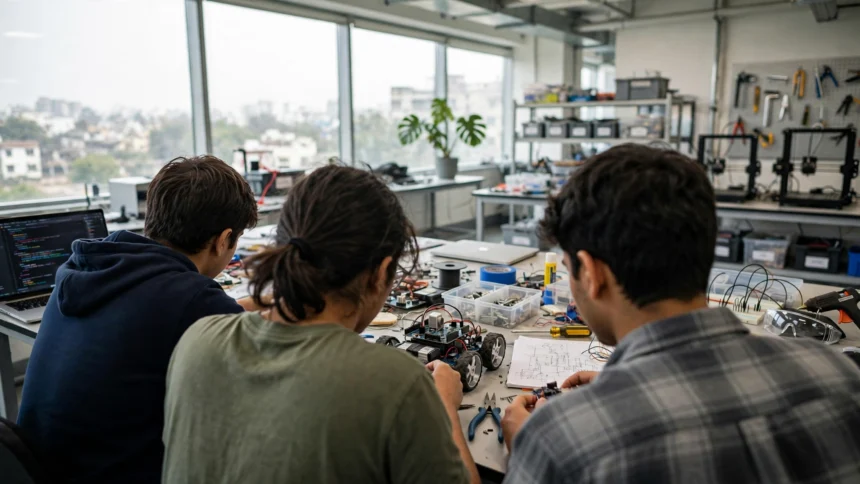
The IDEA Lab scheme is built around a simple idea: students learn best when they build something. It encourages learners to move beyond classroom lectures and apply Science, Technology, Engineering and Mathematics (STEM) concepts to real problems. Students get to experiment, create prototypes and test solutions, following a learning-by-doing approach.
In practice, that means more tinkering, more project work and more chances to turn an idea into a working model. For colleges, an IDEA Lab becomes a space where curiosity meets tools, and where a student’s classroom concept can grow into a prototype worth showing to industry or at a competition.
MODROBS: modern labs and workshops for practical training
MODROBS, short for Modernisation and Restructuring for Outcome Based System, focuses on upgrading institutional infrastructure. Under the scheme, institutions receive support to modernise laboratories, workshops and computing facilities, so that students and faculty have access to equipment that supports research, teaching and practical training.
Outdated lab equipment is a common complaint in technical education, and it shows up directly in the quality of practical training. By funding upgrades, MODROBS aims to close that gap and make practical education more industry-oriented. Colleges can improve the hands-on component of their courses, which is often what employers look at first.

Margdarshan: stronger colleges mentor the rest
Not every college starts from the same place, and Margdarshan is AICTE’s answer to that imbalance. Under this scheme, established institutions and Centrally Funded Institutions mentor other colleges, sharing academic practices, resources and experience. The goal is to help participating colleges improve their teaching standards and overall institutional performance.
The mentoring model matters because it spreads good practice faster than each college figuring things out alone. A college struggling with curriculum delivery or faculty development can lean on a mentor institution that has already solved those problems, rather than reinventing the wheel.
Grant for Organising Conference: a stage for research
The fourth scheme, Grant for Organising Conference (GOC), supports institutions in hosting national and international academic conferences. These events give academicians, researchers and subject experts a platform to exchange knowledge, discuss research findings and track new developments in their fields.
For faculty and students, conferences are where research gets tested and connections get made. Funding for such events can help smaller institutions host gatherings they could not otherwise afford, and give their researchers a stage that is usually dominated by bigger names.
Why this launch matters now
AICTE’s emphasis during the launch was on wider participation. The council said the schemes should reach institutions across districts, including those beyond established educational centres, so that access to resources and opportunities becomes more equitable. That focus on inclusion is significant: much of India’s technical education capacity sits outside the handful of famous institutes, and those colleges often need support the most.
Put together, the four schemes cover the full arc of institutional growth. IDEA Lab builds student innovation, MODROBS fixes the infrastructure, Margdarshan strengthens teaching through mentoring, and GOC connects institutions to the wider research community. It is a package that treats a college as a whole system, not just a collection of classrooms.
Institutions interested in participating will need to check the respective AICTE guidelines for eligibility, financial assistance and application procedures. Details on funding patterns and timelines are typically published scheme-wise by the council, and colleges should watch for the official notifications before applying.
What colleges should do next
- Read the scheme guidelines: Each of the four schemes has its own eligibility rules and funding pattern. Colleges should go through the official AICTE notification for the scheme they want to apply to.
- Identify the right fit: A college with ageing labs may gain most from MODROBS, while one looking to boost student projects should look at IDEA Lab first.
- Line up a mentor: Institutions interested in Margdarshan should start conversations with established institutions early, since mentoring partnerships take time to build.
- Plan conference proposals: Departments with active research can use GOC support to host events that raise their academic profile.
The launch sets the tone for the 2026-27 academic year in technical education: more practical learning, better labs, shared expertise and wider access. For the thousands of engineering and diploma colleges that form the backbone of India’s technical workforce, that is a welcome direction.
FAQs
What are the four new AICTE schemes for 2026-27?
The four schemes are IDEA Lab, MODROBS, Margdarshan and Grant for Organising Conference (GOC), launched by AICTE for the academic year 2026-27.
Who launched the AICTE schemes?
AICTE Chairman Professor Yogesh Singh launched the schemes under the council’s Institutional Development Cell, in the presence of Member Secretary Professor Shyama Rath.
What does the IDEA Lab scheme focus on?
IDEA Lab promotes experiential, learning-by-doing education, encouraging students to apply STEM concepts to real-world problems through experimentation and prototyping.
What is MODROBS?
MODROBS stands for Modernisation and Restructuring for Outcome Based System. It supports institutions in upgrading laboratories, workshops and computing facilities for better practical training and research.
How can colleges apply for these schemes?
Institutions should refer to the respective AICTE guidelines for each scheme, which set out eligibility, financial assistance and application procedures.
Technical education in India educates lakhs of students every year, and schemes like these decide whether that education stays theoretical or turns practical. The 2026-27 package is a step towards the practical side, and colleges that move early stand to gain the most.