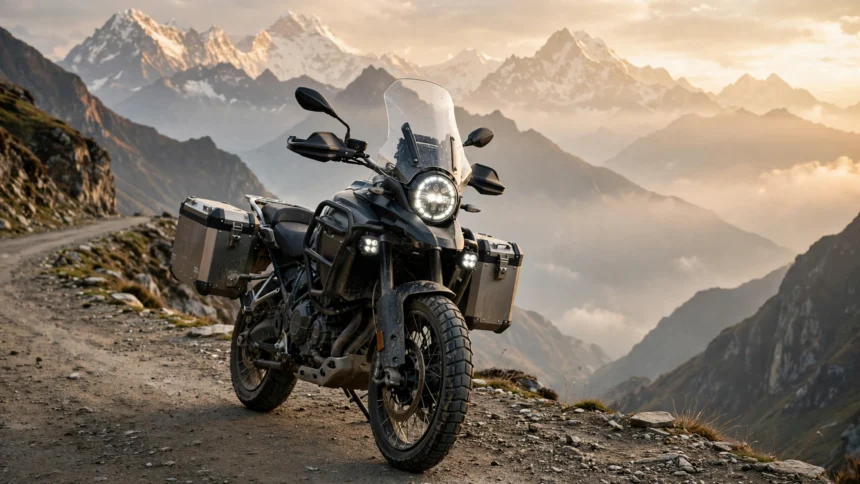
Royal Enfield has taken the covers off its biggest Himalayan yet. The Himalayan 750 broke cover at EICMA 2026 in Milan on Tuesday, and it is the most serious adventure motorcycle the Indian brand has ever built. After months of spy shots, the production bike is finally out in the open.
The headline change is under the tank. The Himalayan 750 moves the range into twin-cylinder territory, and that alone changes what the bike can do on a highway.
A new 750cc twin at the heart of it
The Himalayan 750 runs a new 750cc parallel-twin engine, an air-oil-cooled unit with a 270-degree crankshaft. It is understood to be an enlarged evolution of the 648cc twin that powers Royal Enfield’s Interceptor and Continental GT, reworked for the low-end torque an adventure bike needs when fully loaded.
Reports from the Milan unveiling put output at around 55 to 60 bhp, with torque in the region of 60 to 70 Nm. Royal Enfield has confirmed the engine layout and the twin-cylinder configuration; final homologated output figures for India are still awaited. A six-speed gearbox with a slip-and-assist clutch handles transmission duties, and ride-by-wire throttle opens the door to the bike’s electronics package.
Where the Himalayan 450 is a single-cylinder machine built to be light and manageable, the 750 is built to sit at 120 to 140 kmph all day with a pillion and luggage, without the buzz of a big single working hard.
Hardware built for loaded touring
The chassis is new as well, a steel tubular frame with a bolt-on rear subframe and geometry set up specifically for touring. Up front, adjustable Showa upside-down forks offer compression and rebound adjustment, while the rear monoshock gets remote preload adjustment and a remote reservoir, so riders can tune the bike for luggage loads without tools.
- 19-inch front wheel and 17-inch rear wheel, a road-biased setup compared with the Himalayan 450’s 21-inch front
- Twin front disc brakes with ByBre callipers, a first for a Royal Enfield motorcycle
- Tubeless cross-spoke rims on some variants, with alloy wheels on others
- Vredestein Centauro XR on-off-road tyres on the spoked versions, CEAT tarmac tyres on the alloy versions
- Rear luggage rack rated for a 7 kg load, plus a split-seat layout for rider and pillion comfort
The 19-inch front wheel is a telling choice. It trades a little off-road ability for far better road manners, which is exactly where most big adventure bikes spend their lives.
Tech: cruise control, riding modes and a new TFT
The Himalayan 750 is also the most connected motorcycle Royal Enfield has made. A customisable TFT display runs the show, with Google-powered Tripper navigation and smartphone connectivity baked in.
- Cruise control, a first for the Himalayan family and a genuine highway essential
- Four riding modes: Rain, Road, Custom and Trail
- Switchable traction control and switchable ABS
- Tyre pressure monitoring system (TPMS) and live location sharing
- Height-adjustable LED headlamp, manually adjustable windscreen and an illuminated key ring
Design and colours
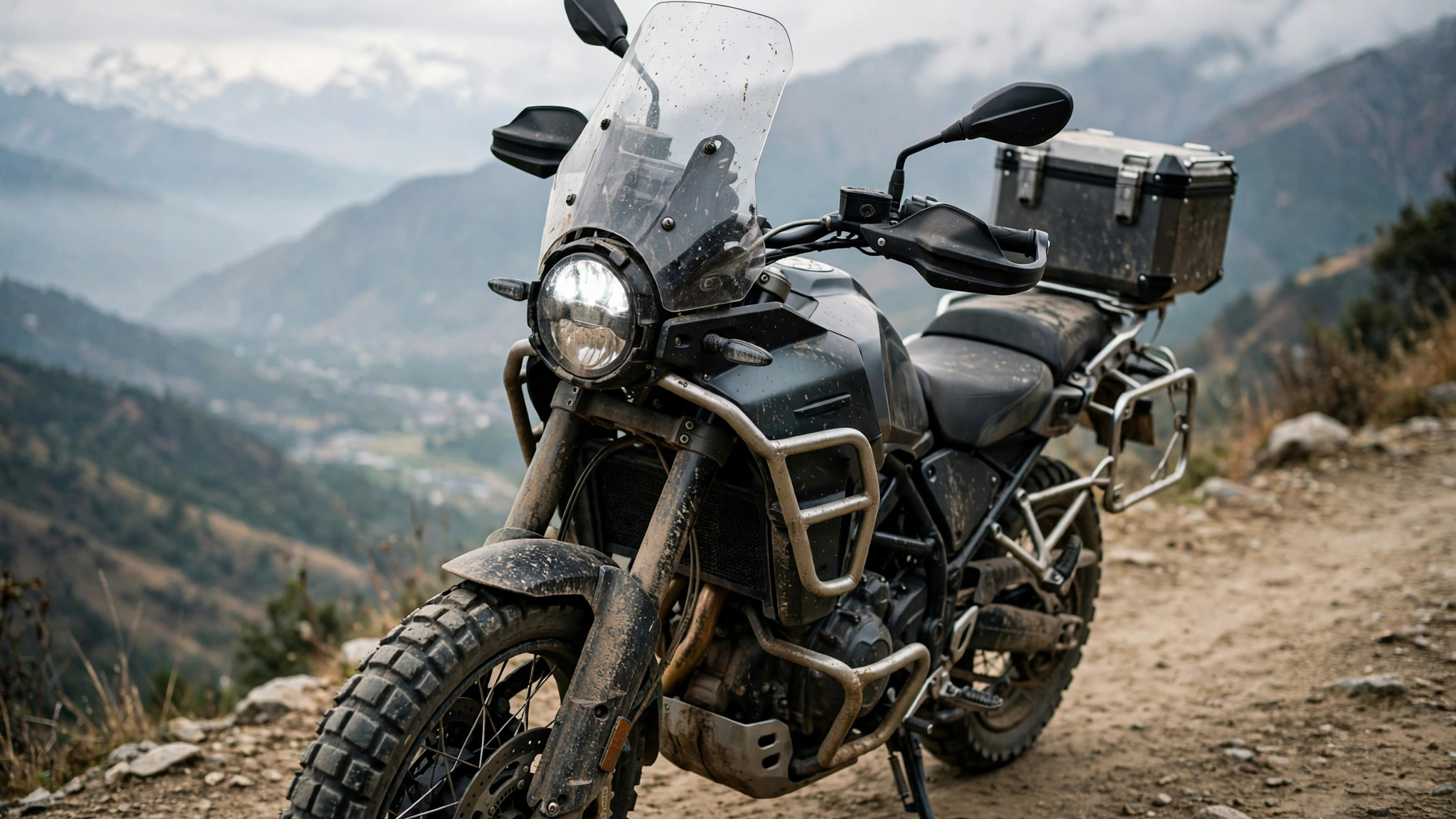
Visually, the Himalayan 750 keeps the family look but scales it up: a tall adventure-touring stance, a round LED headlamp, an upswept exhaust and a beak-style front end. Royal Enfield has revealed five colour options: Aztec Green, Antarctic Silver, Siberia White, Tectonic Black and Viking Bronze.
India launch: Motoverse Goa, then showrooms
The Himalayan 750 will be showcased in India at Motoverse 2026 in Goa, scheduled for November 24 to 26, with a formal launch and price announcement expected around then. The expected price band doing the rounds is Rs 4.00 lakh to Rs 4.20 lakh (ex-showroom) for base variants, stretching to around Rs 4.50 lakh for fully kitted touring versions.
That positions it clearly above the Himalayan 450, which sells between Rs 3.08 lakh and Rs 3.40 lakh. Hero also revealed its XPulse 421 at EICMA.
For Royal Enfield, the stakes are high. The Himalayan name carries enormous goodwill in India, built on the 411 and the 450. The 750 has to keep that go-anywhere character while proving a bigger, heavier twin can still feel like a Himalayan. On paper, the ingredients are all there.
FAQs
When was the Royal Enfield Himalayan 750 unveiled?
The Himalayan 750 made its public debut at EICMA 2026 in Milan on November 3, 2026, after media rides in Sicily, Italy.
What engine does the Himalayan 750 use?
A new 750cc air-oil-cooled parallel-twin with a 270-degree crankshaft, six-speed gearbox and slip-and-assist clutch. Output is reported at around 55 to 60 bhp.
What is the expected price of the Himalayan 750 in India?
The expected ex-showroom price is Rs 4.00 lakh to Rs 4.20 lakh for base variants, going up to around Rs 4.50 lakh for touring versions. Final prices are yet to be announced.
When will the Himalayan 750 launch in India?
It will be showcased at Motoverse 2026 in Goa from November 24 to 26, with the India launch and pricing expected around the same time.
How is the Himalayan 750 different from the Himalayan 450?
The 750 gets a twin-cylinder engine instead of a single, twin front disc brakes, a 19-inch front wheel instead of 21 inches, cruise control, riding modes and a larger, touring-focused chassis.
More details, including final Indian specifications and pricing, should follow at Motoverse later this month.