Mukesh Ambani’s Jio Platforms is in talks with some of the biggest names in American cable about a deal that flips the usual telecom playbook on its head. Instead of paying cash for technology, or buying a network outright, Jio is reportedly offering its own homegrown wireless broadband technology in exchange for a stake in the partner’s business.
Reuters reported the discussions on Tuesday, citing two people familiar with the matter. Jio, which listed in Mumbai only last week after a record $3.2 billion initial public offering, wants to sell Indian-built technology to the world, and it wants equity, not just licence fees, in return.
What is on the table
According to the report, Jio has held talks with several companies, including Comcast and Charter Communications, about licensing its wireless broadband technology in exchange for potential stakes in those businesses. Neither Jio nor the two American firms has confirmed the talks publicly. Jio did not respond to Reuters’ queries, while spokespeople for Comcast and Charter declined to comment.
There is also no timetable for any agreement, the sources said. These are early-stage conversations, not a signed deal: Jio brings the technology, the partner brings the customers, and Jio gets a slice of the business it helps to build.
Why the UBR technology matters
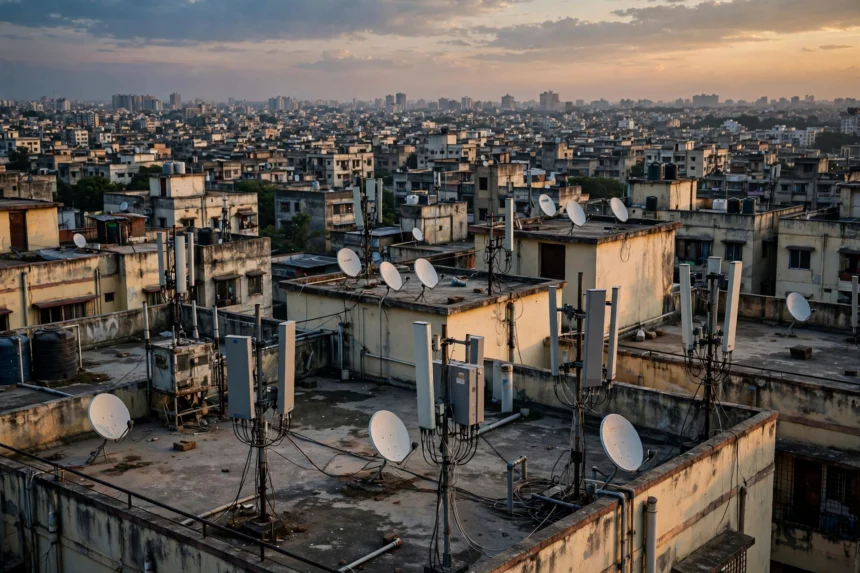
At the centre of the talks is Jio’s unlicensed band radio, or UBR, technology. In plain terms, it delivers high-speed broadband over free, unlicensed Wi-Fi frequencies, using transmitters mounted on nearby towers or rooftops to beam internet to receivers installed on buildings. No cable needs to be dug up to reach each home.
Reliance calls the system a global first, and the cost argument is straightforward. Laying fibre or cable to every home is expensive and slow. A wireless system that rides on unlicensed spectrum can reach homes faster and cheaper.
Jio said last week that it was targeting 10 to 15 partners globally for the platform. The company already has nearly 15 million wired broadband users in India, while Reliance has said UBR-powered users have crossed 6.5 million. This is not a lab experiment. It is a system already serving millions of homes in India, now being offered abroad.
Why Comcast and Charter would listen
For Comcast and Charter, the timing is uncomfortable. Both are among the largest broadband providers in the United States, but both have been losing customers to fibre and fixed wireless rivals. Comcast had about 28.3 million residential broadband customers at the end of September, while Charter had around 29.4 million internet customers in June, and both have watched those numbers come under pressure.
A cheaper way to connect homes, without the heavy cost of new cable, is an attractive proposition for operators trying to defend their base. For Jio, the prize is different: a foothold in the world’s largest broadband market, and equity in established businesses, without having to build a network from scratch in a foreign country.
The MTN lesson
Not every conversation has gone Jio’s way. The report says Jio also held discussions with South Africa’s MTN Group, but those talks broke down because the two sides could not agree on valuation and certain licensing issues. One source put it plainly: MTN could not persuade Jio to invest at a satisfactory valuation.
That detail tells its own story. Jio is not chasing any deal at any price. It is selective about valuation and licensing terms, and it is prepared to walk away when the numbers do not work.
What Jio wants overseas
Jio’s international expansion is being led by Dan Bailey, a former Deutsche Bank technology, media and telecom executive, along with senior company executive Mathew Oommen, according to the report. Managing Director Akash Ambani has said the company wants to take UBR technology to developed and developing markets, while remaining selective about where it expands.
The strategy is deliberately light. Jio intends to operate as a technology-led business overseas rather than build its own networks in foreign markets. That keeps capital spending down and avoids the regulatory headaches of running a network in another country.
For now, this is a report based on sources, not an announcement. But the logic behind it is hard to ignore. Jio has technology that works at Indian scale, American cable giants have a cost problem, and both sides have a reason to talk. Whether those talks turn into equity deals is the question the market will be watching through the rest of this year.
FAQs
What is Jio discussing with Comcast and Charter?
Jio is reportedly in talks to licence its wireless broadband technology to the US cable operators in exchange for potential equity stakes, according to Reuters sources.
What is UBR technology?
Unlicensed band radio technology delivers high-speed broadband over free Wi-Fi frequencies, using rooftop or tower transmitters to beam internet to receivers on buildings, without a cable connection to each home.
Has any deal been signed?
No. The sources said there is no timetable for an agreement, and none of the companies has publicly confirmed the talks.
Why did the MTN talks fail?
Discussions with South Africa’s MTN Group broke down over valuation and licensing issues, according to the report.
How many partners is Jio targeting?
Jio said last week it was targeting 10 to 15 global partners for its technology platform.
Stay with Informeia for updates on Jio’s global expansion and India’s biggest technology stories.