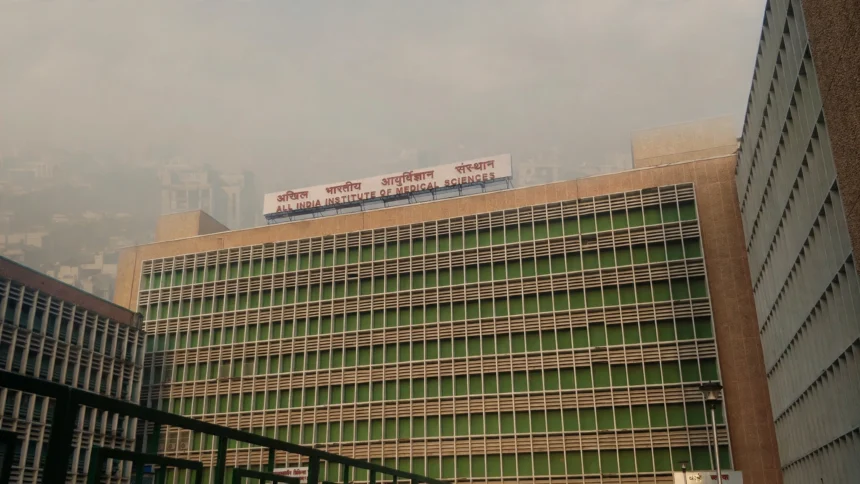
Delhi woke to severe air on Friday, with the citywide air quality index touching 403. As the capital chokes, doctors at the All India Institute of Medical Sciences (AIIMS) in New Delhi are running India’s first population-level study into a question that worries a growing number of families: can years of breathing polluted air cause lung cancer, even in people who have never smoked?
The study, called AIRCARE, short for Air Pollution and Cancer Research Ecosystem, will follow 3,230 people in Delhi and the National Capital Region over three years. It aims to build India-specific evidence on how PM2.5 affects the lungs.
What AIRCARE will do
Researchers plan to enrol 1,615 lung cancer patients and an equal number of their family members, who will act as controls. Family members were chosen deliberately: they usually share the same home, neighbourhood and outdoor air as the patient, for a sharper comparison. Patients will be drawn from the AIIMS outpatient department and the Delhi Cancer Registry, and must be adults aged 18 or older living in Delhi or NCR, with a confirmed diagnosis. Both smokers and non-smokers will be included.
Exposure to PM2.5 will be estimated from satellite data, ground-level monitors and land-use modelling, plus indoor sensors and wearable monitors that track what each person actually breathes. In the laboratory, researchers will expose blood cells to PM2.5 samples and use gene sequencing to look for early genetic changes that could flag people at risk.
The project runs from September 2025 to August 2028, with a budget of about Rs 8.6 crore, per its registry entry.
Researchers are now appealing for participants across Delhi-NCR.

Why non-smokers are at the centre of it
“Lung cancer is no longer a disease that we can associate only with smoking,” Dr Abhishek Shankar, the study’s principal investigator from the Department of Radiation Oncology at Dr B R Ambedkar Institute Rotary Cancer Hospital, AIIMS, told News18.
Lung cancer is the second most common cancer among Indian men and the fourth most common overall. The study protocol cites 81,784 new cases and 75,031 deaths in India, based on GLOBOCAN 2022 estimates. Air pollution, particularly PM2.5, has been identified as a significant risk factor for lung cancer in people who have never smoked.
The International Agency for Research on Cancer classified outdoor air pollution and particulate matter as cancer-causing in humans back in 2013. The AIIMS team’s calculations assume that people exposed to PM2.5 above 37 micrograms per cubic metre face at least twice the odds of lung cancer, close to India’s national annual standard of 40 and far above the World Health Organization’s guideline of 5. Delhi’s winter levels routinely run several times higher.
A second study on early screening
The same AIIMS team has registered a second study, the Indian Lung Screening Trial, or ILST. It is not about pollution. It tests whether low-dose CT scans can catch lung cancer early in people at high risk from smoking. The trial is open to people aged 50 to 80 with at least 20 pack-years of smoking, will run across 10 centres in India, is listed as not yet recruiting, and is expected to finish by September 2028.
Dr Shankar says current screening advice is largely based on age and smoking history, so people who have never smoked but have breathed polluted air for years may not be picked up. Evidence from the two studies could help build risk models that also weigh environmental and household exposures.
What doctors advise right now
The study will take time to produce results. In the meantime, doctors say the basics matter. Avoid tobacco, keep outdoor activity short when the air is severe, use proper respiratory protection outdoors, and do not ignore a cough that lingers, unexplained breathlessness or chest discomfort. Lung cancer often grows silently, and early symptoms are easily mistaken for a common cold.
On Friday, Delhi’s air quality dashboard showed the capital firmly in the severe band, with IIT Delhi recording 488, Chandni Chowk 479 and Delhi University’s North Campus 478. Stage III restrictions under the Graded Response Action Plan are in force across Delhi-NCR. For Delhi’s families, AIRCARE offers something new: hard Indian numbers on what the air they breathe is doing to their lungs.
FAQs
What is the AIRCARE study?
A three-year study by AIIMS New Delhi on how long-term PM2.5 exposure contributes to lung cancer, including in non-smokers. It will enrol 3,230 people in Delhi-NCR.
Who can take part?
Adults aged 18 or older living in Delhi or NCR with a confirmed lung cancer diagnosis, along with an eligible family member. Smokers and non-smokers can both participate.
How long will it run?
From September 2025 to August 2028, per its registry entry. It has been under way for about three months.
Does air pollution really cause lung cancer?
The International Agency for Research on Cancer classified outdoor air pollution and particulate matter as carcinogenic in 2013. AIRCARE aims to produce the first population-level Indian evidence on the link.
What is the ILST trial?
A separate AIIMS trial testing low-dose CT scans to catch lung cancer early in high-risk smokers. It has not started recruiting yet.
As Delhi’s air stays severe, the study is a reminder that the smog is not only a winter inconvenience. For the researchers at AIIMS, it is a slow, measurable health risk, and they are now gathering the evidence to show how much it matters.