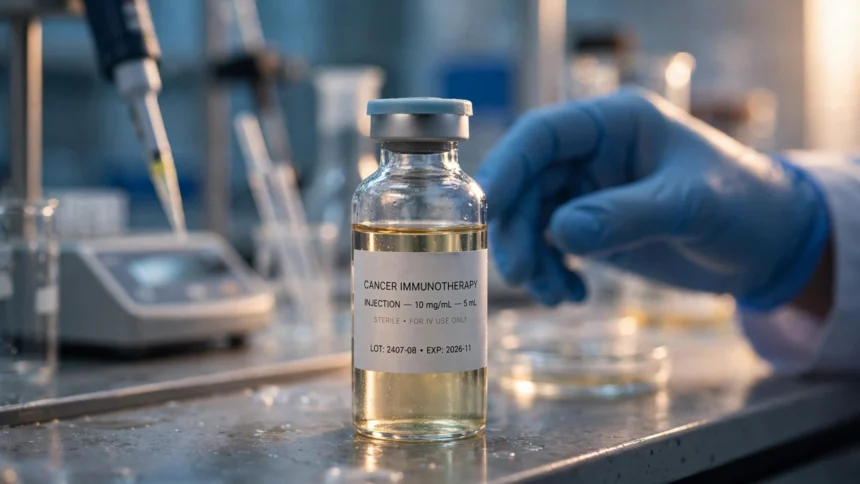
Dr Reddy’s Laboratories said on Wednesday that India’s drug regulator has cleared its cancer immunotherapy drug Zytorvi for a new and much larger patient group, giving doctors another weapon against a disease that claims thousands of lives in the country every year. The announcement, made on October 21, marks the second approved use of the drug in India and a meaningful step forward for patients with advanced esophageal cancer.
The Central Drugs Standard Control Organisation, working under the Drugs Controller General of India, has approved Zytorvi (toripalimab) in combination with the chemotherapy drugs cisplatin and paclitaxel. It is now cleared as a first-line treatment for adult patients with unresectable advanced, recurrent or metastatic esophageal squamous cell carcinoma, or ESCC, the most common form of esophageal cancer in India.
Why This Approval Matters
Esophageal cancer is one of the deadliest cancers because it is usually caught late. By the time many patients in India are diagnosed, the tumour has already spread beyond the point where surgery is possible. For such patients, the treatment options have traditionally been limited to chemotherapy, which works for some but leaves many with poor outcomes.
According to the company, ESCC accounts for roughly 80 per cent of all esophageal cancer cases in India. Expanding Zytorvi’s approved use into this large patient population means that oncologists can now prescribe an immunotherapy combination right from the first line of treatment, instead of waiting for the cancer to progress.
M.V. Ramana, Chief Executive Officer of Global Generics at Dr Reddy’s Laboratories, said the company was continuing to build its oncology portfolio with a focus on meaningful advances. “Our focus remains on bringing meaningful advances and expanding access to innovative treatment options,” he said in a statement.
How Zytorvi Works
Zytorvi contains toripalimab, a humanised monoclonal antibody that targets the PD-1 immune checkpoint. In simple terms, it blocks the interaction between the PD-1 receptor on immune cells and its ligands PD-L1 and PD-L2. Cancer cells use this pathway to hide from the immune system, and blocking it helps the body’s own T-cells recognise and attack the tumour.
This is the same class of drugs that has transformed the treatment of cancers like melanoma and lung cancer globally over the past decade. Bringing such therapies to Indian patients at scale has been one of the big goals of the domestic pharma industry in recent years.
What the Trial Data Shows
The regulatory clearance rests on the results of the Phase 3 JUPITER-06 clinical trial, which tested toripalimab combined with paclitaxel and cisplatin against chemotherapy alone in patients with advanced ESCC. The results, as reported by the company, were encouraging:
- The combination reduced the risk of disease progression or death by 42 per cent compared with chemotherapy alone.
- Median overall survival was 17.7 months for patients receiving toripalimab plus chemotherapy, against 12.9 months for chemotherapy alone.
- The benefit was seen across patient subgroups, regardless of PD-L1 expression levels.
That last point is significant for clinical practice. In India, the approved indication does not require patient selection based on PD-L1 biomarker expression, which means oncologists do not need to run an extra biomarker test before prescribing the drug. This removes a practical barrier and allows broader eligibility for appropriate patients.
The Road So Far
This is Zytorvi’s second approved indication in India. The drug was first cleared and launched in November 2024 for recurrent or metastatic nasopharyngeal carcinoma, a cancer of the area behind the nose and upper throat. With the latest approval, the drug’s use in India has now expanded from a relatively rare cancer to one of the country’s bigger oncology burdens.
Dr Reddy’s entered into a licensing and commercialisation agreement with Shanghai Junshi Biosciences in 2023, securing rights to develop and sell toripalimab across 21 countries. Globally, toripalimab has been approved by major regulators including the US Food and Drug Administration, the European Medicines Agency and the UK’s Medicines and Healthcare products Regulatory Agency.
Market Reaction
Investors gave the announcement a cautious reception. Shares of Dr Reddy’s Laboratories opened higher on October 21 but gave up the gains through the session, trading about 0.35 per cent lower at Rs 1,238.10 on the NSE in afternoon trade. Analysts noted that the commercial impact of the approval will depend on patient access, adoption by oncologists and how quickly the drug can be integrated into treatment protocols across hospitals.

What It Means for Patients
For patients and families dealing with an esophageal cancer diagnosis, the practical takeaway is that there is now an approved first-line immunotherapy option in India for advanced ESCC. The roughly five extra months of median survival seen in the trial may sound modest on paper, but for families living through treatment, every additional month matters.
Doctors caution that immunotherapy is not for everyone, and the choice of treatment depends on the patient’s overall health, the extent of disease and other clinical factors. Patients should discuss options with their oncologist rather than drawing conclusions from approval news alone.
Still, the approval adds to a growing list of advanced cancer therapies becoming available in India, and it strengthens the case for early diagnosis, which remains the single biggest factor in esophageal cancer outcomes.
FAQs
What is Zytorvi?
Zytorvi is the brand name of toripalimab, an immunotherapy drug made as a monoclonal antibody against the PD-1 protein. It helps the immune system find and destroy cancer cells and is given along with chemotherapy.
Which cancer is it now approved for?
In India, Zytorvi is now approved as a first-line treatment for adults with unresectable advanced, recurrent or metastatic esophageal squamous cell carcinoma (ESCC), in combination with cisplatin and paclitaxel. It was earlier approved for nasopharyngeal carcinoma.
How effective is the treatment?
In the Phase 3 JUPITER-06 trial, toripalimab plus chemotherapy cut the risk of disease progression or death by 42 per cent compared with chemotherapy alone, with median overall survival of 17.7 months versus 12.9 months. Individual results vary, and these figures are trial averages, not guarantees.
Do patients need a biomarker test before taking it?
No. The Indian approval does not require selection based on PD-L1 expression, so the drug can be considered for eligible patients without a prior biomarker test.
Is Zytorvi available outside India?
Yes. Toripalimab is approved by the US FDA, the European Medicines Agency and the UK’s MHRA. Dr Reddy’s holds commercialisation rights across 21 countries under its 2023 agreement with Junshi Biosciences.
With the latest DCGI nod, Dr Reddy’s has added another important chapter to India’s cancer care story. As immunotherapy moves from niche to mainstream in Indian oncology, approvals like this one decide how quickly the benefits of global research reach patients in Indian hospitals. For now, doctors have a new first-line option, and patients with advanced esophageal cancer have one more reason to hope.