In the first 18 days of November, global fashion brands quietly moved about $254 million worth of garment orders out of Bangladesh. Most of that work is heading to India, and factory owners in Tiruppur, Surat and Ludhiana are already fielding calls from buyers they have chased for years.
The shift, first reported by Reuters on November 27 and carried by The Hindu BusinessLine, The Times of India and Firstpost, covers orders placed between November 1 and 18. It amounts to nearly a tenth of the monthly orders these brands place in Bangladesh, and factory owners warn it may not reverse even when the current unrest ends.
What happened in Bangladesh
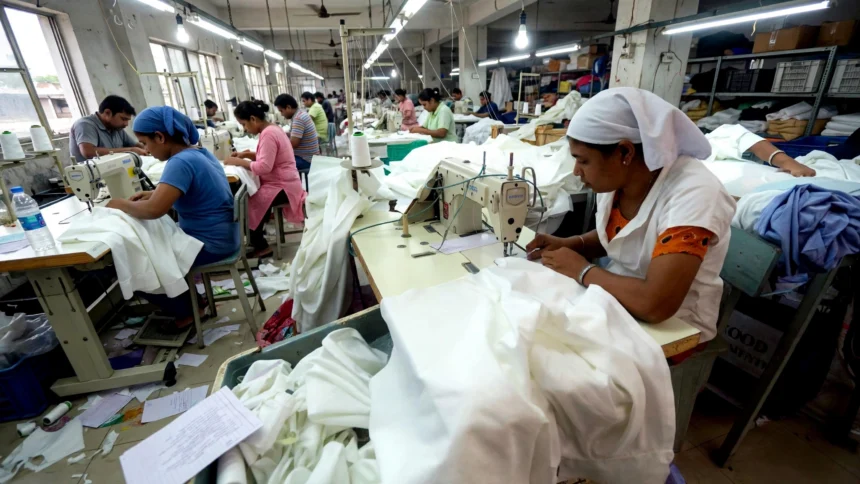
Bangladesh garment workers have been protesting since early November over wages and working conditions, and the unrest has shut factories and disrupted production across the Dhaka and Gazipur manufacturing belts. The Bangladesh Garment Manufacturers and Exporters Association (BGMEA) puts production losses from the protests at more than $400 million.
The latest flashpoint came this week, when the Bangladesh government approved a 36 per cent increase in the minimum wage for garment workers, from 12,500 taka to 17,000 taka, roughly $138 a month. Trade unions called it the smallest hike in four decades. Factory owners say rising wages, energy shortages and political uncertainty have steadily eaten away at the low-cost advantage that made Bangladesh the world’s second-largest apparel exporter after China.
Zara, H&M, Marks & Spencer and Celio were among the brands named by factory owners as diverting orders. The owners spoke on condition of anonymity because they did not want to damage relationships with international buyers.
Why India is the first call buyers make
India has emerged as the biggest beneficiary of the diversion, ahead of Vietnam, Cambodia and Indonesia, which also picked up orders. The reason is partly speed: India can offer buyers a delivery advantage of about a week over Bangladesh, according to industry leaders quoted by Reuters, while Vietnam and Cambodia can cut lead times by as much as 15 days.
The Chamber of Trade and Industry (CTI) in Delhi estimates the orders shifting to India are worth about Rs 2,360 crore, and it expects Tirupur, Surat, Ludhiana, Delhi-NCR, Noida, Gurugram and Bengaluru to benefit directly. In Tiruppur, India’s best-known garment exporting cluster, exporters say orders worth over Rs 200 crore have already moved out of Bangladesh in November.
There is also a longer game in play. Exporters in Tiruppur point to the India-EU free trade agreement, expected to come into effect in the near future, as a reason several European brands are now looking seriously for suppliers in India. A trade deal that cuts tariffs would make Indian garments cheaper in European shops, which is exactly the market these brands serve.
The numbers behind the shift
- $254 million: value of orders diverted from Bangladesh between November 1 and 18, nearly a tenth of monthly orders.
- Over $400 million: production losses from the protests, according to the BGMEA.
- 36 per cent: the minimum wage hike approved in Bangladesh this week, from 12,500 to 17,000 taka.
- Over 80 per cent: garments’ share of Bangladesh’s export earnings, and nearly 40 per cent of its manufacturing jobs.
- Rs 2,360 crore: the CTI’s estimate of the value of orders shifting to India.
- 60 to 90 days: typical delivery time from Indian factories, against about 120 days from Bangladesh.
Why it matters
This is a genuine opening for India’s textile industry, but it is not a prize already won. The $254 million figure counts orders diverted, not orders signed in India, and the distinction matters. Tiruppur’s own exporters are cautious: the Tiruppur Exporters Association says large players are getting these orders now, but its former president, Raja Shanmugham, notes that brands are still exploring alternative sources and actual orders are likely to be finalised only in March.
That gap between diverted and delivered is where India’s factories will be judged. Brands moved because Bangladesh became unreliable, not because India became cheaper, so the test now is whether Indian hubs can deliver at scale, on time, and at the quality global labels demand. If they do, what began as an emergency diversion could harden into longer contracts and more jobs in towns like Tiruppur and Ludhiana.
What happens next
Watch whether brands confirm longer contracts with Indian suppliers rather than one-off orders, whether Tiruppur’s March finalisation timeline holds, and how the India-EU trade agreement progresses.
FAQs
How much in fashion orders moved out of Bangladesh?
About $254 million was diverted between November 1 and 18, 2026, nearly a tenth of the monthly orders global brands place there.
Which brands shifted their orders?
Zara, H&M, Marks & Spencer and Celio were named by factory owners, with most of the diverted business moving to India.
Why did brands move orders out of Bangladesh?
Labour unrest and factory shutdowns since early November, along with rising wages, energy shortages and political uncertainty, disrupted production and eroded Bangladesh’s cost advantage.
How much has India gained from the shift?
The Chamber of Trade and Industry estimates orders worth about Rs 2,360 crore are shifting to India, with Tirupur, Surat, Ludhiana, Delhi-NCR, Noida, Gurugram and Bengaluru expected to benefit.
Will the shift last?
Not necessarily. Tiruppur exporters say brands are still exploring suppliers and actual orders are likely to be finalised in March, so Indian factories must prove they can deliver at scale and on time.