India’s richest shoppers are rewriting the luxury rulebook. While the rest of the world buys less, India keeps buying, just differently: fewer things, better quality, and a growing hunger for experiences over objects. That is the headline finding of the Atlas of Affluence 2026, a study of affluent consumers in six Indian cities by Kantar for The Voice of Fashion, published this week.
The numbers behind the mood are striking. Euromonitor puts India’s luxury market at around $12 billion, or roughly Rs 1.14 lakh crore, in 2025, and consultancy Kearney says the market is growing at 10 to 12 percent a year. The growth is not coming from a handful of old-money families in South Mumbai and South Delhi. It is coming from new buyers in smaller cities, startup founders, creators and small business owners who are trading up for the first time.
A market that refuses to follow the global script
Globally, luxury is having a sober year. Spending on personal luxury goods fell 2 percent to 358 billion euros in 2025, according to the Bain-Altagamma Luxury Goods Worldwide Market Study, and the number of luxury consumers worldwide has shrunk from about 400 million in 2022 to 340 million in 2025. India, grouped with the Middle East, Southeast Asia, Latin America and Africa, stands at about 45 billion euros, roughly the same as mainland China, where spending is expected to shrink by 3 to 5 percent.
What makes India different is who is buying. Government figures show the number of people reporting gross total income of Rs 100 crore or more quadrupled from 142 in assessment year 2021-22 to 576 in 2025-26. Those declaring income above Rs 1 crore rose from 48,417 in 2014-15 to just under 2,30,000 in 2023-24. Knight Frank’s Wealth Report 2026 puts India’s ultra-high-net-worth individuals at 19,877, up 63 percent from 12,161 in 2021, and expects the count to reach 25,217 by 2031.
The rise of the rich, in five years:
- Ultra-high-net-worth Indians: 12,161 in 2021, 19,877 in 2026
- Dollar millionaire families: 4,58,000 in 2021, 8,71,700 in 2025
- People earning Rs 100 crore or more: 142 in 2021-22, 576 in 2025-26
- India’s luxury market: about $12 billion in 2025, growing 10 to 12 percent a year
Cars: fewer sold, more money made
Nowhere is the shift clearer than in luxury cars. Mercedes-Benz India sold 19,007 cars in 2025, slightly fewer than the 19,500 it sold the year before, yet its revenue grew close to double digits. Demand for its top-end models grew 11 percent and sales of its AMG performance cars jumped 34 percent, even as entry-level sales fell 23 percent. The top-end segment now makes up a quarter of its sales, up from 15 percent. Mercedes no longer sells a car below Rs 50 lakh in India.
BMW Group India had a better year in volumes, selling a record 18,001 cars in 2025, up 14 percent. The pattern is the same though: buyers are starting at the top. Mercedes-Benz India chief Santosh Iyer says a new kind of buyer now starts with an E-Class, a GLE or an S-Class, thanks to the startup economy, the creator economy and second-generation wealth. A generation ago, a buyer would have climbed up to an E-Class after years of mass-market cars.
Gold: lighter pieces, heavier bills
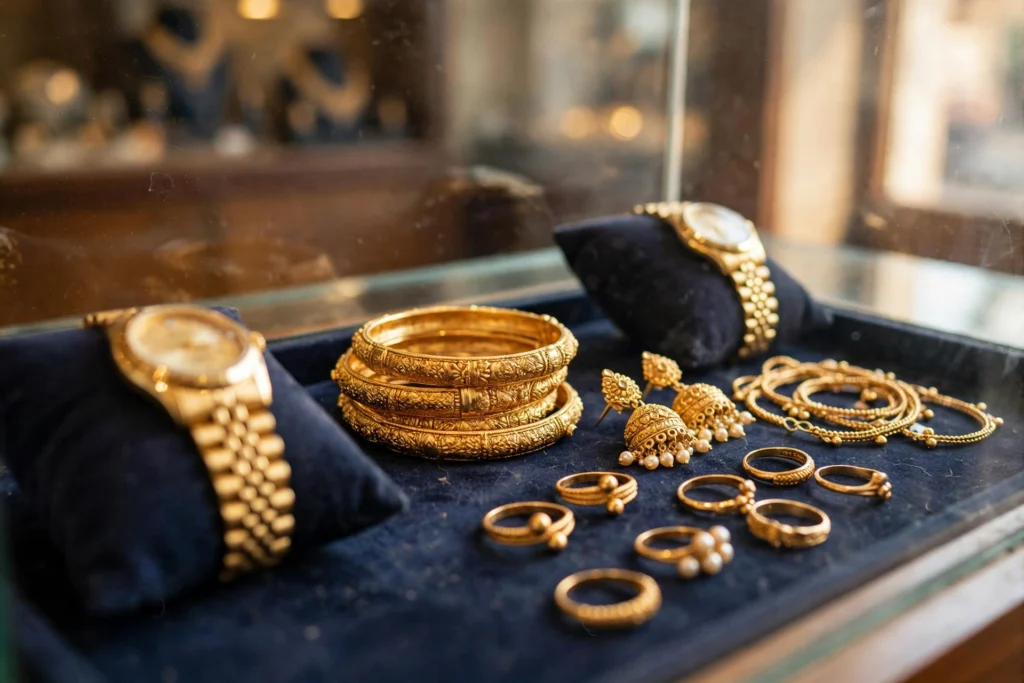
Gold tells a similar story of paying more for less. After what the World Gold Council calls an exceptional rally, the domestic price averaged a record Rs 1,51,108 for 10 grams in the January to March quarter, 81 percent higher than a year earlier. In the first half of 2026, jewellery demand fell 17 percent to 141.2 tonnes, while its value rose 40 percent to about Rs 2.13 lakh crore. Buyers are choosing lighter, lower-carat pieces and smaller, less frequent purchases. Demand for bars, coins and exchange-traded funds rose 54 percent to 82 tonnes in the first quarter alone.
Watches are booming too. Swiss watch exports to India rose 31.7 percent to 231.9 million Swiss francs, around Rs 2,667 crore, in the first eight months of 2026, while worldwide exports grew only 1.7 percent. India is now the industry’s 14th-largest market, up from 21st a year earlier. Ethos, India’s largest luxury watch retailer, saw its average selling price rise 22.9 percent to Rs 2.07 lakh in the year to March 2026, with revenue up 28.8 percent to Rs 1,612 crore.
Experiences are the new status symbol
The most striking change is what affluent Indians now consider a luxury purchase. The Atlas of Affluence found nearly 30 percent of affluent respondents spent Rs 2 lakh or more a year on travel and wellness, and 17 percent spent that much on fine dining. Euromonitor expects the experiential luxury market, covering luxury hospitality and fine dining, to expand 20 percent a year between 2025 and 2030, reaching Rs 62,600 crore.
Visa Consulting and Analytics found that three in four affluent consumers made at least one high-end purchase every quarter, while one in four bought something premium every two weeks. The money is moving from things you own to moments you remember: Antarctica expeditions, private-jet itineraries, curated vineyard dinners and cooking classes with Michelin-starred chefs. Even drinking habits show it. Spirits volumes fell about 3 percent in FY26, yet revenue is expected to grow 10 to 12 percent as buyers pick premium labels. Indian single malts reached about 5,00,000 cases in 2025, up around 22 percent, against roughly 3,50,000 cases of imported single malts.
Why it matters
This is not just a story about the rich getting richer. It changes how brands sell in India, and it changes prices for everyone else. Global luxury houses can no longer copy their China playbook here. Indian buyers want quality and craftsmanship, but they also want value, and they judge a product on its own merit rather than its country of origin, whether that is an Indian single malt or a homegrown jewellery label.
Premiumisation also pushes up the entry price of luxury itself. The Mercedes GLC, priced close to Rs 60 lakh not long ago, now costs Rs 78 lakh, and the brand’s cheapest car starts at Rs 50 lakh. As more first-time buyers enter from smaller towns, Salem and Chandigarh as much as South Bombay, luxury retail will have to follow them beyond the metros. For the middle-class reader, the lesson is simpler and worth copying: buy less, buy better, and spend on the experience rather than the logo.
FAQs
How big is India’s luxury market?
Euromonitor puts it at around $12 billion, about Rs 1.14 lakh crore, in 2025. Kearney says the market is growing at 10 to 12 percent a year, though its estimate of when it reaches $12 billion differs slightly.
What is the Atlas of Affluence 2026?
It is a study of affluent consumers in six Indian cities, conducted by Kantar for The Voice of Fashion. Its headline finding is a shift towards more considered consumption: fewer purchases, more attention to quality, and a growing premium on experiences.
Why are Indians buying fewer but costlier luxury items?
Rising prices, especially gold and imported goods hit by a weaker rupee, are part of it. The bigger driver is a change in taste: buyers are choosing quality, craftsmanship and experiences over owning more things.
Which luxury categories are growing fastest in India?
Top-end cars, Swiss watches, jewellery by value, and experiences such as luxury travel, wellness and fine dining. Spirits volumes are falling, but revenue is rising as buyers trade up to premium labels.
India’s luxury story is no longer about catching up with the world. On current trends, the world will be watching how India shops next.