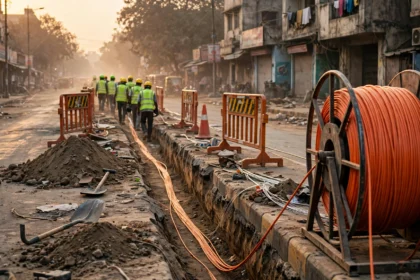
India has been ranked an AI Rising Contender in Boston Consulting Group’s AI Maturity Matrix 2026, putting the country in the second-highest of four readiness bands in a study covering more than 75 economies. The report, picked up widely in India on Wednesday, credits the ranking not to computing power or big-ticket infrastructure, but to something harder to buy: people.
BCG’s message is blunt. “Compute can be procured in months, but talent cannot,” the consultancy said, and that line explains why India sits where it does. The country may not yet be an AI Pioneer, but its workforce gives it a foundation money alone cannot build overnight.
What the ranking actually measures
The matrix assesses more than 75 economies on 33 indicators, grouped under BCG’s ASPIRE framework: Ambition, Skills, Policy and regulation, Investment, Research and innovation, and Ecosystem. Countries are sorted into four readiness bands, and India lands in the second-highest, a group BCG calls Rising Contenders.
These are economies with high readiness to use AI but lower exposure to disruption. Above them sit the seven AI Pioneers: Canada, mainland China, Japan, Singapore, South Korea, the United Kingdom and the United States. Japan and South Korea joined that top tier only in this edition. India did not move up a tier this time, but it held its place in a field where nearly every economy improved on at least one measure.
Talent, not compute, is India’s edge
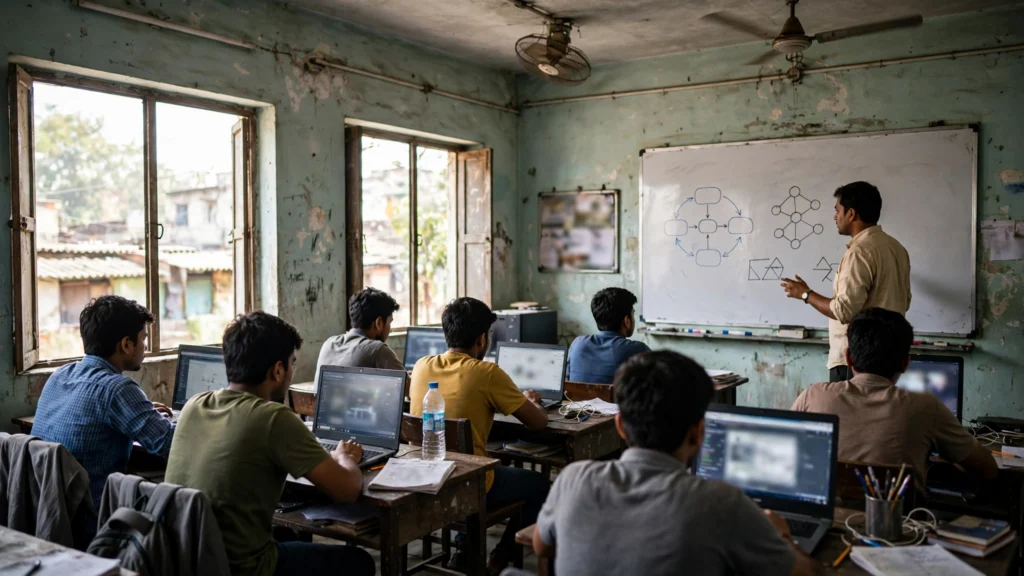
BCG said India’s strength lies in “Skills”: a large pool of AI specialists, backed by a vast IT-services workforce whose managed-delivery work is, in the report’s words, “structurally adjacent to supervising AI systems”. Millions of Indian professionals already do the organised, process-driven work AI oversight demands.
Each Rising Contender, BCG said, identified one or two structural advantages and built Pioneer-level capability there. Saudi Arabia is building a sovereign-owned national champion, the UAE has used sovereign capital and partnerships, and India’s advantage is talent. The report says the country has benefited from highly skilled professionals returning from the United States, Britain, the United Arab Emirates and Canada.
That timing matters. Cross-border relocation of AI talent fell 12 per cent in 2025, shrinking the global pool and intensifying competition for skilled professionals. In a market where experienced AI hands move less, a country that can grow its own, and welcome back its own, has a real edge.
10 million citizens in the upskilling pipeline
The government programmes behind the ranking are aimed at scale. Yuva AI for ALL, a free foundational course, aims to upskill 10 million citizens. IndiaAI FuturesSkills is setting up AI labs in smaller cities and offering professional certifications, broadening access beyond the big metros.
BCG also pointed to India hosting the 2026 AI Impact Summit as evidence of the country’s rising influence. The summit puts India at the centre of debates on how AI should be governed and deployed, not just how it is built.
AI is now a proven economic force
The wider findings show why the ranking matters. BCG said AI is “now a proven economic force”. Enterprise AI investment doubled in 2026 as a share of firm revenue, and nearly nine in ten chief executives surveyed reported cost or revenue benefits. Strikingly, 94 per cent said they would keep investing even if it does not pay off this year.
Exposure is highest in information and communication, financial services and high-tech goods, lowest in agriculture and mining. BCG’s modelling suggests roughly half of US jobs could be redesigned in two to three years, with about one in ten at risk of displacement over a longer horizon.
Execution is the next test
The report’s warning is clear: execution now matters more than intent, since nearly every economy has a national AI strategy. What will separate the gainers in the next edition is the ability to deploy and manage AI at scale, quickly and resiliently, rather than the best access to technology.
Physical constraints are increasingly decisive too: power, permitting speed and grid interconnection decide where AI capacity gets built. For India, the challenge is converting a deep talent bench into deployed capacity fast enough to keep pace with the Pioneers above it.
In a global race where compute can be bought and strategies copied, BCG says India’s people are its moat. The next edition will show whether the country can turn that moat into momentum.
FAQs
What is the BCG AI Maturity Matrix 2026?
It is Boston Consulting Group’s study of how ready economies are for AI, assessing more than 75 economies on 33 indicators.
What does AI Rising Contender mean?
It is the second-highest of four readiness bands, for economies with high readiness to use AI but lower exposure to its disruption, below the seven AI Pioneers.
Why did India rank as a Rising Contender?
BCG credited India’s large pool of AI specialists and its IT-services workforce, plus returning talent from the US, UK, UAE and Canada.
What is Yuva AI for ALL?
It is a free foundational AI course that aims to upskill 10 million citizens, spreading AI skills beyond major cities.
Which countries are AI Pioneers?
Canada, mainland China, Japan, Singapore, South Korea, the United Kingdom and the United States. Japan and South Korea joined the top tier in the 2026 edition.
India’s AI story is now about turning talent into deployed capacity. The ranking is a strong start; the hard work of execution comes next.