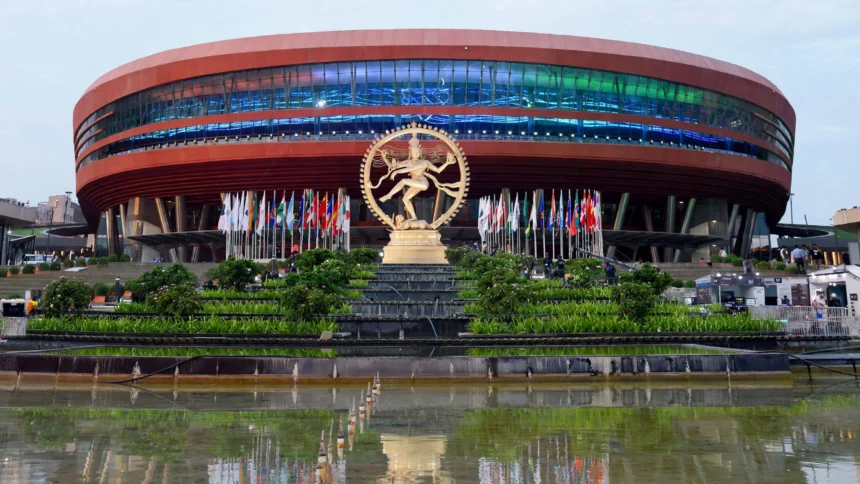
New Delhi: At a crowded exhibition hall in Bharat Mandapam, the stall that drew Prime Minister Narendra Modi this week was not selling a phone or a gadget. It was showing how India might build the next generation of mobile networks itself, and how that technology could reach places where a phone signal still cannot.
The startup behind the stall was WiSig Networks, incubated at the Indian Institute of Technology Hyderabad. During the Emerging Science, Technology and Innovation Conclave, ESTIC 2026, which ran from October 27 to 29, WiSig showed Modi its indigenous 5G work, a satellite messaging device and early research aimed at 6G. Modi stopped at the stall, watched the demonstrations and asked the team about the 6G work under way at IIT Hyderabad and at WiSig.
ESTIC 2026 brought together scientists, policymakers, industry leaders and around 150 deep-tech startups across 12 thematic areas.
What WiSig showed at Bharat Mandapam
WiSig presented three strands of work, and each one was about a different kind of distance. The first was rural connectivity. The startup demonstrated indigenous 5G networks already deployed in rural India, providing high-speed connectivity to households, gram panchayats, anganwadis and schools in underserved villages. It is the part of telecom that decides whether a village school can hold an online class or a panchayat office can file records without a long trip to town.
The second was a small device with an outsized job. Called the Koala Tag, it is a compact communication device designed to connect through terrestrial mobile towers and satellites. In plain terms, it is meant for places where the mobile network ends. A user in a remote area could send messages, share a location and seek emergency assistance using an existing mobile phone, with the device bridging the gap to a satellite when no tower is in reach. WiSig said the technology could help fishermen far offshore and defence personnel in border regions, two groups for whom a lost signal can quickly become a safety problem rather than an inconvenience.
The third was the longest view of all. The team briefed Modi on OTFDM, an emerging pre-6G waveform developed by IIT Hyderabad researchers and WiSig Networks.
Why rural 5G matters first
In villages, connectivity is often about access to services that cities take for granted: school lessons, health information and government services. A network built for those places has to work with local conditions, not just in a laboratory.
- Koala Tag: a compact device that connects through mobile towers and satellites, for messages, location sharing and emergency help in remote areas.
- Rural 5G: indigenous 5G networks demonstrated for households, gram panchayats, anganwadis and schools in underserved villages.
- Pre-6G research: OTFDM, an emerging waveform developed by IIT Hyderabad researchers and WiSig, briefed to the Prime Minister.
- The setting: ESTIC 2026 at Bharat Mandapam, New Delhi, October 27 to 29, with around 150 deep-tech startups across 12 thematic areas.

The people behind the demo
The demonstrations were led by Sakshama Ghoslya, principal engineer at WiSig Networks and an MTech alumnus of IIT Hyderabad. That detail matters because WiSig grew out of IIT Hyderabad’s research ecosystem, and its work on radios and chips, the hardware that carries mobile signals, was designed in India for Indian networks first.
India’s push for indigenous telecom technology has been building for years, driven by a simple concern: a country of this size should not depend entirely on imported equipment for the networks its economy and public services run on.
What happens next
The conclave lasted only three days, and the harder test will come after the exhibition lights go off: wider rural deployments, reliable performance in the field, and devices that ordinary users can afford and understand. Satellite messaging will need clear answers on cost and availability, and on how it works alongside regular mobile networks.
For now, the showcase has done what such demonstrations are meant to do. It took research out of the lab and tied it to a concrete question: can Indian-built telecom reach the fisherman offshore, the school in an underserved village and the soldier on a remote border, as reliably as it reaches a city office? WiSig’s answer this week was to show the hardware and let the demos speak.
FAQs
What is WiSig Networks?
WiSig Networks is a telecom technology startup incubated at IIT Hyderabad. It works on radios and chips for mobile networks, with a focus on indigenous 5G and research aimed at 6G.
What is the Koala Tag?
It is a compact device shown by WiSig at ESTIC 2026 that connects through mobile towers and satellites. It is designed to let users in remote areas send messages, share locations and seek emergency help using their existing phones.
What did PM Modi see at the WiSig stall?
Modi visited the stall at Bharat Mandapam during ESTIC 2026, watched demonstrations of rural 5G, satellite communication and pre-6G research, and asked about the 6G work at IIT Hyderabad and WiSig.
When and where was ESTIC 2026 held?
ESTIC 2026 was held at Bharat Mandapam in New Delhi from October 27 to 29, 2026, with around 150 deep-tech startups across 12 thematic areas.
WiSig’s showcase will be watched closely now, not for the applause in the hall, but for what reaches villages, coasts and border areas next.