New Delhi is thinking in decades, not news cycles. Speaking at the Bloomberg New Economy Forum on Wednesday, Union Minister Ashwini Vaishnaw laid out India’s plan to reduce its critical technology dependencies over the next 20 to 25 years, framing the goal as building resilience rather than chasing isolation.
The message was carefully calibrated. India does not want complete self-sufficiency, he said. It wants to become a trusted partner across global technology supply chains, strong enough that a shift in geopolitics or a policy change in another capital cannot derail its factories or its economy.
A 20-year horizon, not a quick fix
Vaishnaw described a three-layered strategy: short-term goals for the next three to five years, medium-term targets stretching five to 15 years, and long-term ambitions running 20 to 25 years. The starting point, he said, is an honest audit of where dependence on other countries could turn into vulnerability.
“Things change, politics change, geopolitics play a big role,” he said, arguing that India must constantly calibrate its approach as the world shifts. The minister stressed that technology will remain a global industry with supply chains spanning many countries. The priority, he added, is to identify strategic dependencies and make sure partnerships do not compromise India’s resilience.
Semiconductors: the ecosystem comes first
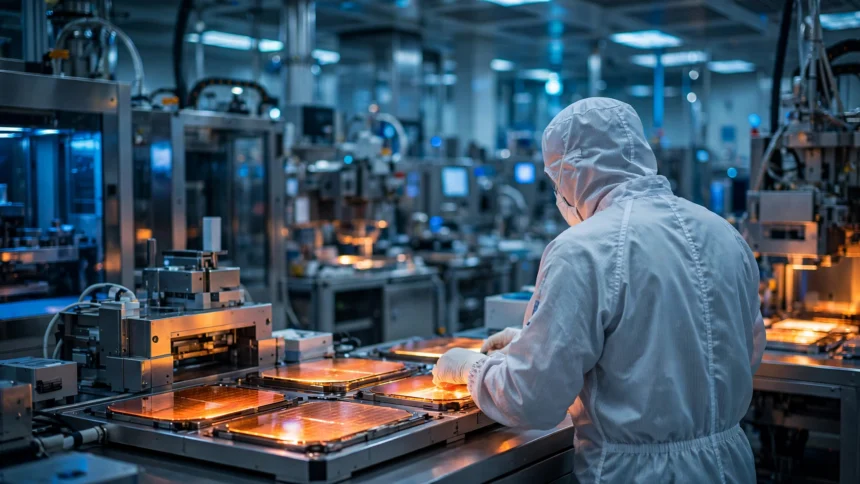
The clearest example of this thinking is semiconductors. The second phase of India’s semiconductor programme places far greater weight on the inputs behind the chip: materials, chemicals, gases and substrate materials, alongside chip design and manufacturing itself.
Vaishnaw was blunt about the reason. Without a complete ecosystem, he said, no manufacturing effort will ever pay off. A fabrication plant alone is not enough. The gases, the chemicals, the substrates and the tooling all have to exist around it, or the factory stays tied to the very supply lines it was meant to replace.
From assembly to components: the phone playbook
To show that the strategy works, the minister pointed to mobile phones. India started with assembly, then moved up into modules and components. Today the country manufactures many of the components it needs domestically and has even begun exporting some of them to other countries.
It is the model New Delhi now wants to repeat across other strategic sectors: climbing the value chain step by step instead of betting everything on one giant leap.
The 4G stack and the R&D push
Vaishnaw also highlighted India’s end-to-end 4G telecom stack, built through government and private sector collaboration in three and a half years and now deployed on more than 100,000 towers. He presented it as proof that patient, directed engineering can deliver genuinely sovereign infrastructure.
On research, he acknowledged a gap. India needs to increase its R&D spending and, just as importantly, direct it better, with a sharper tilt toward applied research that reaches industry and production lines.
AI jobs, debt and the coming turbulence
The minister closed on a note of caution about the world India is planning for. He warned that artificial intelligence would disrupt employment, particularly in services industries, and that the unwinding of debt levels in advanced economies would add to the turbulence ahead.
India, he said, is preparing by strengthening its financial, economic and technological resilience. The country’s public debt-to-GDP ratio has declined from 61 per cent to 55 per cent over the past five years, a number he offered as evidence of fiscal discipline.
Joining the discussion, Cisco chairman and CEO Chuck Robbins said India’s scale and its approach of building strategically important capabilities while partnering with trusted companies offered a practical path toward technology sovereignty.
What the plan boils down to
- A 20 to 25 year horizon to cut critical technology dependencies
- Short, medium and long-term targets layered on top of each other
- A trusted-partner strategy inside global supply chains, not isolation
- Semiconductor phase two focused on ecosystem inputs, not just fabs
- More R&D spending with a push toward applied research
FAQs
What did Ashwini Vaishnaw announce at the Bloomberg New Economy Forum?
He said India is planning over a 20 to 25 year horizon to reduce critical technology dependencies and build resilience against global disruptions, with layered short, medium and long-term goals.
Does India want complete technological self-sufficiency?
No. Vaishnaw said the aim is for India to become a trusted partner across global technology supply chains, building domestic capabilities in strategic areas while staying integrated with global value chains.
Why is the government emphasising the semiconductor ecosystem over fabs?
Because, as Vaishnaw put it, without the full ecosystem, materials, chemicals, gases, substrates and tooling, no manufacturing effort will ever pay off. Phase two of the semiconductor programme focuses on these inputs.
What did Vaishnaw say about AI and future disruptions?
He warned that AI would bring significant disruption to employment, especially in services, and that high debt levels in advanced economies would add to global turbulence, making resilience essential.
For now the plan is a statement of intent. But it is a long one, and in New Delhi’s telling, that is the point.