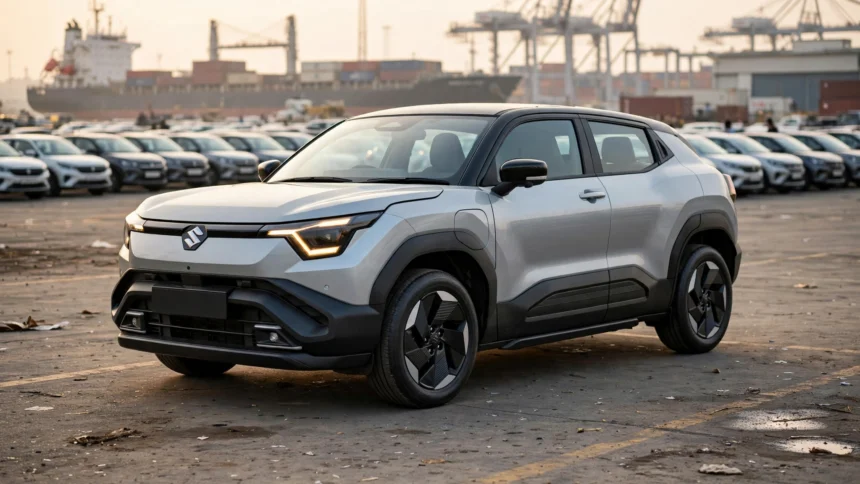
Maruti Suzuki has crossed a milestone that says as much about India as a manufacturing base as it does about one car. The company announced on October 29 that cumulative exports of its electric vehicles from India have passed 50,000 units, just over a year after overseas shipments began in August 2025.
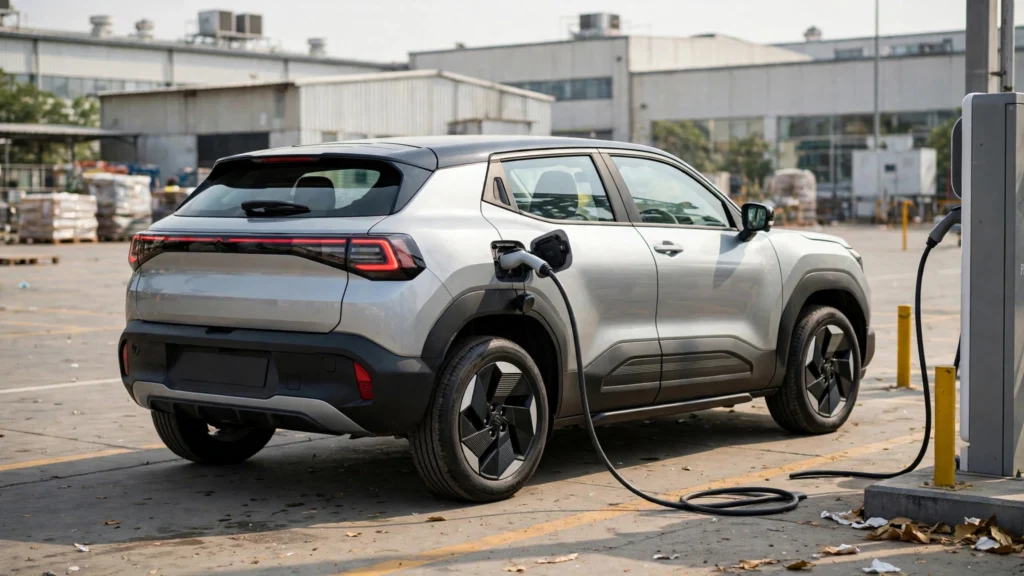
The vehicle behind the number is the e Vitara, Suzuki’s first battery-electric model for global markets. Every unit is built at Maruti Suzuki’s Hansalpur plant in Gujarat. From there, the made-in-India car now reaches nearly 50 countries, with Europe as its largest export destination.
For a company long known at home for small petrol hatchbacks, this is a different kind of leadership. In the April to September 2026 period, Maruti Suzuki accounted for nearly 93 per cent of India’s electric passenger vehicle exports, according to the company. It retained its position as India’s largest exporter of electric vehicles, a rank it also held in the previous financial year.
A Gujarat plant at the centre of the story
The Hansalpur facility is doing heavy lifting well beyond the e Vitara. The plant recently raised its annual production capacity to one million units, making it the first Suzuki facility anywhere in the world to reach that level of output at a single location. Maruti Suzuki says the site accounted for close to half of all its overseas shipments in the last financial year, and cumulative investment in the facility stands at Rs 25,288.7 crore.
Beyond electric models, the company says it has been India’s leading passenger vehicle exporter for five consecutive years. During April to September 2026, it accounted for more than 50 per cent of all passenger vehicle exports from India, shipping 16 models to nearly 120 markets.
Where the e Vitara is going
Europe remains the main destination by volume, and it was also the first overseas market for the car. The top ten export destinations include the United Kingdom, Norway, Germany, Japan and Switzerland, a mix that puts the Gujarat-built SUV in some of the most competitive electric car markets in the world.
Maruti Suzuki’s managing director and chief executive, Hisashi Takeuchi, linked the milestone back to the start of the programme. He said the export journey began in August 2025, when Prime Minister Narendra Modi marked the start of production of the e Vitara at Hansalpur, for sale in over 100 countries. At the same event, the Prime Minister described Maruti Suzuki as a brand ambassador of the Make in India initiative, Takeuchi said.
“Today, Maruti Suzuki exports EVs to nearly 50 of these countries, with Europe being the largest destination,” Takeuchi said. “In April-September 2026, Maruti Suzuki accounted for nearly 93 per cent of India’s electric passenger vehicle exports. This milestone reflects India’s advanced manufacturing capabilities and its growing competitiveness.”
Why 93 per cent matters, and what it does not prove
A 93 per cent share is striking, but it needs context. India’s electric passenger vehicle export base is still small and concentrated, so one successful model from one large plant can dominate the total. The figure shows that Maruti Suzuki got to scale first with a global electric car built in India. It does not, on its own, mean that India is already a large electric car exporter in absolute terms.
What it does show is execution. Building a car in Gujarat that buyers in Norway, Germany and Japan will accept, and shipping it in volume within a year of starting production, is a demanding test that the e Vitara has cleared on the evidence of these first 50,000 exports.
What buyers and the industry should watch
- More markets: watch whether shipments move beyond the current top destinations and closer to the planned 100-country footprint.
- Domestic spillover: a plant proven on global quality standards often raises the bar for cars built on the same lines for Indian buyers too.
- Competition: other Indian manufacturers are preparing electric exports of their own. A falling share for Maruti Suzuki could still mean a much larger total market.
- Capacity: with Hansalpur now at one million units a year, the question is how much of that capacity electric models will take up as demand grows.
For now, the headline is simple. A car built in Gujarat, launched for the world in August 2025, has passed 50,000 exports in just over a year, an early proof point for India’s ambitions as an electric vehicle manufacturing hub.
FAQs
How many electric vehicles has Maruti Suzuki exported from India?
More than 50,000 units cumulatively since overseas shipments began in August 2025, the company announced on October 29, 2026.
Which car accounts for these EV exports?
The e Vitara, Suzuki’s first battery-electric model for global markets. It is built exclusively at the Hansalpur plant in Gujarat.
What share of India’s electric car exports does Maruti Suzuki hold?
Nearly 93 per cent of India’s electric passenger vehicle exports in April to September 2026, according to the company.
Where does the e Vitara go?
To nearly 50 countries, with Europe as the largest destination. Leading markets include the United Kingdom, Norway, Germany, Japan and Switzerland.
When did e Vitara production and exports begin?
Production at Hansalpur was marked in August 2025, and global shipments began the same month. The car was planned for sale in over 100 countries.
Informeia will track Maruti Suzuki’s export numbers as the company reports them.