


Ola Electric’s September quarter results, filed with the stock exchanges on Thursday, tell a story the company has now repeated for two years: a smaller loss, but on a much smaller business. Revenue from operations fell 39 percent year on year to Rs 421 crore in the July to September quarter of FY27, even as the net loss narrowed 13 percent to Rs 362 crore. The market’s verdict came fast. Shares of the electric two-wheeler maker fell more than 6 percent in early trade on Friday, touching an intraday low of Rs 33.50.
The numbers underline how far Ola Electric has slipped from its position as India’s largest electric scooter maker. A year ago, the same quarter produced Rs 690 crore of revenue. In the June quarter, revenue was Rs 455 crore. The latest quarter is the eighth in a row in which revenue has fallen compared with the same period a year earlier, according to Mint.
The headline numbers
- Revenue from operations: Rs 421 crore, down 39 percent from Rs 690 crore a year ago and down about 7 percent from Rs 455 crore in the June quarter.
- Net loss: Rs 362 crore, narrower than the Rs 418 crore loss a year ago, but wider than the Rs 336 crore loss in the June quarter.
- Operating EBITDA loss: Rs 218 crore, against Rs 203 crore in the year-ago quarter.
- Gross margin: 29.9 percent, compared with 30.9 percent a year ago and 30.5 percent in the June quarter.
- Total income: Rs 448 crore including other income of Rs 27 crore, down 41 percent from Rs 756 crore a year ago.
- Total expenses: Rs 639 crore, down 28 percent from Rs 893 crore a year ago, as the company cut costs through workforce restructuring, lower warranty spending and tighter working-capital management.
- Deliveries: 34,667 vehicles, down 34 percent from 52,666 in the same quarter last year.
The automotive business contributed Rs 420 crore of the revenue, while the cell business added just Rs 3 crore. The automotive segment posted an operating EBITDA loss of Rs 120 crore, while the cell business narrowed its operating EBITDA loss by 36 percent to Rs 32 crore.
Shrinking while the market grows
The most uncomfortable part of the results is the contrast with the wider industry. India’s electric two-wheeler market grew rapidly in the same quarter, with industry volumes rising nearly 83 percent year on year to about 5,99,000 units, according to Mint data. Ola Electric moved in the opposite direction, with deliveries down by a third.
The trend continued into October. Ola’s registrations fell about 26 percent to roughly 12,000 units even as the overall market grew 48 percent, Mint data shows. Its market share in electric two-wheelers has now narrowed to 5.4 percent in October, from around 35 percent in 2024.
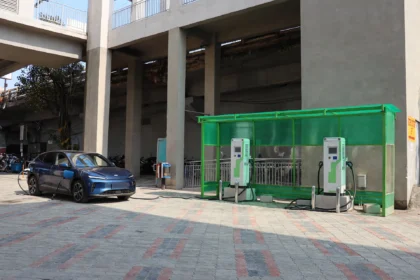
Chairman Bhavish Aggarwal wrote in the shareholder letter that demand was running ahead of supply and that a shortage of chargers had delayed delivery of about 5,000 vehicles. Even so, the gap between Ola’s volumes and the industry’s growth remains the central question for investors: rivals such as TVS and Bajaj have taken share while Ola has restructured.
The dealer pivot
Ola Electric is betting its recovery on a complete change in how it sells scooters. The company has moved away from its original direct-to-consumer, company-owned store model to a dealership network. It stopped taking orders at its own stores on 1 November.
As of 8 November, Ola had onboarded 255 dealer partners and set up 319 operational stores. The plan is to reach 450 stores by December and 700 by March. The shift is meant to cut fixed costs and put scooters in front of buyers in smaller towns, where dealers already have relationships and service reach that a company-owned network could not build quickly.
The cost cuts are visible in the results. Operating expenses fell to Rs 369 crore in the quarter, and total expenses dropped 28 percent year on year. But the adjusted operating EBITDA margin worsened to minus 58.5 percent from minus 37.4 percent a year ago, showing that the smaller revenue base is still not covering costs.
What brokerages are saying
Brokerages were unconvinced. Goldman Sachs maintained its Sell rating on the stock and lowered its target price to Rs 22 from Rs 23, cutting its FY27 to FY29 revenue estimates by up to 6 percent and citing weak volumes and continued losses. Kotak also flagged more pain ahead for the stock after the results.
The scepticism reflects the maths of the turnaround. Ola needs volumes to recover sharply for the dealer model and the cost cuts to translate into profits, and the October registration numbers suggest that recovery has not yet started. The company’s own guidance will be watched closely in the coming quarter, along with whether the charger shortage that delayed 5,000 deliveries is resolved.
What to watch next
Three things will decide whether this quarter marks a bottom or just another step down. First, whether monthly registrations stabilise as the dealer network expands towards 450 stores by December. Second, whether the company clears the charger shortage and delivers the 5,000 delayed vehicles. Third, whether gross margins hold near 30 percent as volumes change, since discounting to win back share would squeeze them further.
For now, Ola Electric is a smaller company than it was a year ago, losing less money but making far less of it too. The dealer pivot is its clearest plan yet to reverse that. The next two quarters will show whether dealers can sell scooters faster than company-owned stores did.
FAQs
What was Ola Electric’s revenue in Q2 FY27?
Revenue from operations was Rs 421 crore, down 39 percent from Rs 690 crore in the same quarter last year.
How much did Ola Electric lose in Q2 FY27?
The consolidated net loss was Rs 362 crore, narrower than the Rs 418 crore loss a year ago but wider than the Rs 336 crore loss in the June quarter.
How many vehicles did Ola Electric deliver in the quarter?
Deliveries fell 34 percent year on year to 34,667 vehicles, from 52,666 in the same quarter last year.
Why did Ola Electric shares fall after the results?
Shares fell more than 6 percent in early trade on Friday, 13 November, after revenue fell 39 percent and Goldman Sachs kept a Sell rating with a lower target price of Rs 22.
What is Ola Electric’s new sales model?
Ola has shifted from company-owned stores to a dealer network, with 255 dealer partners and 319 stores as of 8 November, targeting 450 stores by December and 700 by March.
Ola Electric’s results show a company still searching for the bottom. The cost cuts are real, the dealer network is growing, but volumes have to turn before the story changes.