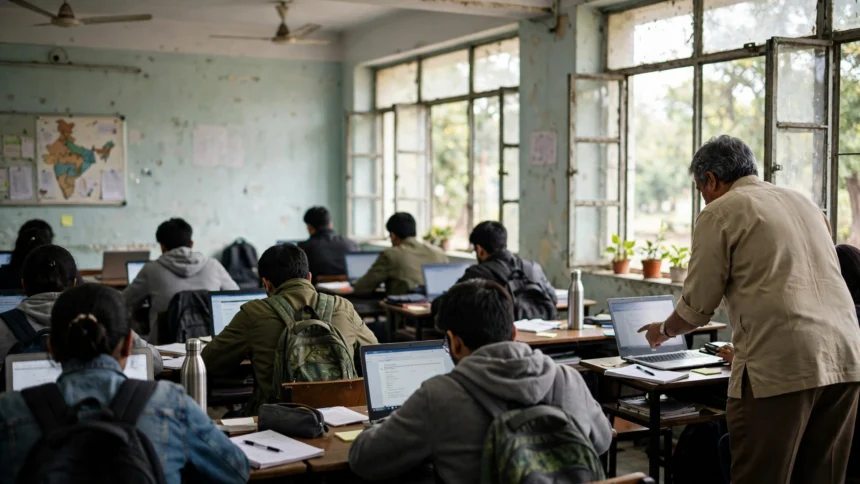
Bengaluru, November 2: OpenAI is changing tack in India. The company that spent the past year getting its tools into classrooms and campuses now wants to prove they actually help students learn, and to make sure the benefit reaches far beyond the best connected colleges.
That was the message from Raghav Gupta, OpenAI’s Head of Education for India and Asia Pacific, in an interaction with Deccan Herald published on Monday. Gupta said the next phase of OpenAI’s India work is about evidence and implementation: understanding where AI improves learning, where human teaching and judgment remain essential, and how to make the benefits available responsibly at India’s scale.
It is a notable shift in language. Access, Gupta suggested, was only the first step. Capability is the harder part, and it will decide whether AI narrows India’s education gaps or widens them.
From access to capability
Students across India already use AI to ask questions, practise concepts, write code and explore ideas at their own pace. Teachers use it to plan lessons, summarise material and prepare classroom resources. Gupta’s argument is that none of that, on its own, answers the real question: are students learning more, and learning better?
“If AI is only available to the already advantaged, it widens gaps,” he said. “If deployed responsibly, it can help more learners get high-quality support when and where they need it.”
That distinction matters because classrooms differ enormously. A student in a well equipped city college and a student in a small town school may both open the same app, but they do not start from the same place. Gupta pointed out that the digital divide is not only about internet access. Language, devices, affordability, teacher preparedness and institutional capacity all shape what a student can actually do with the tool.
What changes in schools, colleges and workplaces
According to Gupta, AI should play a different role at each stage of learning:
- In schools: use should be age appropriate and teacher guided, helping students build understanding rather than bypass it.
- In universities: AI can support research, coding, data analysis, writing and project work, giving students a faster way to test ideas.
- In the workplace: it becomes part of continuous learning, helping professionals synthesise documents, analyse information, debug code and plan projects.
The assessment problem
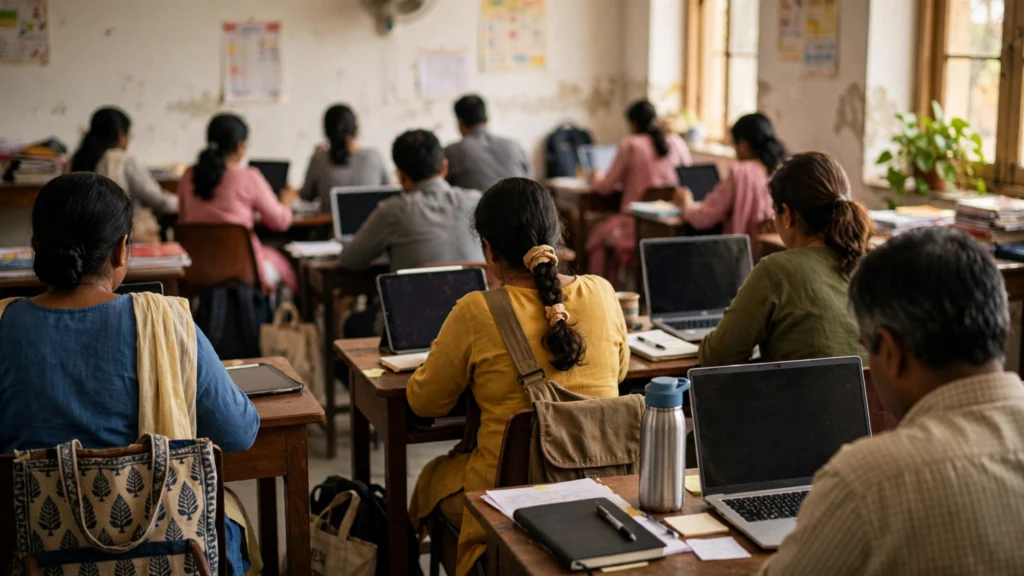
One of the most discussed parts of the interview was assessment. When students can produce a polished answer in seconds, teachers face a genuine problem: how do they know what the student actually learned?
Gupta’s answer is to make the learning process visible, not just the final answer. That could mean asking students to show drafts, explain their reasoning, or complete part of the work without AI assistance. The point is not to ban the tool, but to design assessments that reveal understanding rather than rewarding a clean output.
1 lakh-plus Edu licences already in place
The classroom push builds on education partnerships OpenAI has already announced in India, covering more than 1 lakh ChatGPT Edu licences. Participating institutions reported in earlier coverage include IIM Ahmedabad, AIIMS New Delhi, Manipal Academy of Higher Education, the University of Petroleum and Energy Studies (UPES) and Pearl Academy.
Alongside those licences, OpenAI has announced teacher training, education specific workspaces, Study Mode for step by step learning, research partnerships and plans to expand OpenAI Certifications for workforce skilling. Its India first Learning Accelerator programme has also aimed to widen access through the Ministry of Education, the All India Council for Technical Education (AICTE) and school networks, with IIT Madras research collaboration backed by $500,000 in funding.
Gupta’s latest remarks suggest the company now wants to measure that footprint more carefully. “India’s success should be measured by whether students across regions and backgrounds can use AI safely and meaningfully, not just whether the technology is available,” he said.
What students and teachers should watch
For students, the practical message is straightforward: AI can speed up routine work, but it can also make mistakes, reflect bias or miss important context. Checking claims and comparing sources remains part of learning, not an optional extra.
FAQs
What did OpenAI’s Raghav Gupta say on November 2?
He said OpenAI in India is shifting from access to capability, with the next phase focused on evidence, implementation and responsible use at scale.
How many ChatGPT Edu licences has OpenAI announced in India?
Education partnerships covering more than 1 lakh ChatGPT Edu licences have been announced, with institutions including IIM Ahmedabad, AIIMS New Delhi, Manipal, UPES and Pearl Academy.
Should students use ChatGPT for assignments?
Students should follow their institution’s rules, show their reasoning, and verify AI outputs rather than submitting them unchecked.
What is Study Mode?
Study Mode is a ChatGPT feature designed for step by step learning, guiding students through concepts with questions and practice instead of giving a direct answer straight away.
Does AI widen or narrow India’s education gap?
According to Gupta, it depends on deployment. Used responsibly, it can give more learners high quality support. Limited to the already advantaged, it risks widening gaps.
OpenAI’s classroom experiment in India is entering its most important stage. The tools are here. Now comes the harder work of proving they help every student learn.