

New Delhi, October 11: India’s factory floor is feeling upbeat again. The Reserve Bank of India’s latest Industrial Outlook Survey, released on Saturday, shows that manufacturers across the country expect demand to gather pace in the October to December quarter, with fuller order books, busier plants and stronger exports on the horizon. The mood, in short, is cautiously optimistic.
There is, however, a familiar sting attached to the good news. Raw material costs remain elevated, and companies told the central bank they expect to pass some of that burden on to buyers through higher selling prices in the months ahead.
What the survey found
The RBI released the results of the 115th round of its quarterly Industrial Outlook Survey, which assessed business conditions in India’s manufacturing sector during the July to September quarter (Q2FY27) and captured firms’ expectations for the October to December quarter (Q3FY27) and the two quarters after that. The survey was conducted between July and September and covered responses from 1,224 manufacturing companies.
The headline reading was encouraging. The Business Assessment Index, the central bank’s composite gauge of current business conditions, rose to 104.4 in Q2FY27 from 100.4 in the previous quarter. In plain terms, more factory owners said business had improved than said it had worsened, and by a wider margin than before.
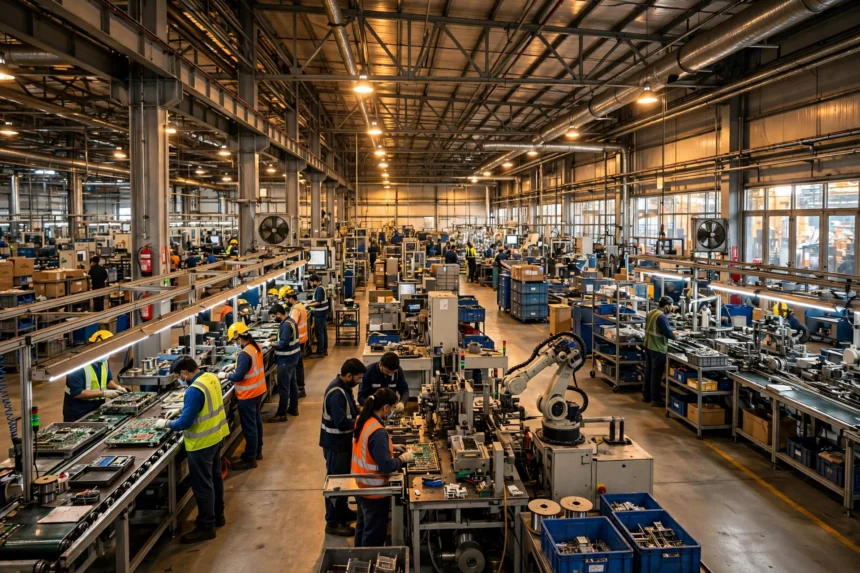
During the second quarter, manufacturers reported better demand conditions than in the previous quarter, supported by stronger production, healthier order books and higher capacity utilisation. It is the kind of broad-based improvement economists like to see, because it suggests the recovery is running through actual production and sales rather than just sentiment.
Why factories expect a stronger festive quarter
Looking ahead to Q3FY27, manufacturers remained optimistic about demand and expected improvements across the board: production, order books, capacity utilisation and exports. The Business Expectations Index, the survey’s forward-looking counterpart to the assessment index, also improved, reflecting stronger confidence about the months ahead.
The optimism extends further out. For the quarters ending March 2027 and June 2027, manufacturing firms expect healthy demand conditions to continue, with a positive outlook on overall business conditions, production, order books and capacity utilisation.
The timing matters. The October to December period includes the heart of India’s festive season, when consumer spending typically peaks. A strong factory order book now usually translates into busier assembly lines, more overtime and, eventually, more jobs in manufacturing hubs from Chennai’s auto belt to the pharmaceutical corridors around Hyderabad.

The cost cloud hanging over the recovery
Not everything in the survey made for cheerful reading. Pressures from raw material costs remained elevated through the second quarter, while sentiment on selling prices showed moderation, a sign that companies have been absorbing cost increases rather than fully passing them on.
That patience may be running out. Looking ahead, the RBI said cost pressures are anticipated to remain elevated, “with accompanying pass-through in selling prices.” In other words, factory owners told the survey they plan to raise prices to protect their margins.
For households, this is the part to watch. If input cost pressures feed through to finished goods, it could show up in the prices of everyday manufactured items in the coming months. The central bank watches this transmission closely, because it feeds directly into its inflation outlook and its thinking on interest rates, particularly after its recent decision to raise borrowing costs.
Services and infrastructure hold steady
The RBI also released its latest Services and Infrastructure Outlook Survey on Saturday, and the picture there was broadly reassuring. Services firms reported improved business conditions, turnover and full-time employment in the second quarter, and remained optimistic about demand in Q3FY27, though their level of optimism moderated compared with the previous quarter.
Cost pressures in services are expected to ease moderately, but companies expressed relatively lower optimism about selling prices and profit margins. Infrastructure companies, meanwhile, reported easing cost pressures and stayed optimistic about overall business conditions, employment and turnover.
Taken together, the three surveys paint a picture of an economy that is running warm but not overheated: demand is holding up and business confidence is intact, while cost pressures and margin worries remain the main areas of caution.
FAQs
What is the RBI’s Industrial Outlook Survey?
It is a quarterly survey the Reserve Bank conducts among manufacturing companies to assess current business conditions and future expectations. The latest edition was the 115th round, covering 1,224 firms.
When does Q3FY27 fall?
India’s financial year runs from April to March, so Q3FY27 covers October to December 2026, which includes the festive season.
What does a rising Business Assessment Index mean?
A higher index means more firms reported an improvement in business conditions than reported a deterioration. The index rose to 104.4 in Q2FY27 from 100.4 in Q1FY27.
Will the survey lead to price rises?
The survey itself does not set prices, but companies told the RBI they expect to pass elevated input costs through to selling prices in the coming quarters, which could show up in consumer prices.
How did the services sector do?
Services firms reported better business conditions, turnover and employment in Q2FY27 and stayed optimistic about Q3FY27 demand, though optimism moderated and margin concerns persisted.
For now, the factory floor has reason to smile. The real test will be whether the festive quarter delivers the demand manufacturers are banking on, and whether rising costs can be managed without denting the recovery. Keep watching this space.