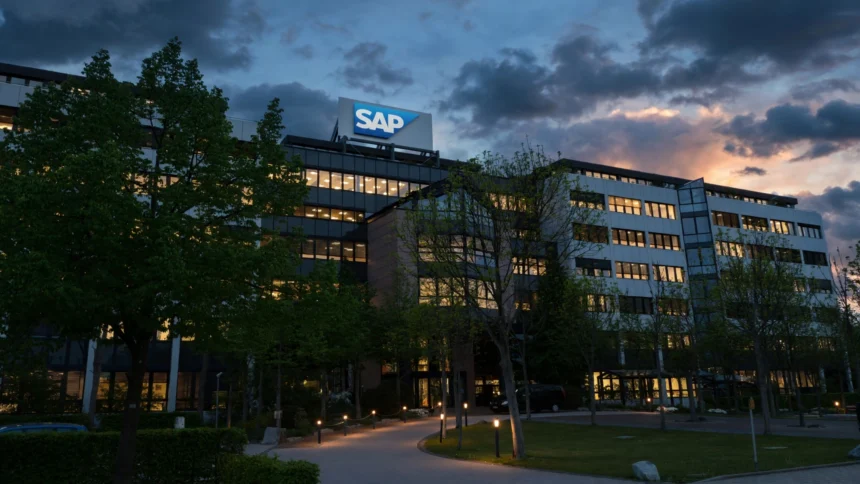
German software giant SAP is reportedly weighing a workforce cut of at least 10,000 jobs as it reshapes itself for the artificial intelligence era, according to a Bloomberg report published on Thursday. If it goes ahead, the move would affect at least 9 per cent of the company’s global workforce and would be its second restructuring of this scale in less than three years.
The plan has not been finalised, and the final number could still change after talks with employee representatives. SAP itself has declined to confirm the cuts, telling Bloomberg it continuously reviews its organisation and does not comment on speculation. But the report has already put the spotlight on how quickly AI is redrawing jobs inside even the world’s most profitable software companies.
What the report says
Bloomberg, citing people familiar with the discussions, reported that SAP is preparing a plan to eliminate at least 10,000 positions as part of a sweeping restructuring. Product development, engineering and sales are the departments most likely to be affected, as the company reorganises how it builds and sells its products around AI.
The discussions are still at an early stage. The plans have yet to be formally discussed with employee representatives, according to the Financial Times, and the total could change after labour negotiations. SAP employs more than 110,000 people worldwide, with its headcount at roughly 113,000 after hiring resumed following its last restructuring.
For now, the company is keeping its options open. In a statement to Bloomberg, SAP said it “continuously reviews its organisation to ensure it remains aligned with its strategy and customer needs”. Separately, it told news outlets that no decisions have been made on further measures.
Why now: the AI-first push
The reported cuts come as chief executive Christian Klein pushes to turn SAP into an AI-first company. Klein has reorganised SAP’s executive board twice this year, and two of its six board members are due to leave in March. The aim is to embed AI more deeply into SAP’s enterprise software and change how the company develops and markets its products.
The timing is striking because SAP’s business is growing. In its third-quarter results for 2026, revenue crossed 10 billion euros in a single quarter for the first time, rising 13 per cent year on year. SAP is Europe’s most valuable software company and the world’s largest vendor of enterprise software. The message from the report is blunt: even a company posting record revenue believes AI will let it do the same work with fewer people.
SAP has been here before. In 2024 it announced a restructuring that eliminated around 10,000 positions, at a cost of about 3 billion euros, and the process took more than a year. Bloomberg noted that SAP has historically announced major restructurings in late January, alongside its annual results, so a formal announcement, if one comes, may still be weeks away.
What it means for India
India has more reason than most countries to watch this closely. More than 18,000 people work for SAP in India, its second-largest location after Germany, according to the company’s own newsroom. SAP Labs India, based in Bengaluru, is the company’s largest research and development hub outside Germany.
The India connection runs deeper than headcount. Around 40 per cent of SAP’s global R&D workforce is now based in India, nearly a quarter of the company’s worldwide patents originate from the country, and more than 80 per cent of SAP’s AI agents are being built here, according to a Financial Express report from August. Bengaluru is driving development of Joule, SAP’s AI assistant, and the company’s AI security and Business Data Cloud work.
That makes the reported restructuring a double-edged story for Indian tech workers. On one hand, the teams building SAP’s AI future sit largely in India, and the company opened a second Bengaluru campus in August 2025 with a 194 million euro investment and room for 15,000 professionals. On the other hand, product development and engineering, the very functions concentrated in Bengaluru, are exactly the areas the report puts under review.

Why it matters
This is not just another layoff headline. It is a test case for a question facing every large technology employer: when AI starts doing the work, who stays, and who goes?
Three things make the SAP report significant. First, the scale. Cutting 10,000 roles for a second time in three years would mean SAP has effectively restructured a fifth of its workforce in a short span, even while revenue grows. Second, the timing. The cuts are being discussed not because the business is struggling, but because the business model is changing. Third, the signal to the rest of the industry. When Europe’s biggest software company openly reorganises around AI, smaller firms and Indian IT services companies, many of which build their business on SAP implementations, will read it as permission to do the same.
For Indian professionals, the practical lesson is in the detail. The roles under review are in product development, engineering and sales, not in the AI teams themselves. Workers who can build, deploy and sell AI tools are the ones SAP is investing in. The safest place in an AI restructuring, this report suggests, is on the side of the technology doing the restructuring. Upskilling in AI agents, data platforms and enterprise AI integration is no longer a career upgrade; it is career insurance.
There is also a protection worth noting. In Germany, SAP’s largest employment market, the labour council negotiated an employment guarantee through 2028 earlier this year. No such blanket guarantee exists for workers elsewhere, which is why the coming labour negotiations, and what they secure for staff outside Germany, will matter as much as the headline number.
What happens next
The immediate next step is talks with employee representatives, which will shape the final number and the timetable. If SAP follows its own pattern, a formal announcement could come in late January with its full-year results. Any restructuring would then take months to play out, as the 2024 exercise did.
Indian employees and jobseekers should watch three things: whether SAP confirms or denies the plan in the coming days, whether the Bengaluru R&D centre is named in any announcement, and whether hiring at SAP Labs India, which has run at 1,500 to 2,000 people a year, continues at the same pace. For now, the company has not confirmed a single cut, and that uncertainty is itself part of the story.
FAQs
Is SAP cutting 10,000 jobs?
Not confirmed. Bloomberg reported that SAP is considering eliminating at least 10,000 positions, but the plan is not finalised and SAP has said no decisions have been made.
Which roles could be affected?
Product development, engineering and sales are reportedly under review, as SAP reorganises around AI. The final list will depend on labour negotiations.
How many people does SAP employ in India?
More than 18,000, making India SAP’s second-largest location. Around 40 per cent of its global R&D workforce is based in India.
Has SAP done this before?
Yes. In 2024 SAP announced a restructuring that eliminated around 10,000 positions at a cost of about 3 billion euros.
When will we know more?
SAP has historically announced major restructurings in late January alongside annual results. Talks with employee representatives come first.
SAP has not confirmed the reported cuts. This article is based on the Bloomberg report as carried by Moneycontrol, Business Standard, The Hindu BusinessLine and Channel News Asia on 26-27 November 2026.