When a daughter is born, most Indian parents start thinking about two expenses long before they arrive: her higher education and her wedding. The Sukanya Samriddhi Yojana, often called SSY, is the government savings scheme built exactly for that. You open an account in her name, deposit a little every year, and it grows at a government-backed interest rate until she is grown up.
What is Sukanya Samriddhi Yojana?
Sukanya Samriddhi Yojana is a government-backed savings scheme launched in 2015 under the Beti Bachao Beti Padhao campaign. Parents deposit money every year into an account opened for a girl child, and the government pays interest usually higher than a savings account or fixed deposit. The account runs for 21 years, and the money is meant for her higher education or marriage.
Three things set it apart: a government-set interest rate usually higher than bank fixed deposits, deposits, interest and maturity all tax-free, and an account that can be opened only before the girl turns ten, rewarding parents who start early.
Who can open an SSY account?
- The account is opened in the name of a girl child below ten years of age on the date of opening.
- A parent or legal guardian opens and operates it until the girl turns eighteen, after which she operates it herself.
- One account per girl child, at most two per family, except for twins or triplets, when a third is allowed.
- The account can be opened at any post office or an authorised bank branch. Ask your branch whether it offers SSY, as not every branch does.
- There is no income limit. Any parent of an eligible girl child can apply.
The age rule causes most rejections. If your daughter has already turned ten, the account cannot be opened. If she is nine and a half, do not wait. Open it now.
Documents you need
Carry originals plus one photocopy of each. The branch verifies the originals and keeps the copies.
- Birth certificate of the girl child. This proves her age, so it is the one document you cannot skip.
- Identity proof of the parent or guardian, such as Aadhaar card or PAN card.
- Address proof of the parent or guardian, such as Aadhaar card, voter ID, passport or utility bill.
- Two passport-size photographs of the girl child and two of the parent or guardian.
- The SSY account opening form, available at the branch or downloadable from the India Post website.
Fill the form at home before you go. It asks for the girl’s name exactly as it appears on her birth certificate, her date of birth, the guardian’s name and relationship, address, and the first deposit amount. A name spelt differently from the birth certificate is the most common reason for delays.
How to open an SSY account, step by step
- Step 1: Collect the form. Ask for the Sukanya Samriddhi Account opening form at the post office or bank, or download it from the India Post website and print it.
- Step 2: Fill the form. For example, for Ananya Sharma, born 12 March 2021, write her name as on the birth certificate, date of birth 12/03/2021, your name and relationship as guardian, your address, and your first deposit, say Rs 25,000.
- Step 3: Attach the documents. Staple the birth certificate copy, your ID and address proof copies, and the photographs to the form.
- Step 4: Submit and pay the first deposit. The minimum first deposit is Rs 250, in multiples of Rs 50. Pay by cash, cheque or demand draft; many branches also accept online transfer.
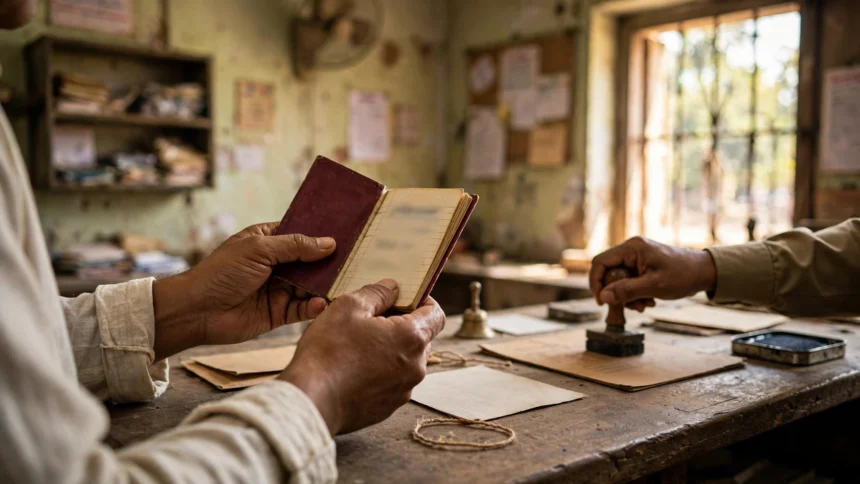
- Step 5: Collect the passbook. The branch issues a passbook in your daughter’s name with the account number. Every deposit is recorded in it, and you will need it for withdrawals and at maturity.
The visit usually takes under an hour if your documents are in order.
How much to deposit, and what it grows into
Deposit at least Rs 250 and at most Rs 1,50,000 in a financial year, compulsory only for the first 15 years. After that you stop depositing, but the account keeps earning interest until it matures in the 21st year.
The examples below assume the rate stays at its current 8.2 percent per annum, compounded annually. The rate is revised every quarter, so treat these as illustrations, not promises.
- Rs 10,000 a year: you deposit Rs 1,50,000 over 15 years. At maturity, the account holds roughly Rs 4.8 lakh.
- Rs 25,000 a year: you deposit Rs 3,75,000 over 15 years. At maturity, roughly Rs 12 lakh.
- Rs 50,000 a year: you deposit Rs 7,50,000 over 15 years. At maturity, roughly Rs 24 lakh.
- Rs 1,50,000 a year: you deposit Rs 22,50,000 over 15 years. At maturity, roughly Rs 72 lakh.
Depositing Rs 50,000 a year means Rs 7.5 lakh of your own money, but about Rs 24 lakh at maturity, thanks to compound interest over 21 years. Starting early matters for the same reason: an account opened at age one has six more years of compounding than one opened at seven.
Interest rate and how it is calculated
The rate is notified by the government every quarter and has stood at 8.2 percent per annum in recent quarters, compounded annually and credited once a year.
One detail saves real money: interest for a month is calculated on the lowest balance between the close of the 5th day and the end of that month. Deposit on the 3rd and it earns interest for the full month. Deposit on the 20th and it earns interest only from the next month. If you deposit once a year, do it in the first few days of April, so the money works for the maximum number of months.
Miss the Rs 250 minimum in a year and the account becomes defaulted. Revive it before the 15-year deposit period ends by paying Rs 50 per defaulted year plus the Rs 250 minimum for each of those years.
Maturity and withdrawal rules
The account matures 21 years after opening, when the full balance is paid to the girl, completely tax-free.
The account can be closed early when the girl marries, provided she is at least eighteen. Partial withdrawal is also allowed for higher education: once she turns eighteen or passes Class 10, whichever comes first, up to 50 percent of the previous financial year’s closing balance can be withdrawn, as a lump sum or in yearly instalments for up to five years, limited to the actual cost of the education. Keep fee receipts and admission proof ready.
Premature closure is also allowed on the death of the account holder or on compassionate grounds, such as a life-threatening disease of the girl. The account can be transferred between post offices and banks if the family moves.
Tax benefits
SSY has exempt-exempt-exempt tax treatment: the yearly deposit qualifies for deduction under Section 80C, up to the overall 80C limit of Rs 1.5 lakh a year, and the interest and the maturity amount are tax-free.
Common mistakes to avoid
- Waiting too long: the ten-year age limit is absolute. Discover the scheme at eleven and you have already missed it.
- Depositing late in the month: deposit before the 5th so the money earns interest for that month.
- Skipping a year: missing the Rs 250 minimum makes the account defaulted. Set a reminder for the first week of April.
- Opening a third account: a family can hold accounts for at most two girls, except for twins or triplets.
- Mismatched names: the girl’s name on the form must match her birth certificate exactly.
- Losing the passbook: it is the record of every deposit. Keep it with your other important documents.
Frequently asked questions
Can I open an SSY account online? No. The account is opened in person at a post office or an authorised bank branch, with physical documents and a passbook. Some banks allow online deposits into an existing account.
What is the minimum and maximum deposit? Rs 250 minimum and Rs 1,50,000 maximum per financial year, in multiples of Rs 50, in one go or in instalments.
For how many years do I need to deposit? Fifteen years from opening. It then keeps earning interest for six more years and matures in the 21st year.
Can I withdraw money for my daughter’s education? Yes. After she turns eighteen or passes Class 10, whichever is earlier, up to 50 percent of the previous year’s closing balance can be withdrawn for higher education, in a lump sum or yearly instalments for up to five years.
If your daughter is still below ten, the best time to open the account was when she was born. The second-best time is this week. Take her birth certificate, your ID proof and two photographs to the nearest post office, start with whatever amount fits your budget, and let the years do the rest. Before you act, verify the interest rate, deposit limits and withdrawal rules in the official notification on the India Post website or at your branch.