New Delhi: A fresh investigation into the 2024 elections has flagged a troubling gap in the Election Commission’s own records. In 51 constituencies across Maharashtra, Haryana and Jammu and Kashmir, the number of votes recorded as cast did not match the number of votes counted on electronic voting machines.
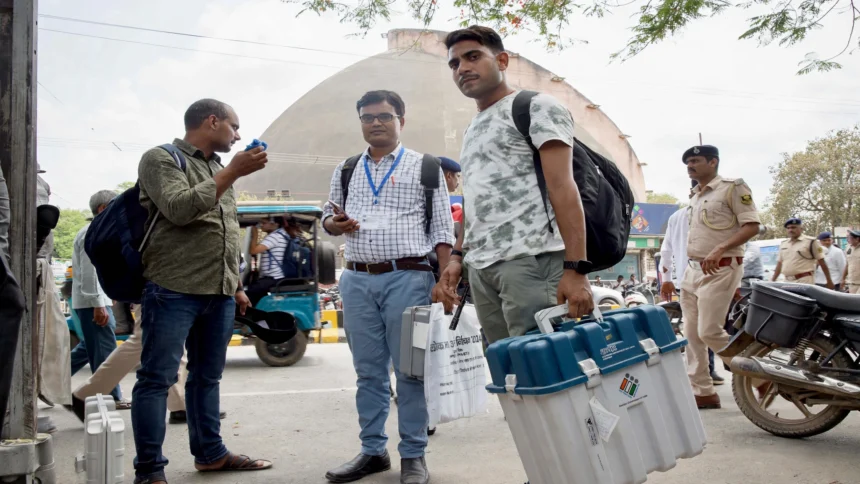
The investigation was carried out by The Reporters’ Collective as part of its Election Audit series. The team examined internal records from 530 constituencies, 63 parliamentary and 467 assembly seats, and digitised and rechecked 4,212 physical records submitted by returning officers. What it found was not a single clerical slip but a pattern spread across three states.
What the audit found
Every election in India runs on two parallel counts. The Register of Voters, known as Form 17A, records how many people actually entered a polling booth and voted. The Account of Votes Recorded, Form 17C, records how many votes the machine counted. By rule, the two numbers must match before a result is declared.
In 51 constituencies, they did not. In 19 of them, election officials had entered zero or nil against the number of voters who entered polling booths, a figure that would mean nobody voted at all in those booths. In two seats, Kaithal in Haryana and Srinagar in Jammu and Kashmir, the records suggest more votes were counted than were cast.
The sharpest examples came from individual seats. In Haryana’s Badkhal assembly constituency, the Commission’s internal records showed 3.32 lakh votes as polled, while the declared count on the machines stood at 1.60 lakh. In the Mumbai North Lok Sabha seat, the register showed 18.11 lakh people as having voted, but only 10.33 lakh votes were counted.
Why the mismatch matters
To be clear, the investigation does not prove that any election was rigged. The Reporters’ Collective itself says the discrepancies do not by themselves establish manipulation. What the findings do raise is a serious question about recordkeeping, and about how the Commission responds when its own paperwork does not add up.
The Election Commission has previously explained that differences between votes polled and votes counted can occur if mock-poll data are not properly cleared before voting begins. That explanation has never been tested against booth-level records, because the Commission stopped making booth-level polling data public after the 2019 general elections.
When the Collective sent its detailed questions to the Commission, the poll body treated the queries as a grievance and asked the organisation to hand over the data it had accessed, assuring that the information would remain confidential. The Collective has instead published the questions it asked and the reply it received, and says it will make the raw data and original election records public in the concluding part of its investigation.
The political backdrop
The findings land in the middle of an already heated argument. Opposition parties have alleged irregularities in the 2024 elections, and the Commission has firmly rejected claims of rigging in Maharashtra and Haryana, maintaining that the process was conducted properly under electoral law.
Congress leader Rahul Gandhi has repeatedly raised questions about voter lists and vote counts in both states. The Commission, led by Chief Election Commissioner Gyanesh Kumar, has pushed back, pointing to the scale of the exercise and the officials and party agents involved at every booth.
With the raw records now set to be published, political parties and researchers will be able to test the Commission’s explanations against the documents themselves. For a body whose authority rests almost entirely on public trust, the next few weeks will matter more than the last two years of denials.
What happens next
The Collective says the final part of its investigation will release the underlying data, allowing independent verification of every constituency it examined. The Election Commission has not yet issued a detailed public response to the specific mismatches flagged in the report.
Until it does, the central question remains unanswered: how do two official counts of the same election disagree by lakhs of votes in some seats, and by entire booths showing zero voters in others? The answer will decide whether this becomes a footnote about paperwork or a full-blown crisis of confidence in how India counts its votes.
FAQs
What did the investigation find?
It found mismatches between votes recorded as cast and votes counted on EVMs in 51 constituencies across Maharashtra, Haryana and Jammu and Kashmir.
Does the report prove the elections were rigged?
No. The investigation itself states that the discrepancies do not by themselves establish rigging. It raises questions about recordkeeping and accountability.
What are Form 17A and Form 17C?
Form 17A is the Register of Voters, recording how many people entered a booth to vote. Form 17C is the Account of Votes Recorded, showing how many votes the machine counted. The two must match before results are declared.
What has the Election Commission said?
The Commission has previously said differences can occur if mock-poll data are not cleared before voting. On this report, it treated the Collective’s questions as a grievance and asked for the data to be shared confidentially.
What happens next?
The Reporters’ Collective says it will publish the raw data and original records, allowing independent checks of the mismatches it flagged.
The Election Commission has been approached for a detailed response to the specific constituencies named in the report. This story will be updated when it responds.