New Delhi, 7 November 2026: India has weathered two of the biggest worries facing its economy this year with remarkable ease, according to a new HSBC Global Investment Research report released today. The bank’s economists say the story of India right now is one of resilience and opportunity, not concern, even as the global AI frenzy sucks capital into a narrow set of sectors and economies.
The report takes a sharply contrarian view at a time when investors have questioned whether India can keep growing while it sits largely outside the artificial intelligence boom. HSBC’s answer is that the very factors seen as weaknesses may matter less than feared.
The AI capital squeeze that largely passed India by
The global rush into AI has concentrated money in a handful of companies and a few selected economies. Returns, at least for a while, have been stunning. But India has been largely bypassed by this wave, and that has fed a familiar set of worries in investors’ minds.
HSBC lists three of them plainly: India has no vibrant AI hardware sector, there is a risk that services exports could suffer as AI is adopted more widely, and the spike in global energy prices has historically hit India hard. “Well, time for a rethink,” the bank’s economists said in the report.
The point is not that these risks do not exist. It is that the evidence so far shows India absorbing them better than expected.
Energy shock absorbed, deficit kept in check
India’s economy has weathered the challenges so far with remarkable ease, the report notes. Activity pulled back a little earlier this year, around the height of the conflict in the Middle East, but it has since bounced back.
For one, India has managed to cushion the economy from higher energy prices, with the current account deficit not blowing out as in previous such episodes. That is in part being helped by the continued, robust rise in services exports, which have yet to show, in aggregate, an adverse impact from AI.
This matters because energy price spikes have traditionally been one of India’s biggest vulnerabilities. A contained current account deficit in such a period signals improved external resilience.
Services exports keep climbing
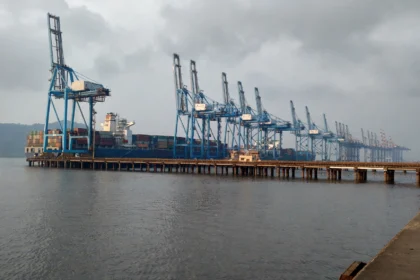
The export story is where the report is most upbeat. World trade in non-AI goods has largely stalled, yet India’s shipments have accelerated in recent months after several years of sideways movement.
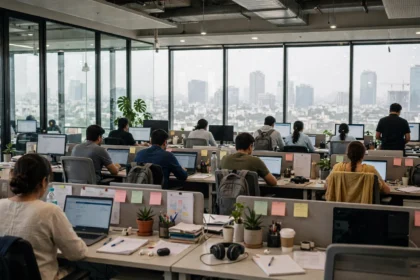
Services exports, meanwhile, continue to rise steeply and are not far off goods exports on an annual basis. That is a striking milestone for an economy whose IT and business services have long been seen as exposed to automation and now to AI.
The export rebound is especially noteworthy, the economists note, because it is happening in a global environment where most trade is driven by AI hardware, a sector in which India is not a major player. The trajectory, the report adds, suggests India is gradually gaining global market share.
In short, the fear that AI would hollow out India’s services engine has not shown up in the aggregate data yet. Services exports keep rising in a straight line, and the report suggests those fears were exaggerated.

Domestic demand is picking up too
It is not only the external picture that looks steady. The domestic economy is also showing renewed momentum: private credit growth and corporate revenue growth have rebounded, car sales are strong, and government infrastructure spending continues to push higher. That combination is what leads HSBC to frame India as an opportunity rather than a worry.
What it means for the months ahead
The report does not claim India is immune to global shocks. Energy prices remain a risk, and the AI shift is still in its early stages. But its message is that investors should look beyond the narrow AI trade and the familiar list of Indian vulnerabilities.
Whether the optimism holds will depend on the data in the coming months, including official growth figures due later in November. For now, though, one of the world’s largest banks is telling investors to rethink their worries about India, and the numbers it cites give that call some weight.
FAQs
What did HSBC say about India in its new report?
HSBC Global Investment Research said in a report released on 7 November 2026 that India has shown remarkable resilience and opportunity amid the global AI frenzy, cushioning itself from higher energy prices and AI fears.
Has AI hurt India’s services exports?
Not in aggregate, according to the report. Services exports have continued to rise steeply and have shown no overall adverse impact from AI adoption so far, and they are now not far off goods exports on an annual basis.
What about India’s current account deficit?
HSBC says the deficit has not blown out as it did in previous energy price spikes, helped by the robust rise in services exports. That points to improved external resilience.
Is India gaining export market share?
The report says India’s goods shipments have accelerated in recent months after years of sideways movement, even as world trade in non-AI goods has stalled, suggesting India is gradually gaining global market share.
What is driving the domestic recovery?
Private credit growth and corporate revenue growth have rebounded, car sales are strong, and government infrastructure spending continues to climb, according to the report.
India’s economy will be watched closely in the coming weeks as fresh growth and trade data land. For now, HSBC’s message is clear: resilience, not retreat, is the story to follow.