
New Delhi’s most powerful address is about to change its job description. On Wednesday, the Union Cabinet cleared Rs 3,230 crore to turn the North and South Blocks on Raisina Hill into the Yuge Yugeen Bharat Museum, a national museum the government says will rank among the largest in the world.
The decision, taken by the Cabinet Committee on Economic Affairs chaired by Prime Minister Narendra Modi, moves a project first announced in May 2023 from promise to plan. The Secretariat buildings, which have housed the core of the Indian government for nearly a century, will be adapted into a public museum while keeping their architecture intact. For the first time, the grand sandstone blocks that decided the country’s fate behind closed doors will open their doors to everyone.
What the Cabinet approved
The approval covers the full development of the museum at an estimated cost of Rs 3,230 crore, a figure appraised by the Public Investment Board on 27 July 2026 and concurred with by the Ministry of Culture, which will implement the project. The work will be done through adaptive reuse of the North and South Block complex, preserving the buildings’ architectural character and heritage significance while converting them into a public cultural institution.
The numbers underline the scale of the ambition. The museum will have a built-up area of around 1,78,509 square metres, and the government says it will be able to receive nearly 30,000 visitors a day. The project will be implemented in phases over five financial years, from 2026-27 to 2030-31. The first gallery, on the theme of Adornment, is expected to open to the public in the North Block in the latter part of 2027.
The museum decision was one of five cleared by the Cabinet on Wednesday, with a combined outlay of Rs 77,101 crore. The others included the Rs 62,370-crore fertiliser subsidy for the Rabi season, the extension of credit guarantee support under the Mudra and Stand-Up India schemes, and an extension of the Noida Metro’s Aqua Line.
From seat of power to public space
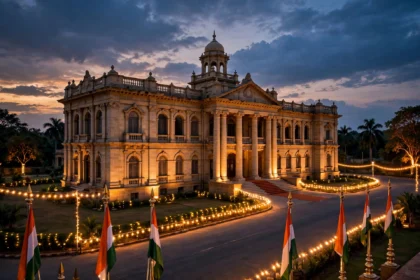
The two blocks have been the centre of Indian governance since the capital shifted from Calcutta to Delhi in 1911. Designed by British architect Herbert Baker in the Indo-Saracenic style, with red and cream Dholpur sandstone, domes, colonnades and carved screens, they were in place when New Delhi was inaugurated as the capital in 1931. South Block housed the Prime Minister’s Office, the Defence Ministry and the External Affairs Ministry; North Block housed Finance and Home Affairs.
Their corridors carry the weight of modern Indian history. Jawaharlal Nehru worked from South Block in the run-up to Independence, while Sardar Vallabhbhai Patel worked from North Block as he oversaw the integration of the princely states.
That is now changing under the Central Vista redevelopment. Ministries have been moving to the new Kartavya Bhavans and the Prime Minister’s Office has shifted to Seva Teerth, the new complex nearby. With the offices vacating Raisina Hill, the government has chosen to give the buildings a public second life rather than leave them as empty monuments.

What visitors will actually see
The museum will present India’s civilisational journey through curated thematic galleries, exhibitions and interpretation of the country’s cultural traditions, knowledge systems, artistic practices and heritage. The plan includes gallery development, collection storage and conservation facilities, visitor amenities, immersive technologies, landscaping and intelligent building systems.
The project is being developed in collaboration with France, drawing on that country’s experience in converting historic buildings into major cultural institutions. The name itself sets the tone: Yuge Yugeen Bharat means India through the ages.
The approach matters as much as the content. Adaptive reuse means the facades, courtyards and domes that define the Raisina Hill skyline will stay as they are, while the interiors are reworked for galleries and visitors.
Why this matters beyond Delhi
First, it settles the question of what happens to the most symbolic government buildings in the country once the government moves out. Many capitals struggle with this moment, and the choice here is to hand the buildings to the public rather than to another department.
Second, it completes the re-imagining of the capital’s core. With the new Parliament building, the Kartavya Bhavans and the museum, the stretch from Rashtrapati Bhavan to India Gate will mix working government, public ceremony and public culture in a way it never has before.
Third, the museum is a statement of cultural intent. A national museum of this size, telling a civilisational story rather than a narrow art-historical one, is designed to be a destination in itself, for Indian visitors and for foreign tourists arriving in the capital.
What happens next
The phased schedule means the full museum will take shape over five years, with the first gallery in late 2027 as the earliest public test of the plan. The details to watch are the exhibition design, how the collections are assembled, and the visitor plan for a site that will also remain one of the most photographed stretches of the capital.
For now, the approval itself is the news: the money is cleared, the implementing ministry is named, and the timeline is public. After three and a half years as an announcement, the Yuge Yugeen Bharat Museum has a budget, a deadline and a building. The next time the doors of North Block open, they may open to the public.
FAQs
What is the Yuge Yugeen Bharat Museum?
It is the new national museum being developed in the North and South Block buildings on Raisina Hill in New Delhi, presenting India’s civilisational journey through thematic galleries.
How much will it cost and when will it open?
The estimated cost is Rs 3,230 crore. The project runs in phases from 2026-27 to 2030-31, and the first gallery, themed Adornment, is expected to open in the North Block in the latter part of 2027.
What does Yuge Yugeen Bharat mean?
It means India through the ages, reflecting the museum’s theme of tracing the country’s civilisational journey.
Will the North and South Blocks change from the outside?
No. The project uses adaptive reuse, which preserves the buildings’ architectural character and heritage significance while converting the interiors into museum space.
Who is building the museum?
The Ministry of Culture is implementing the project, and it is being developed in collaboration with France, drawing on French experience with major museum conversions.
The Yuge Yugeen Bharat Museum is one of the biggest cultural projects India has taken up, and its first gallery is less than two years away. Informeia will track the project as the work begins on Raisina Hill.