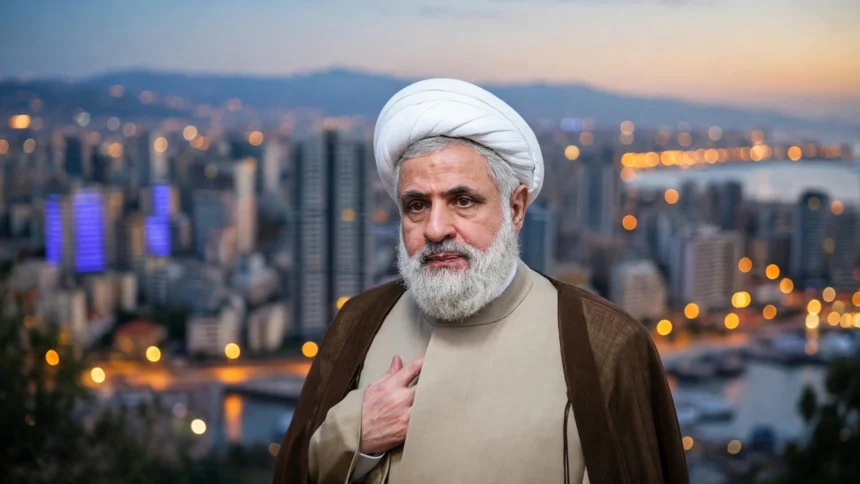
Hezbollah chief Naim Qassem has hailed Donald Trump’s defeat in last week’s United States midterm elections as an “earthquake” and an “opportunity” for his movement, arguing that the setbacks suffered by the American president and Israeli Prime Minister Benjamin Netanyahu have weakened the push to disarm his group.
Speaking on Wednesday at a Martyrs’ Day ceremony in Beirut, Qassem said the results of the two elections, held a week apart, had changed the balance in the region. “Today, we have a good opportunity. Trump was defeated in the elections… an earthquake has occurred in America,” he told supporters in a televised address.
“The one confronting Iran, Lebanon, Palestine, Yemen… has lost,” Qassem added, arguing that Trump could “no longer continue as is”. He described Netanyahu’s showing in Israel’s October 27 parliamentary election as a “defeat”, saying the Israeli prime minister “has been broken” after his bloc fell short of the 61 seats needed to stay in power.
Why Qassem sees an opening
Trump’s Republican Party suffered heavy losses in the midterm elections on November 3, with Democrats taking control of both chambers of Congress. Trump himself has acknowledged that the war he launched with Israel against Iran in February played a part in the defeat, and Vice President JD Vance put it even more bluntly last week, saying: “The reason we lost is the war.”
Qassem seized on that admission. He praised Iran’s closure of the Strait of Hormuz during the conflict, which pushed global oil prices sharply higher and disrupted shipping routes, and said it had weakened American and Israeli influence in the region.
In Israel, Netanyahu’s right-wing bloc won 53 seats in the 120-member Knesset, while the opposition bloc led by Gadi Eisenkot took 48 and Arab-led parties won a record 19. Neither side has a majority, and Eisenkot has been given the first chance to form a government. Qassem framed both results as a single message: the leaders driving the campaign against his movement had lost their mandates.
“No disarmament under occupation”
The heart of Qassem’s speech, however, was not the elections. It was a firm refusal to give up Hezbollah’s weapons while Israeli forces remain in southern Lebanon.
“There will be no state monopoly on the resistance’s weapons, no regulation, no prohibition, and no disarmament under Israeli occupation,” Qassem said, repeating a line he has used since taking over as Hezbollah’s secretary-general after Israel assassinated his predecessors Hassan Nasrallah and Hashem Safieddine in 2024.
The stance puts Hezbollah on a collision course with Lebanese President Joseph Aoun, who is backed by Washington in pressing the group to hand over its arsenal. Qassem warned Lebanese authorities against making commitments that serve Israeli goals and urged them to focus on domestic problems instead.
“Why are you binding yourselves before the world to positions that serve the Israeli project?” he asked.
The stalled June framework
Lebanon and Israel concluded a framework agreement in June under US mediation, providing for the gradual withdrawal of Israeli forces from southern Lebanon in parallel with Hezbollah’s disarmament. Implementation has stalled, with each side accusing the other of failing to move first.

Qassem called the agreement a series of free concessions to Israel and urged the Lebanese authorities to withdraw from it, arguing that it violates Lebanon’s 1989 Taif Agreement and its constitution. Israel, meanwhile, continues to occupy large parts of southern Lebanon and has kept bombing the south despite the June ceasefire, devastating dozens of the roughly 60 villages and towns it holds.
The backdrop is a region still reeling from the war that began in February, when the United States and Israel launched surprise attacks on Iran and assassinated Supreme Leader Ali Khamenei. Hezbollah’s retaliation, firing missiles and drones into Israel, led to weeks of intense Israeli strikes on south Lebanon in which more than 4,300 people were killed, according to Lebanese authorities, and around a million were displaced, the United Nations said.
What happens next
Qassem’s speech closes the door, at least for now, on any quick disarmament deal. His message to Beirut was to rebuild the country together and resist what he called “American tutelage”. “Lebanon belongs to all of us. We are partners in building it and sharing the cost of protecting its sovereignty,” he said.
Whether the election results in Washington and Jerusalem genuinely ease the pressure on Hezbollah remains an open question. The Trump administration has shown no sign of dropping its demand that the group disarm, and Israel has continued its strikes on southern Lebanon. But Qassem’s calculation is clear: with both leaders weakened at home, he believes the moment favours holding the line rather than giving ground.
FAQs
Who is Naim Qassem?
Qassem is the secretary-general of Hezbollah, the Iran-backed Lebanese movement. He took over the leadership after Israel assassinated Hassan Nasrallah and his successor Hashem Safieddine in 2024.
What did Qassem say about the US midterm elections?
He called the Democrats’ victory over Donald Trump’s Republicans an “earthquake” and “a good opportunity” for Hezbollah and other opponents of the United States in the region.
Why is Hezbollah refusing to disarm?
Qassem says the group will not hand over its weapons while Israel occupies parts of southern Lebanon, arguing that disarmament under occupation would amount to surrender.
What is the June framework agreement?
A US-mediated deal under which Israeli forces would gradually withdraw from southern Lebanon as Hezbollah disarms. Implementation has stalled, with both sides accusing each other of failing to act first.
What happened in Israel’s election?
Netanyahu’s bloc won 53 seats in the October 27 vote, short of the 61 needed for a majority. Opposition leader Gadi Eisenkot, whose bloc won 48 seats, has been given the first chance to form a government.
Hezbollah chief Naim Qassem was speaking at a Martyrs’ Day ceremony in Beirut on Wednesday, November 11.