
Bengaluru, Nov 14: Union Minister for Electronics and Information Technology Ashwini Vaishnaw on Saturday said India must build its own machines and high-precision components for making semiconductors, arguing that a self-reliant chip industry cannot rest on imported equipment alone. The minister made the remarks during a visit to the Ethereal Machines facility in Bengaluru, a company that builds advanced machinery and precision parts.
Vaishnaw said the push fits the Atmanirbhar Bharat vision, and that the government is firmly committed to strengthening the country’s semiconductor ecosystem. His visit came just over a week after the Centre opened applications under Semicon 2.0, the second phase of the India Semiconductor Mission, which carries a total outlay of Rs 1,27,500 crore.
Why machines matter now
Semiconductor fabrication is one of the most equipment-heavy industries in the world. A single fab needs lithography systems, etching tools, deposition machines and testing rigs, most of which are today supplied by a handful of companies in the Netherlands, the United States and Japan. India has been approving chip plants and packaging units, but the machines that run them still come from abroad.
That is the gap Vaishnaw wants to close. “In the spirit of Atmanirbhar Bharat, as envisioned by Prime Minister Narendra Modi, it is important that India develops and manufactures its own machines and high-precision components required for semiconductor manufacturing,” he said during the visit.
The minister also praised Ethereal Machines, saying the Bengaluru facility is playing an important role by producing advanced machinery and high-precision components.
What Semicon 2.0 covers
The Centre launched the Semicon 2.0 web application portal on November 6 under the India Semiconductor Mission. The portal accepts applications across six focus areas: chip design, semiconductor equipment and materials, fabrication facilities, assembly and testing infrastructure, research and development, and talent development.
Domestic development of machinery and materials is one of the six focus areas, which marks a clear shift from the first phase. Semicon 1.0 concentrated on getting fabs and packaging units approved and built. Semicon 2.0 goes deeper into the supply chain, targeting the tools, materials and components that sit behind every chip.
The next phase has a fiscal outlay of Rs 1.27 lakh crore, and it is designed to expand India’s capabilities beyond chip manufacturing and packaging into the full production chain.
Where the first phase stands
Under the first phase of the Semicon India Programme, 12 semiconductor projects have been approved across six states, involving cumulative investments of more than Rs 1.64 lakh crore. Five of those projects had commenced commercial production as of October 2026, according to the latest official data released on November 6.
The numbers show the programme has moved from announcements to operating plants. But they also show why the equipment question is now urgent: as more fabs and packaging units come online, demand for machines, spares and precision components will only grow, and every imported tool adds cost, delay and dependence.
The Bengaluru bet
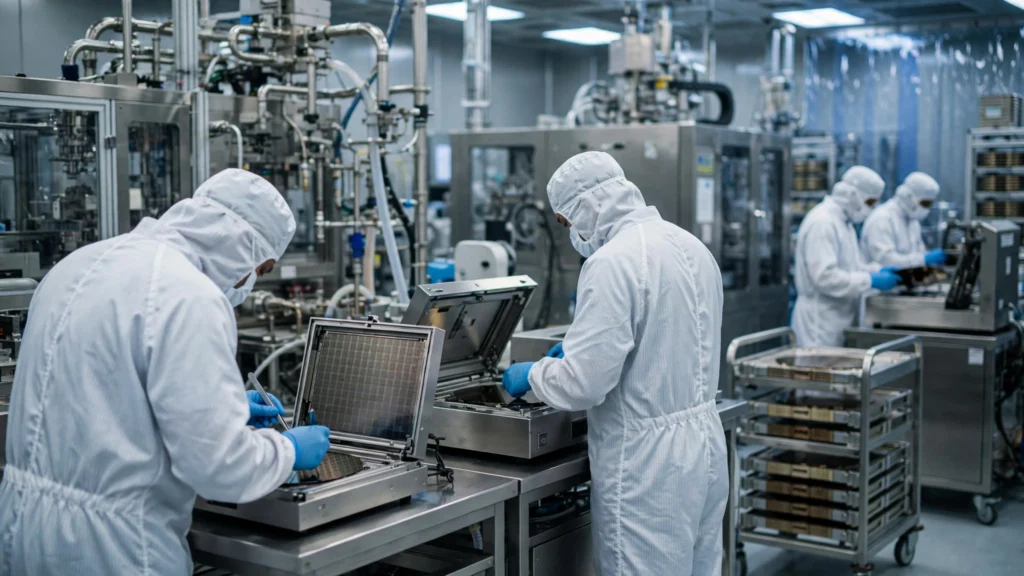
Ethereal Machines is part of a small but growing group of Indian companies working on the precision engineering that chipmaking needs. High-precision components, the kind used in semiconductor tools, demand tolerances measured in microns, clean-room grade manufacturing and materials that behave predictably under extreme conditions.
Vaishnaw’s visit signals that the government wants Indian firms in this space to scale up, with policy support and demand from the fabs being built under the mission. The broader push also includes promoting domestic manufacturing of critical electronics components, materials and capital goods to cut import dependence and strengthen India’s position in the global semiconductor supply chain.
What happens next
With the Semicon 2.0 portal now open, companies building equipment, materials and components can apply for support under the programme. The government will be watching how many equipment makers come forward, since that will show whether the supply chain is deepening or whether fabs continue to rely on imported tools.
For now, the message from Bengaluru is plain: India wants to make chips, and it also wants to make the machines that make chips. The coming months will show how quickly Indian precision engineering can meet that ambition.
FAQs
What did Ashwini Vaishnaw say about semiconductor machines?
He said India must develop and manufacture its own machinery and high-precision components for semiconductor manufacturing, in the spirit of Atmanirbhar Bharat.
What is Semicon 2.0?
It is the second phase of the India Semiconductor Mission. Its application portal opened on November 6, and the programme has a total outlay of Rs 1,27,500 crore across six focus areas, including equipment and materials.
How many semiconductor projects has India approved so far?
Twelve projects have been approved across six states under the first phase, with cumulative investments of over Rs 1.64 lakh crore. Five had started commercial production as of October 2026.
Why does India need its own chip-making machines?
Chip fabrication depends on specialised equipment supplied by very few companies abroad. Building the machines at home cuts import dependence, lowers costs and delays, and strengthens India’s place in the global semiconductor supply chain.
What is Ethereal Machines?
It is a Bengaluru-based company that produces advanced machinery and high-precision components. Vaishnaw visited its facility on November 14 and said it is playing an important role in building India’s semiconductor equipment capability.
Vaishnaw’s Bengaluru visit underlines a shift in India’s chip strategy: from building fabs to building the machines behind them. The test now is how fast Indian industry can deliver.